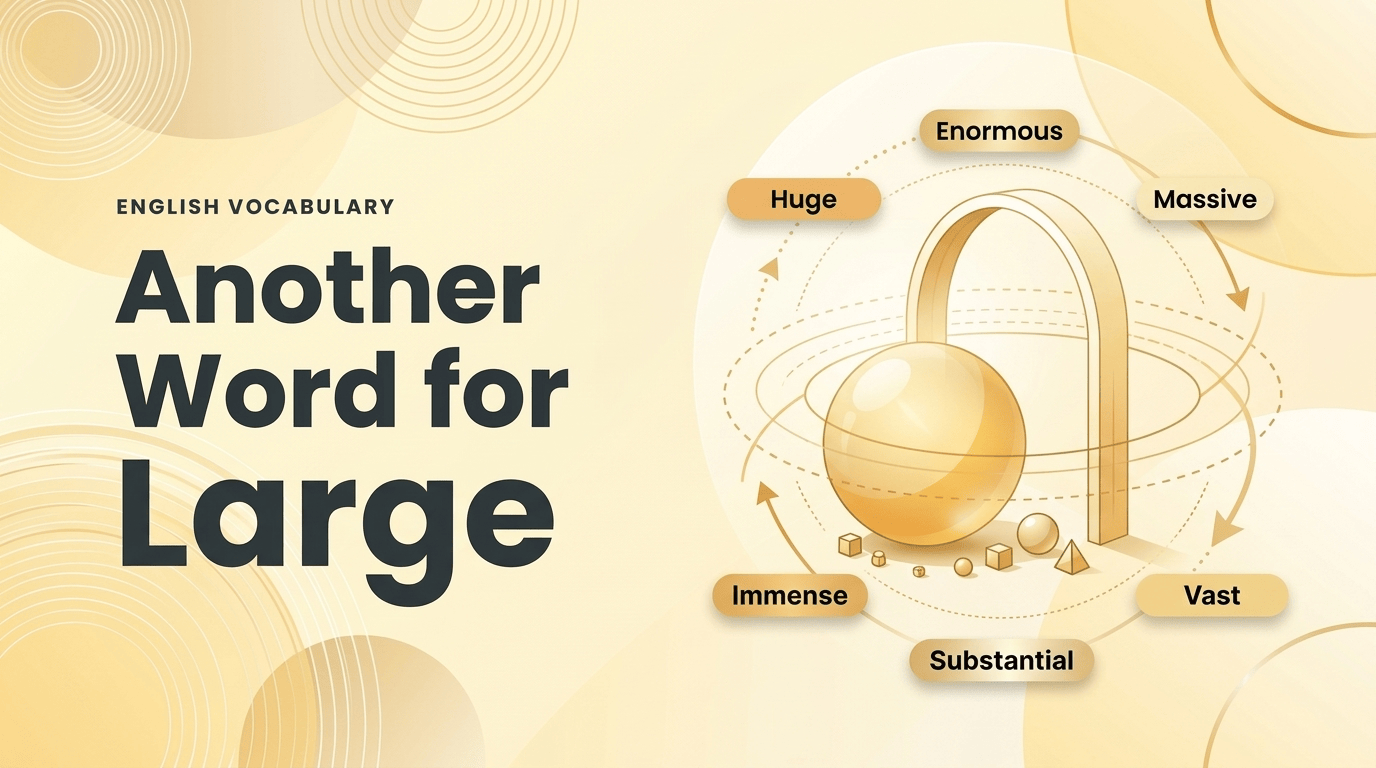
Common alternatives to large include big, huge, enormous, massive, immense, vast, substantial, considerable, and extensive.
The best synonym depends on what you want to describe, whether it is physical size, a large amount, a wide area, or a high degree. For example, a huge building emphasizes physical size, a substantial investment refers to a significant amount of money, and a vast landscape describes a wide area. Choosing the right alternative helps you avoid repetition and make your writing more precise.
In this guide, you will find 25 synonyms for large, their meanings, example sentences, tips for choosing the right word, and information about the word’s pronunciation, origin, related forms, and antonyms.
Meaning and Definition of Large
Large is an adjective that describes something considerable in size, quantity, number, extent, or degree. It can refer to physical objects, spaces, groups of people, amounts of money, and many other things.
Examples:
- They live in a large house with several bedrooms.
- The school has a large number of students.
- The company made a large investment in new technology.
The word is generally neutral. It tells readers that something is bigger, greater, or more extensive than usual without necessarily expressing an opinion about it.
25 Synonyms for Large

The following synonyms can help you describe size, quantity, space, and extent more accurately. Although they share a similar general meaning, they are not interchangeable in every sentence.
| No. | Synonym | Meaning | Example Sentence |
| 1 | Big | Large in size, amount, or importance; common in everyday English | They bought a big dining table. |
| 2 | Huge | Extremely large in size or amount | A huge crowd gathered outside the stadium. |
| 3 | Enormous | Very large, often beyond what is expected | The elephant was enormous. |
| 4 | Massive | Very large, heavy, or solid | The castle had massive stone walls. |
| 5 | Immense | Extremely great in size, extent, or degree | The project required immense effort. |
| 6 | Vast | Extremely wide or extensive in area or scope | The explorers crossed a vast desert. |
| 7 | Giant | Much larger than usual; also used for a very successful or powerful person or organization | A giant tree stood beside the road. |
| 8 | Gigantic | Extremely large, often in a striking or unusual way | They saw a gigantic ship in the harbor. |
| 9 | Colossal | Exceptionally large or impressive | The team faced a colossal challenge. |
| 10 | Mammoth | Extremely large or requiring great effort | The researchers completed a mammoth task. |
| 11 | Sizable | Fairly large or considerable in amount | The charity received a sizable donation. |
| 12 | Substantial | Large enough to be important or significant | The business made a substantial profit. |
| 13 | Considerable | Quite large in amount, degree, or importance | She has considerable experience in teaching. |
| 14 | Extensive | Covering a wide area or including many parts | The library has an extensive collection of books. |
| 15 | Expansive | Covering a wide area or showing a broad scope | The house opens onto an expansive garden. |
| 16 | Broad | Wide from side to side or extensive in scope | The road has a broad shoulder. |
| 17 | Spacious | Providing plenty of room | Their new classroom is spacious and bright. |
| 18 | Roomy | Having plenty of interior space; often informal | The car is roomy enough for five passengers. |
| 19 | Bulky | Large and often awkward to carry, store, or handle | The bulky package was difficult to lift. |
| 20 | Oversized | Larger than the standard or expected size | He wore an oversized jacket. |
| 21 | Grand | Impressive in size, appearance, or style | Visitors admired the grand entrance. |
| 22 | Towering | Extremely tall or rising high above the surroundings | Towering buildings filled the skyline. |
| 23 | Far-reaching | Having a wide or significant effect or influence | The new policy had far-reaching effects. |
| 24 | High-volume | Involving or processing a large quantity, number, or flow | The warehouse handles high-volume orders. |
| 25 | Plentiful | Available in large amounts or more than enough | Fresh fruit was plentiful at the market. |
How to Choose the Right Synonym for Large
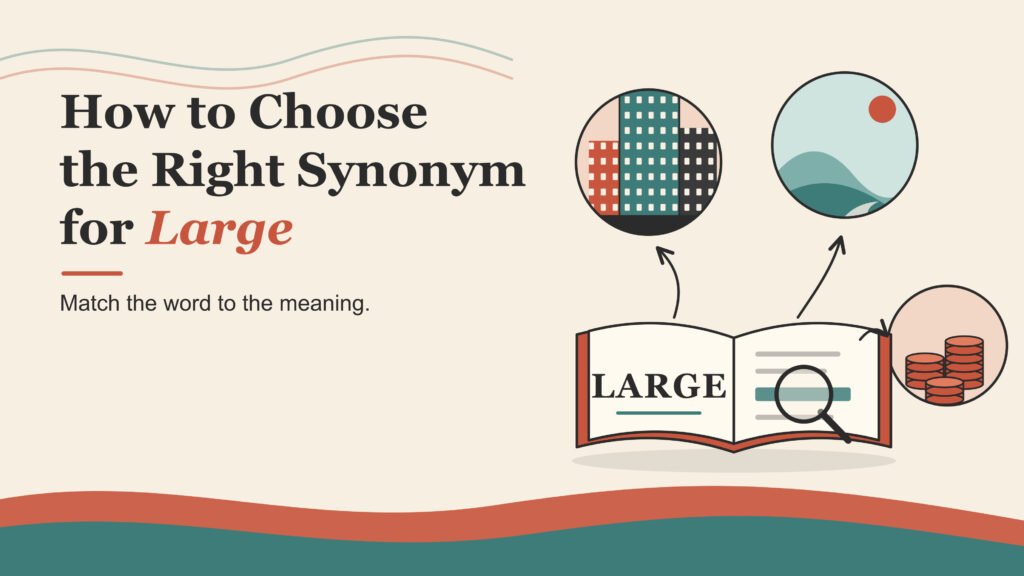
The most suitable alternative depends on the noun you are describing and the meaning you want to communicate.
1. For Physical Size
Use big, huge, enormous, massive, gigantic, or colossal when describing objects, buildings, animals, or other things with considerable physical dimensions.
- The museum contains a huge sculpture.
- A massive rock blocked the path.
- They built an enormous warehouse outside the city.
Big is suitable for everyday conversation, while enormous and colossal often create a stronger impression.
2. For a Large Amount or Number
Use substantial, considerable, sizable, or high-volume when discussing money, quantities, sales, orders, or numbers.
- The project received substantial funding.
- A considerable number of applicants attended the interview.
- The retailer processes high-volume orders every day.
You can also use a great deal of for uncountable nouns and a large number of for countable plural nouns.
- We spent a great deal of time preparing.
- A large number of visitors attended the event.
3. For a Large Area or Wide Scope
Use vast, extensive, expansive, or broad when describing landscapes, regions, collections, research, or the range of something.
- The farm covers a vast area.
- The report provides an extensive analysis of the issue.
- The organization has a broad range of services.
Vast emphasizes great size or extent, while extensive often highlights how much ground, information, or subject matter is covered.
4. For Space and Capacity
Use spacious or roomy when a place or object offers plenty of usable space.
- The apartment has a spacious living room.
- We chose a roomy vehicle for the family trip.
These words focus on the amount of room available rather than simply the outside dimensions.
5. For Importance, Degree, or Impact
Use substantial, considerable, immense, or far-reaching, depending on the sentence.
- The company made substantial progress.
- The decision required considerable thought.
- The team showed immense courage.
- The agreement could have far-reaching consequences.
Remember that far-reaching describes the scope of an effect, not the physical size of an object.
Examples of Large in Sentences
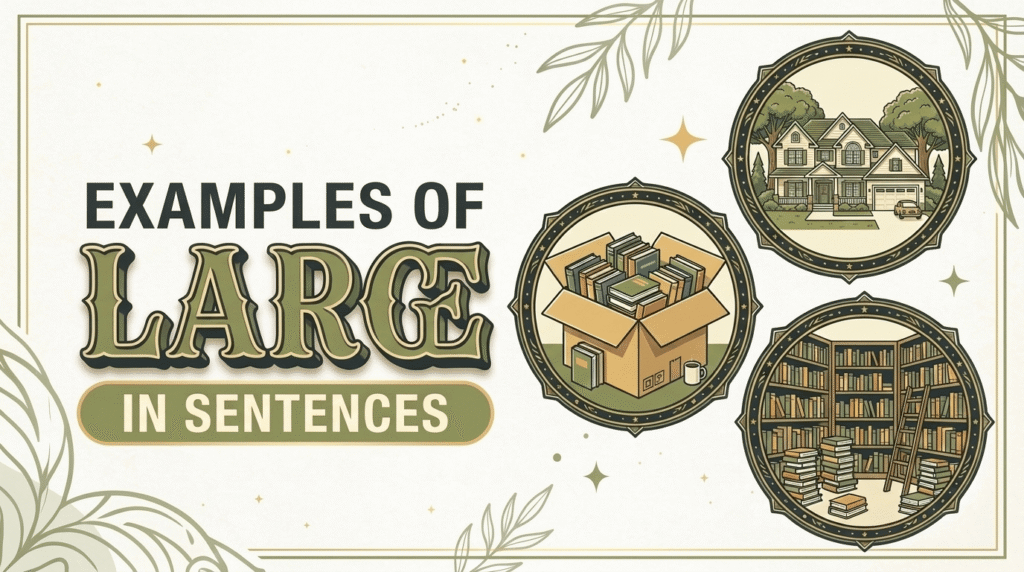
Here are five examples showing how to use large naturally:
- The city has a large population and a busy downtown area.
- We need a large box to store these books.
- The project requires a large amount of time and careful planning.
- She owns a large collection of historical novels.
- The company opened a large office near the city center.
Each sentence can be improved by choosing a more specific alternative when the context allows it. For example, a vast collection may emphasize breadth, while a substantial amount of time may sound more natural in formal writing.
Connotative Meaning of Large
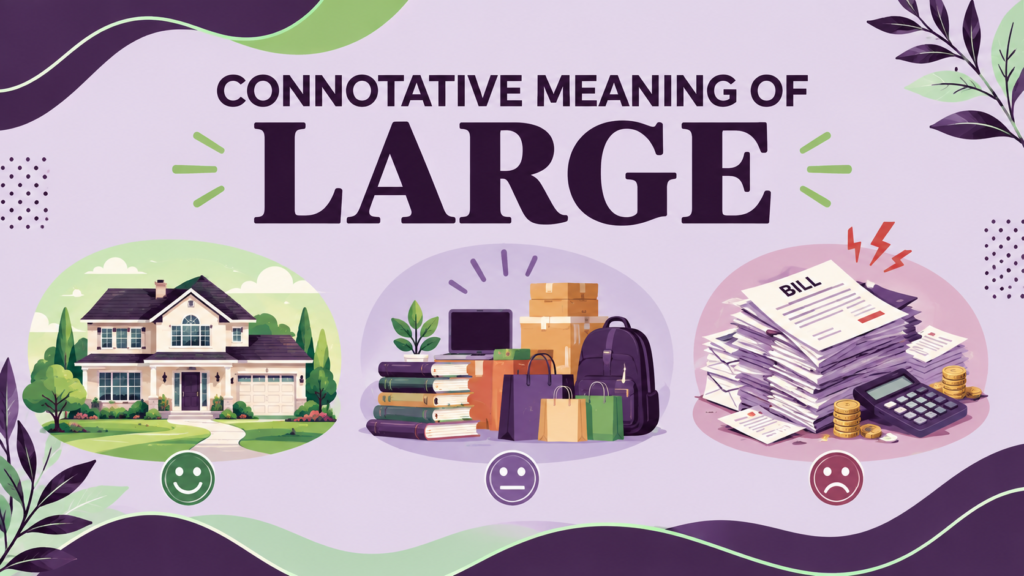
The word large usually has a neutral meaning, but its connotation can change according to the noun and surrounding context.
- Positive: “They made a large donation to the hospital.” The sentence may suggest generosity.
- Neutral: “The survey included a large number of participants.” The word simply describes quantity.
- Negative: “The company faces a large debt.” The phrase emphasizes a potentially serious financial burden.
The word itself does not automatically communicate praise or criticism. The situation determines how readers interpret it.
Etymology of Large
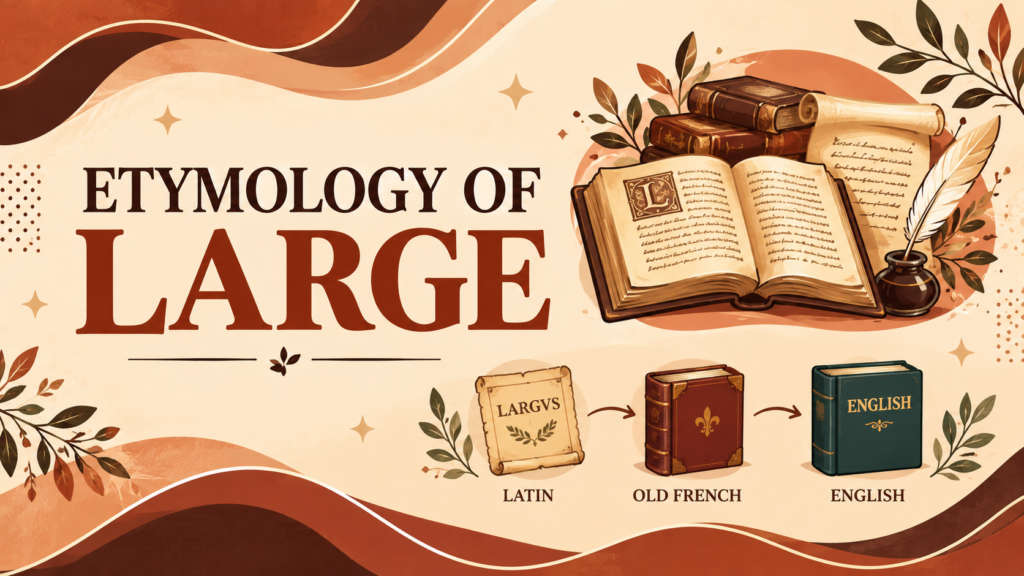
The English word large came through Old French large, meaning broad, wide, or generous. Its history can be traced further to Latin largus, associated with abundance or generosity.
Over time, large developed and retained meanings connected with physical size, quantity, extent, and degree. Its modern use includes both concrete descriptions, such as a large room, and abstract expressions, such as a large investment.
Pronunciation of Large
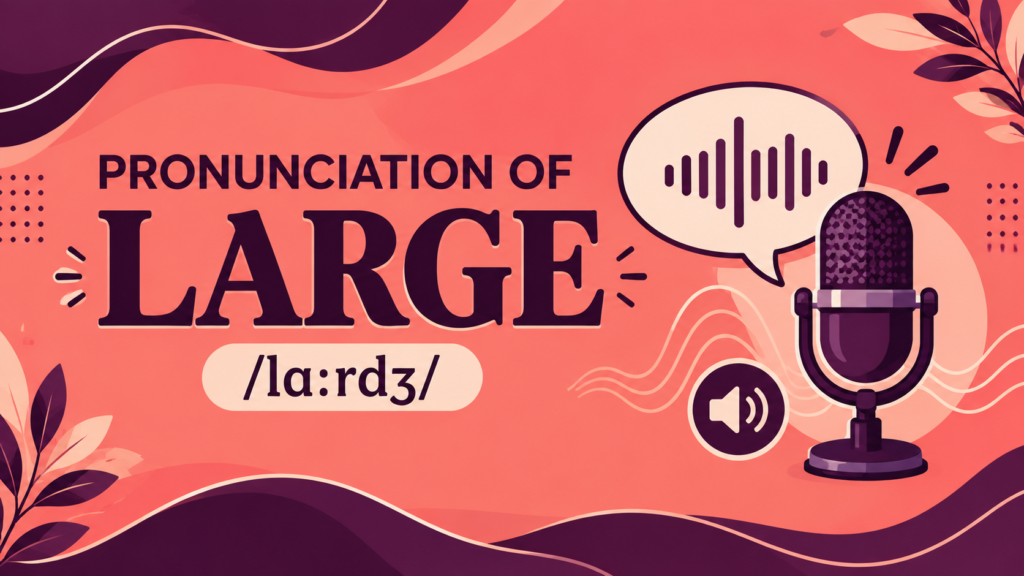
- Word: Large
- Part of speech: Adjective; also used as a noun in certain contexts
- Syllables: One
- American English IPA: /lɑrdʒ/ in many pronunciations
- British English IPA: /lɑːdʒ/ in many pronunciations
To pronounce large, begin with the “l” sound, follow with the vowel sound in father for many speakers, and finish with the sound heard at the end of judge. Pronunciation varies by accent.
Word Formation and Related Forms of Large
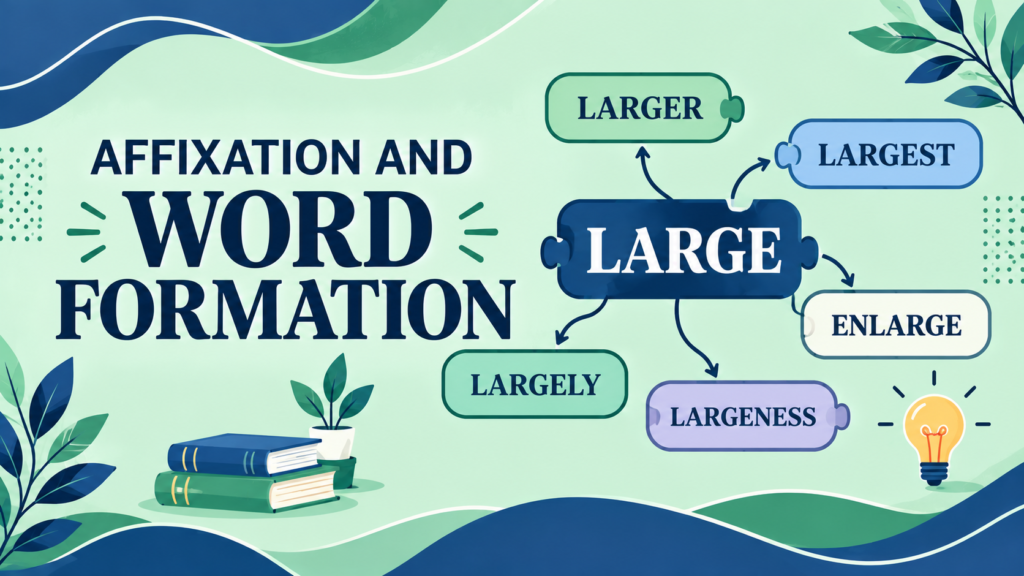
The word large has several related forms. Some express grammatical comparisons, while others have different grammatical functions or meanings.
| Word Form | Type or Function | Meaning | Example |
| Large | Base adjective | Considerable in size or amount | They bought a large desk. |
| Larger | Comparative adjective | Bigger than another thing | This room is larger than mine. |
| Largest | Superlative adjective | The biggest in a group | It is the largest building in town. |
| Largely | Adverb | Mostly or to a great extent | The event was largely successful. |
| Largeness | Noun | The quality or state of being large | The largeness of the hall surprised us. |
| Enlarge | Verb | To make or become bigger | Click the image to enlarge it. |
Larger and largest are comparative and superlative forms of the adjective large. Largely and largeness are related forms with different grammatical functions. Enlarge is a verb formed with the prefix en-, meaning to make or become larger.
Antonyms of Large
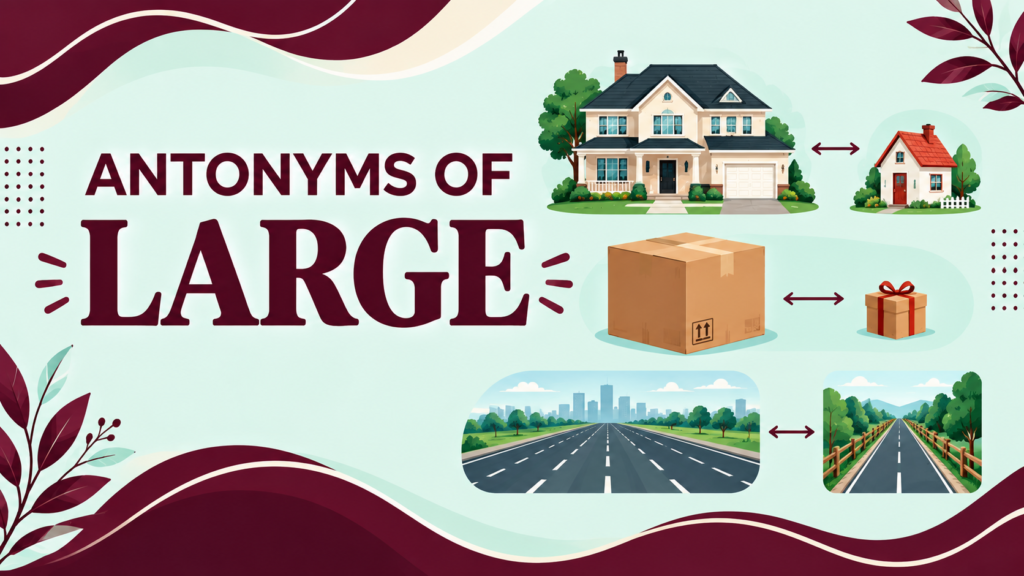
An antonym is a word with the opposite or contrasting meaning. The best opposite of large depends on what is being described.
| Antonym | Meaning | Example |
| Small | Limited in size or amount | They live in a small apartment. |
| Tiny | Extremely small | A tiny insect landed on the leaf. |
| Little | Small in size, amount, or degree | We have little space left. |
| Miniature | Made on a much smaller scale | She collected miniature houses. |
| Compact | Small and efficiently arranged | The compact camera fits in a pocket. |
| Narrow | Limited in width or scope | They walked along a narrow path. |
For a general contrast, small is usually the most direct antonym of large. Other choices are more specific: narrow refers to width, compact emphasizes efficient arrangement, and miniature often describes a scaled-down version of something.
Frequently Asked Questions
1. What is the simplest word for large?
Big is one of the simplest and most common alternatives to large. It works well in everyday conversation, such as “a big house” or “a big opportunity.”
2. What is a formal word for large?
Substantial, considerable, extensive, and significant can work in formal writing, depending on the context. For example, substantial investment refers to a significant amount invested, while extensive research describes research covering a broad range.
3. What is another word for a large amount?
Useful alternatives include a substantial amount, a considerable amount, a great deal, and a large quantity. Choose the expression that fits the noun and sentence. For example, “a great deal of time” is natural, while “a large number of books” is appropriate for countable items.
4. What is another word for a large area?
Vast, extensive, and expansive are useful alternatives. Vast emphasizes great size, extensive often highlights the area or range covered, and expansive can suggest an open, wide-reaching space.
5. What is the opposite of large?
The most common opposite is small. Depending on the context, you can also use tiny, little, compact, or narrow. These words have more specific meanings and may not fit every sentence.
Conclusion

Learning another word for large can make your writing more precise and varied. Use big for everyday situations, huge or enormous to emphasize physical size, vast for wide areas, and substantial or considerable for amounts and degrees. When describing space, spacious and roomy may be more natural choices.
The key is to choose a synonym that matches your intended meaning rather than replacing large with the first similar word you find. Understanding these differences will help you write more clearly in essays, articles, business communication, and everyday conversation.

I’m Naz Fatima, a dedicated content writer with expertise in language, synonyms, and well-researched article writing.
My experience in creating clear, engaging, and informative content reflects my commitment to quality, accuracy, and reader value.










