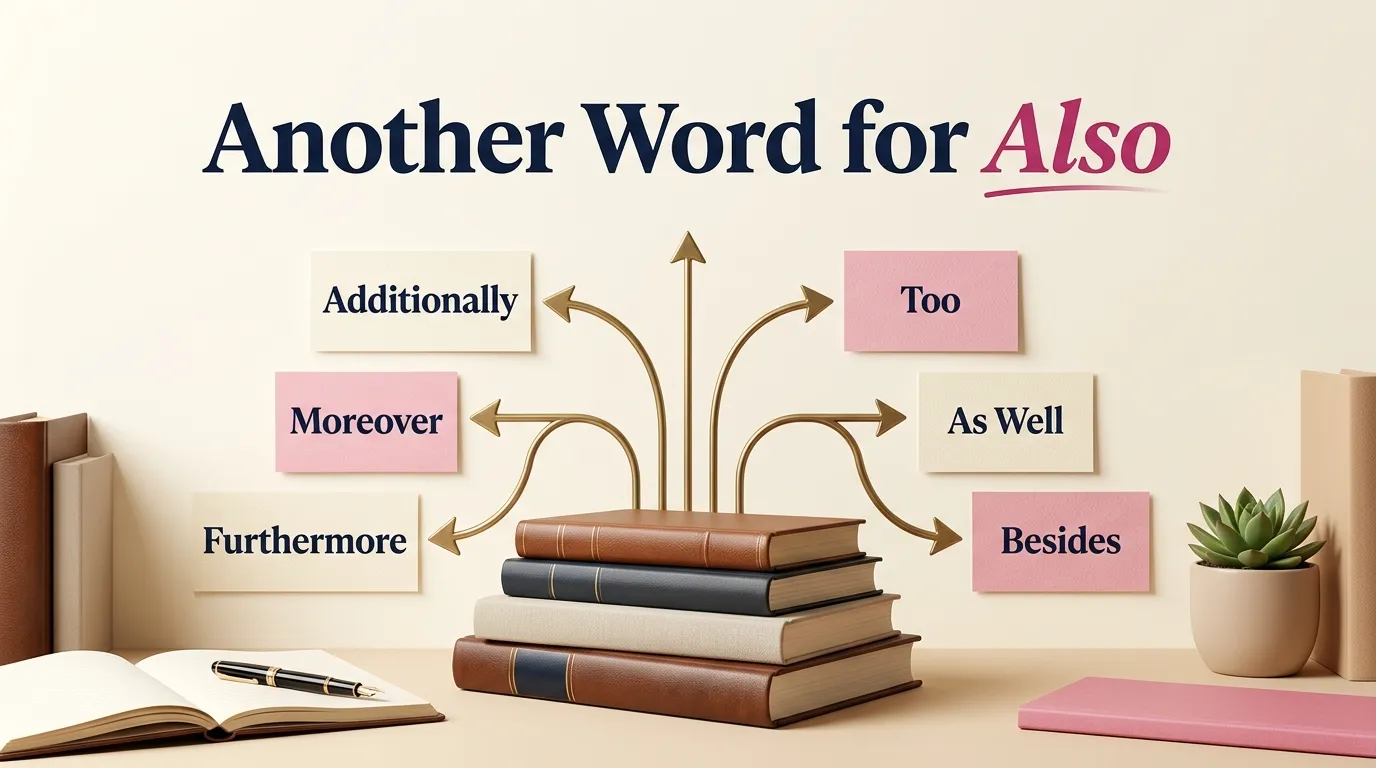
Another word for also is: too, as well, additionally, moreover, furthermore, besides, in addition, likewise, similarly, plus, and, what’s more, on top of that, as well as, along with, equally, further, not to mention, together with, coupled with, additionally, also, in conjunction with, and similarly.
Also is a common English word used when we want to add another idea, fact, person, or action. For example, if someone says, “She is a talented writer,” we can add another fact by saying, “She is also a skilled speaker.” The word makes the connection between two ideas simple and clear.
Because also appears so often in everyday English, essays, emails, and professional writing, repeating it too much can make your writing sound less varied. Learning alternatives such as too, as well, additionally, moreover, furthermore, besides, and in addition can help you communicate more naturally.
In this article, you will learn the meaning of also, its examples, connotations, history, pronunciation, word formation, 24 useful alternatives, semantic categories, antonyms, and common questions.
Meaning of Also
Also is mainly an adverb that means in addition, too, or as well.
Definition
To also means to add another fact, action, person, or idea to something already mentioned.
Examples:
- She also speaks Spanish.
- I also want to visit the museum.
- He is a teacher and also a writer.
Position of Also in a Sentence
Also can appear in different positions depending on the sentence.
Before the main verb:
- She also likes music.
After the verb “be”:
- He is also a talented artist.
At the beginning of a sentence:
- Also, remember to bring your notebook.
Connotative Meaning of Also
Connotation means the feeling or association connected with a word beyond its basic dictionary meaning.
- Positive: Also can introduce another positive quality or achievement.
- Neutral: It normally adds information without a strong emotional feeling.
- Negative: The word itself is not negative, although the information it introduces can be negative.
Example:
She is intelligent and also very hardworking.
Here, also simply adds another positive quality.
Etymology of Also
The word also has roots in Old English and developed over time into its modern form.
Old English
The modern word developed from older English elements connected with ideas of all and so, expressing an additional or similar idea.
Middle English
During Middle English, these elements gradually developed into forms closer to the modern word also.
Modern English
Today, also is widely used to mean in addition or too. It appears in casual conversations as well as academic and professional writing.
Pronunciation of Also
Also is commonly pronounced:
/ˈɔːlsoʊ/
Syllables
al-so: 2 syllables
The main stress is on the first syllable:
AL-so
Affixation Pattern
Also is a historical compound rather than a modern word formed with a productive prefix or suffix.
It developed from older English elements related to:
- all: whole or completely
- so: in that way
Common expressions containing also include:
- Also known as
- Also called
- Also available
- Also included
- Also useful
Examples:
- She is also known as a talented artist.
- The package also includes a user guide.
- The product is also available online.
24 Other Words With Meaning & Examples
1. Too (Adverb)
Meaning: Used to mean “also” or “in addition.”
Examples:
- I want to come too.
- She enjoys reading too.
2. As Well (Adverbial Phrase)
Meaning: Used to add another person, thing, or action.
Examples:
- He speaks French as well.
- I would like some tea as well.
3. Additionally (Adverb)
Meaning: In addition to something already mentioned.
Examples:
- The hotel has a gym. Additionally, it has a swimming pool.
- Additionally, customers receive free delivery.
4. Moreover (Adverb)
Meaning: Used to add another important or supporting point.
Examples:
- The course is affordable. Moreover, it is flexible.
- The phone is fast; moreover, its battery lasts all day.
5. Furthermore (Adverb)
Meaning: In addition to information already given.
Examples:
- The plan is simple. Furthermore, it is inexpensive.
- Furthermore, the new system saves time.
6. Besides (Adverb/Preposition)
Meaning: In addition to something or someone.
Examples:
- Besides English, she speaks German.
- I do not want to go. Besides, it is already late.
7. In Addition (Phrase)
Meaning: Used to introduce another fact or idea.
Examples:
- In addition, the store offers free returns.
- She has experience in addition to her qualifications.
8. Likewise (Adverb)
Meaning: In the same or a similar way.
Examples:
- She enjoyed the book, and I likewise enjoyed it.
- The first team performed well. Likewise, the second team succeeded.
9. Similarly (Adverb)
Meaning: In a similar way.
Examples:
- The first product is affordable. Similarly, the second is budget-friendly.
- He enjoys science. Similarly, his sister loves technology.
10. Plus (Preposition/Conjunction)
Meaning: In addition to something.
Examples:
- The apartment is affordable, plus it is close to work.
- You get a free bag plus a discount.
11. And (Conjunction)
Meaning: Used to connect and add words, phrases, or ideas.
Examples:
- She is smart and hardworking.
- He bought a notebook and a pen.
12. What’s More (Phrase)
Meaning: Used to introduce another important or interesting point.
Examples:
- The hotel is comfortable. What’s more, it is affordable.
- She completed the task quickly. What’s more, she did it accurately.
13. On Top of That (Phrase)
Meaning: In addition to everything already mentioned.
Examples:
- The journey was long. On top of that, the weather was bad.
- The course is useful. On top of that, it is free.
14. Not to Mention (Phrase)
Meaning: Used to add another important point.
Examples:
- The house is large, not to mention beautiful.
- The phone is fast, not to mention stylish.
15. As Well As (Phrase)
Meaning: Together with or in addition to.
Examples:
- She teaches English as well as history.
- He bought a jacket as well as new shoes.
16. Along With (Phrase)
Meaning: Together with someone or something else.
Examples:
- She brought her notebook along with her laptop.
- The package comes along with a user guide.
17. Equally (Adverb)
Meaning: To the same degree or extent.
Examples:
- Both options are equally useful.
- She is equally interested in art and music.
18. Further (Adverb)
Meaning: In addition or beyond what has already been mentioned.
Examples:
- Further, the report explains the main problem.
- We need further information before making a decision.
19. Together With (Phrase)
Meaning: Alongside someone or something else.
Examples:
- She attended the event together with her colleagues.
- The report, together with the charts, was submitted.
20. Coupled With (Phrase)
Meaning: Combined with another thing.
Examples:
- Her experience, coupled with her skills, helped her succeed.
- Good planning coupled with hard work can produce strong results.
21. Over and Above (Phrase)
Meaning: In addition to something.
Examples:
- Employees receive benefits over and above their basic salary.
- She did extra work over and above the required tasks.
22. In Conjunction With (Phrase)
Meaning: Together with or combined with something else.
Examples:
- The program works in conjunction with local schools.
- The treatment was used in conjunction with regular exercise.
23. At the Same Time (Phrase)
Meaning: Used to show that another fact or action exists at the same time.
Examples:
- The course is challenging. At the same time, it is rewarding.
- She works and studies at the same time.
24. In Addition to (Prepositional Phrase)
Meaning: As well as something else.
Examples:
- In addition to English, he speaks Arabic.
- In addition to her job, she runs a small business.
Usage note: These alternatives are not always interchangeable. Too and as well are very close to also, while moreover and furthermore are more common in formal writing. Likewise and similarly usually express similarity rather than simple addition.
Prototype Meaning of Also
The prototype meaning of also is adding another related piece of information.
A simple pattern is:
Idea A + Also + Idea B
For example:
She is a talented designer. She is also a photographer.
The word also tells the reader that the second fact should be added to the first.
Prototype Categorization of Also
The alternatives for also can be grouped into different semantic categories.
1. Simple Addition
- Too
- As well
- Additionally
- In addition
- Plus
These are useful when simply adding another fact or item.
2. Formal Addition
- Moreover
- Furthermore
- Further
- In addition
- In conjunction with
These work well in academic and professional writing.
3. Similarity
- Likewise
- Similarly
- Equally
These are useful when the new information is similar to the previous information.
4. Emphatic Addition
- What’s more
- On top of that
- Not to mention
- Besides
These can make the added point feel stronger or more noticeable.
5. Combination
- Along with
- As well as
- Together with
- Coupled with
These show that people, things, or ideas are connected or included together.
Antonyms of Also
Also does not have one exact antonym because it is an addition word. However, words that express exclusion or replacement can create an opposite idea.
1. Instead (Adverb)
Meaning: In place of something else.
Example:
- We did not take the bus. Instead, we walked home.
2. Only (Adverb)
Meaning: No more than the person or thing specified.
Example:
- Only two students attended the meeting.
3. Excluding (Preposition)
Meaning: Leaving someone or something out.
Example:
- The price is $50, excluding delivery.
4. Rather (Adverb)
Meaning: Instead of the previous choice or idea.
Example:
- He did not complain. Rather, he suggested a solution.
5. Alone (Adverb/Adjective)
Meaning: Without anyone or anything else.
Example:
- She completed the project alone.
Short Questions and Answers
What does also mean?
Also means in addition, too, or as well. It is used to add another fact or idea.
When should also be used?
Use also when you want to add information connected to something already mentioned.
Is also formal or informal?
Also works in both casual and formal English. It is common in conversations, essays, emails, and professional writing.
What is the difference between also and too?
Both can mean “in addition.” Too often comes at the end of a sentence, while also commonly appears before the main verb.
Examples:
- I also like coffee.
- I like coffee too.
What is the difference between also and as well?
Both mean “in addition.” As well often appears at the end of a sentence.
Examples:
- She also speaks French.
- She speaks French as well.
What is a formal word for also?
Depending on the context, additionally, moreover, furthermore, and in addition can be used as more formal alternatives.
Conclusion
The word also is a simple and useful way to add information in English. It is common in everyday conversations, academic writing, emails, and professional communication. However, repeating it too often can make writing sound less varied. Alternatives such as too, as well, additionally, moreover, furthermore, besides, in addition, and what’s more can help create more natural and engaging writing.
The right alternative depends on the context. Use too or as well for simple everyday addition, additionally or in addition for clear formal writing, and moreover or furthermore when adding an important supporting point. Understanding these differences can make your vocabulary richer and your writing clearer.
Another word for is: 30 Better Alternatives

I’m Mubashra Waleed, a content writer specializing in English vocabulary, synonyms, word meanings. I focus on creating clear, accurate, and engaging content that makes English language learning simple and useful for readers.










