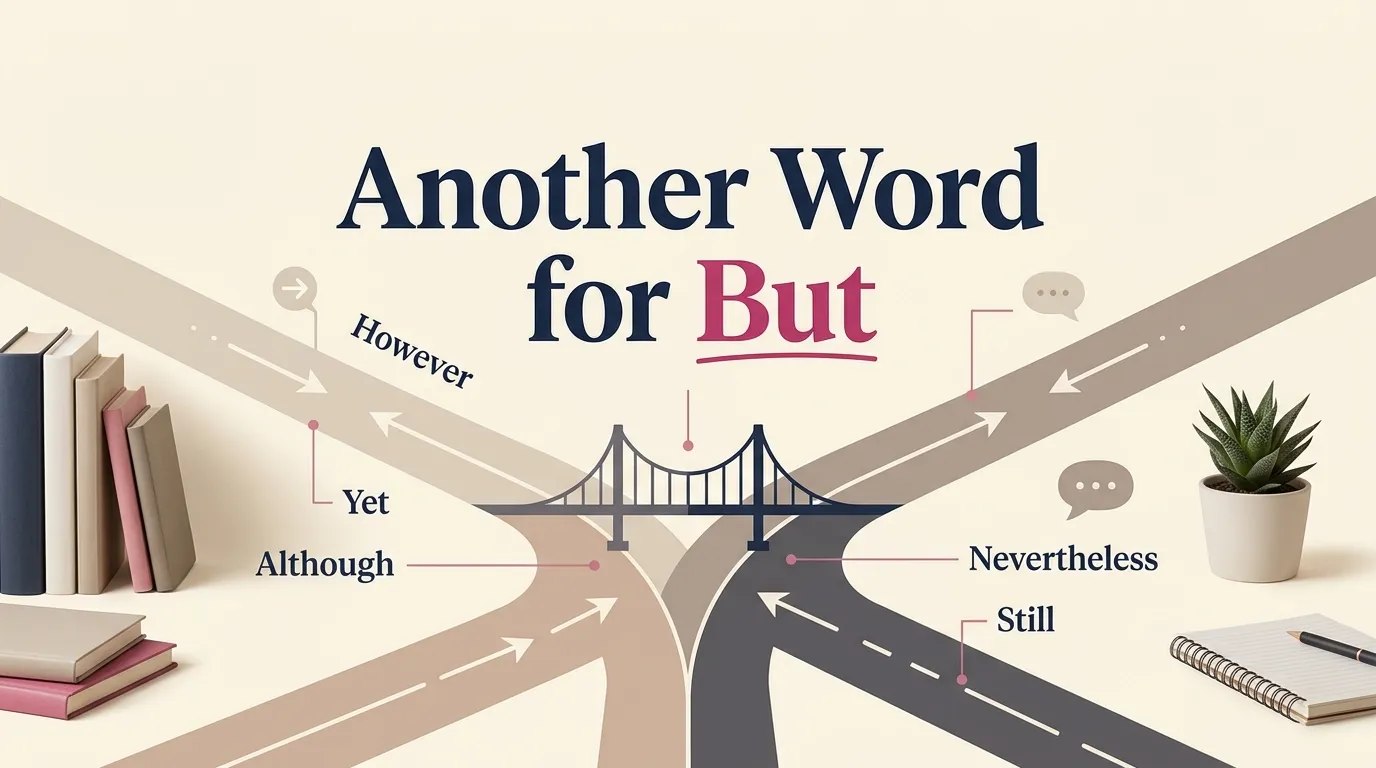
| Another Word for But | Best Use |
| However | Show contrast |
| Yet | Show an unexpected contrast |
| Although | Introduce a contrast |
| Though | Add a contrasting idea |
| Nevertheless | Show contrast despite a fact |
| Nonetheless | Show that something remains true |
| Still | Show an opposing point |
| Whereas | Compare two different facts |
| While | Show contrast between ideas |
| Conversely | Show the opposite situation |
But is one of the most common words in English. We use it when we want to connect two ideas that are different or opposite. For example, you may say, “I wanted to go outside, but it started raining.” The word is short, simple, and useful, so people use it often in both speaking and writing. However, using but too many times can make writing sound repetitive.
Learning another word for but helps English learners express contrast in more flexible ways. It also helps content writers make sentences smoother and more precise.
In this article, we will explore the meaning of but, its grammar, history, pronunciation, word formation, and 25 useful alternatives. We will also look at examples, semantic categories, antonyms, and common questions about using but correctly.
Meaning of But
Definition
But (Conjunction/Preposition/Adverb):
A word used to introduce an idea that contrasts with or limits what was just said.
Examples
- I wanted to buy the dress, but it was too expensive.
- She is young, but she is very responsible.
Connotative Meaning
Positive tone: It can introduce a positive or hopeful contrast.
Negative tone: It can introduce a problem, limitation, or disagreement.
Neutral tone: It simply connects two ideas that differ.
(Connotation: the feeling or idea that a word suggests beyond its basic meaning.)
Etymology
The word but has a long history in English. It comes from Old English būtan, which originally had meanings related to “outside,” “except,” or “without.” Over time, its uses expanded to include the modern conjunction that introduces contrast.
- Old English (450–1100): Būtan was used with meanings such as “outside,” “except,” and “without.”
- Middle English (1100–1500): Forms such as but and bot developed and became common in English.
- Modern English (1500–Present): But became widely used as a conjunction for contrast, as in “I like it, but it is expensive.”
Pronunciation (IPA)
- IPA: /bʌt/
- Syllables: one syllable
Affixation Pattern of But
- Root: but
- Prefix: None
- Suffix: None
- Word formations: but does not normally form a large family of standard words through prefixes and suffixes. Its main forms and uses are grammatical rather than morphological.
Common grammatical uses
- But: conjunction
- But: preposition
- But: adverb
- But: noun in some expressions
25 Other Words With Meaning & Examples
1. However (Adverb)
Meaning: Used to introduce a statement that contrasts with a previous idea.
Examples:
- The task was difficult. However, we finished it.
- I liked the hotel. However, the room was small.
2. Yet (Conjunction/Adverb)
Meaning: Used to show an unexpected contrast.
Examples:
- She is young, yet she is very wise.
- The book is simple, yet it is powerful.
3. Although (Conjunction)
Meaning: Used to introduce a fact that contrasts with another fact.
Examples:
- Although it was cold, we went outside.
- Although he was tired, he continued working.
4. Though (Conjunction/Adverb)
Meaning: Used to introduce a contrasting idea.
Examples:
- Though the test was hard, she passed.
- I enjoyed the movie, though it was quite long.
5. Nevertheless (Adverb)
Meaning: Used to show that something remains true despite another fact.
Examples:
- The road was dangerous. Nevertheless, they continued.
- It was expensive; nevertheless, she bought it.
6. Nonetheless (Adverb)
Meaning: Used to introduce a contrasting fact that still remains true.
Examples:
- The plan had problems. Nonetheless, we accepted it.
- He was nervous. Nonetheless, he gave the speech.
7. Still (Adverb)
Meaning: Used to show that something remains true despite another fact.
Examples:
- It was raining. Still, we went for a walk.
- The job was difficult, but she still enjoyed it.
8. Whereas (Conjunction)
Meaning: Used to compare two things that are different.
Examples:
- John likes tea, whereas Sara prefers coffee.
- The first plan is cheap, whereas the second is faster.
9. While (Conjunction)
Meaning: Used to show a contrast between two ideas.
Examples:
- While the first option is cheaper, the second is safer.
- While I understand your point, I disagree.
10. Conversely (Adverb)
Meaning: Used to introduce an opposite or contrasting situation.
Examples:
- Some people enjoy city life. Conversely, others prefer the countryside.
- Prices rose last year. Conversely, they fell this year.
11. On the Other Hand (Phrase)
Meaning: Used to introduce another side of an issue.
Examples:
- The apartment is small. On the other hand, it is affordable.
- The job pays well. On the other hand, it requires long hours.
12. In Contrast (Phrase)
Meaning: Used to show a clear difference between two ideas.
Examples:
- The first room is bright. In contrast, the second is dark.
- Summer is hot here. In contrast, winter is quite cold.
13. In Comparison (Phrase)
Meaning: Used to point out a difference when comparing things.
Examples:
- This phone is expensive. In comparison, that model is cheaper.
- The old design was simple. In comparison, the new design is complex.
14. Despite This (Phrase)
Meaning: Used to show that something happens even though there is a reason against it.
Examples:
- The weather was poor. Despite this, we continued.
- The plan had flaws. Despite this, it worked.
15. Even So (Phrase)
Meaning: Used to show that a fact does not change the result.
Examples:
- The task was difficult. Even so, she completed it.
- He knew the risks. Even so, he decided to try.
16. That Said (Phrase)
Meaning: Used to introduce a different or limiting point.
Examples:
- The course is challenging. That said, it is very useful.
- The book is long. That said, it is worth reading.
17. Still and All (Phrase)
Meaning: Used to introduce a contrasting point or concession.
Examples:
- The trip was tiring. Still and all, we enjoyed it.
- The plan was risky. Still and all, they accepted it.
18. Instead (Adverb)
Meaning: Used to show a different choice or action.
Examples:
- I did not take the bus. Instead, I walked.
- She did not choose the red dress. She chose the blue one instead.
19. Rather (Adverb)
Meaning: Used to show a preferred or different option.
Examples:
- I would rather stay home than go out.
- He chose tea rather than coffee.
20. Except (Preposition/Conjunction)
Meaning: Used to exclude something from a general statement.
Examples:
- Everyone came except John.
- I would go, except I have no time.
21. Except That (Conjunction)
Meaning: Used to introduce an exception or limiting fact.
Examples:
- I would agree, except that we need more evidence.
- The plan is good, except that it costs too much.
22. Other Than (Preposition)
Meaning: Used to show something different from or apart from another thing.
Examples:
- I have no plans other than studying.
- There was nothing other than a small mistake.
23. Save (Preposition)
Meaning: Used in formal English to mean “except.”
Examples:
- Everyone attended save the manager.
- The whole team agreed, save one member.
24. Notwithstanding (Preposition/Adverb)
Meaning: Used to show that something happens despite a particular fact.
Examples:
- Notwithstanding the difficulties, the project succeeded.
- The decision was made, notwithstanding our concerns.
25. Barring (Preposition)
Meaning: Used to mean “unless something prevents it” or “except for.”
Examples:
- Barring any problems, we will finish tomorrow.
- Barring a major change, the plan will continue.
Prototype Meaning
The prototype meaning of but is contrast. When people hear but, they usually expect the next part of the sentence to provide a different, unexpected, or limiting idea. For example, “The food was good, but it was expensive” first gives a positive idea and then adds a contrasting point. Because but is simple and flexible, it is one of the most common words for showing contrast in everyday English.
Prototype Categorization
The 25 alternatives can be grouped into useful semantic categories:
- Direct contrast: however, yet, though, although, nevertheless, nonetheless, and still directly connect contrasting ideas.
- Comparison: whereas, while, conversely, in contrast, and in comparison work well when comparing two different ideas or situations.
- Concession: despite this, even so, that said, and notwithstanding show that something remains true despite another fact.
- Alternative or replacement: instead and rather are useful when one option replaces another.
- Exception: except, except that, other than, and save introduce an exception or limitation.
- Formal contrast: nevertheless, nonetheless, notwithstanding, and conversely are especially useful in formal or academic writing.
- Conditional exception: barring is useful when something is expected unless an unexpected problem prevents it.
This categorization helps writers choose an alternative based on the exact relationship between their ideas instead of replacing but with a word that does not fit the sentence.
Antonyms of But
Because but is a conjunction used to show contrast, it does not have a direct antonym in the same way that an adjective does. However, words and phrases that express addition or agreement can serve as functional contrasts.
1. And (Conjunction)
Meaning: Used to connect ideas that support or add to each other.
2. Also (Adverb)
Meaning: Used to add another related point.
3. Likewise (Adverb)
Meaning: Used to show that something is similar or also true.
4. Similarly (Adverb)
Meaning: Used to show that two things are alike.
5. Moreover (Adverb)
Meaning: Used to add another important point.
Short Questions and Answers
What does but mean?
But is mainly used to connect two ideas that contrast with each other.
When should but be used?
Use but when you want to show that the second idea is different from, unexpected after, or limits the first idea.
Is but positive or negative?
But is neutral. Its effect depends on the ideas around it.
How is but different from however?
But is usually a conjunction that directly joins contrasting ideas, while however is commonly used as an adverb to introduce a contrasting statement.
Can I use although instead of but?
Often, yes, but the sentence structure changes. For example, “Although it was raining, we went outside” uses although to introduce the contrasting clause.
Conclusion
Learning another word for but can make your English more varied and precise. Common alternatives such as however, yet, although, though, nevertheless, nonetheless, whereas, and while help you express contrast in different ways. Other choices, such as except, instead, rather, and despite this, work better for specific meanings. Understanding these differences is more useful than simply memorizing a synonym list.
When you choose the right word, your writing becomes smoother, clearer, and more natural. It also helps you avoid repeating but in essays, blog posts, articles, and everyday communication. Try learning one new alternative each day and use it in your own sentences. Regular practice will improve your vocabulary and build confidence in both writing and speaking.
Another Word for Impact: 25 Powerful Alternatives

I’m Mubashra Waleed, a content writer specializing in English vocabulary, synonyms, word meanings. I focus on creating clear, accurate, and engaging content that makes English language learning simple and useful for readers.