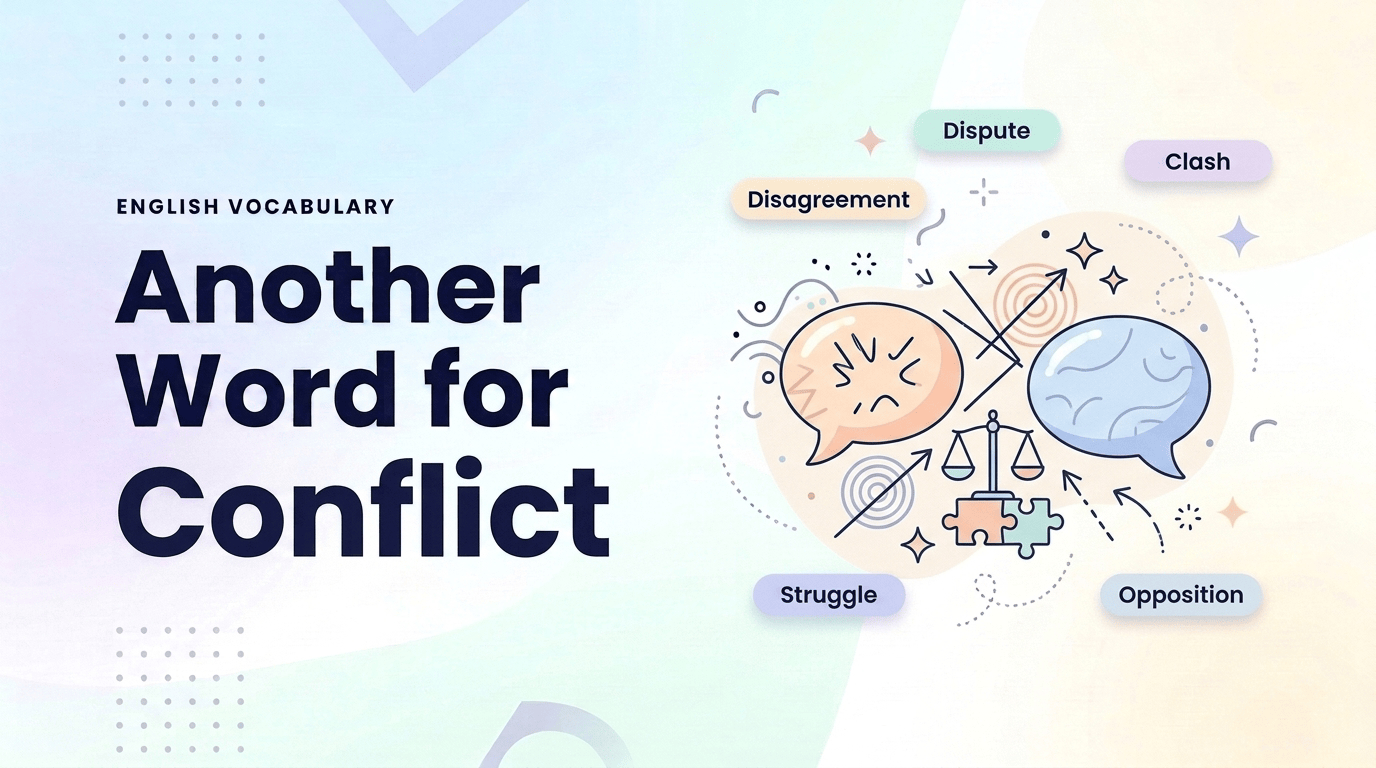
Common alternatives to conflict include disagreement, dispute, clash, struggle, confrontation, opposition, friction, and discord.
The word conflict means a disagreement, struggle, or clash between people, ideas, or groups. It can happen when people have different opinions, goals, or needs. For example, two friends may have a conflict over a misunderstanding, or two teams may face a conflict over a shared goal. Conflict is common in daily life, stories, workplaces, and relationships. However, using the same word repeatedly can make your writing less interesting.
Learning another word for conflict helps you express the exact type of disagreement or struggle you mean. Words such as dispute, clash, and struggle have different uses. Some describe arguments, while others refer to serious opposition or inner emotional challenges. In this guide, you will learn useful synonyms for conflict, their meanings, example sentences, pronunciation, word history, and antonyms.
Meaning and Definition of Conflict
Conflict is a noun or verb that describes a serious disagreement, opposition, or struggle between people, groups, ideas, or interests.
Examples:
- The two friends had a conflict over a misunderstanding.
- The story focuses on a conflict between good and evil.
- My plans conflict with the meeting schedule.
25 Synonyms for Conflict
The best synonym depends on whether you mean an argument, a struggle, or a difference between ideas.
| No. | Synonym | Meaning | Example Sentence |
| 1 | Disagreement | A difference of opinion | They had a disagreement about the plan. |
| 2 | Dispute | An argument over an issue | The neighbors settled their dispute. |
| 3 | Clash | A strong disagreement or collision | Their opinions often clash. |
| 4 | Struggle | A difficult effort or fight | She faced an inner struggle. |
| 5 | Confrontation | A direct meeting involving opposition | The confrontation ended peacefully. |
| 6 | Opposition | Resistance to an idea or action | The proposal faced strong opposition. |
| 7 | Discord | A lack of agreement or harmony | The argument created discord in the group. |
| 8 | Friction | Tension between people or groups | There was friction between the two teams. |
| 9 | Feud | A long and bitter disagreement | The families ended their feud. |
| 10 | Argument | A disagreement expressed through words | Their argument lasted several minutes. |
| 11 | Tension | A feeling of strain or unease | Tension grew during the discussion. |
| 12 | Battle | A serious fight or struggle | She faced a battle between duty and desire. |
| 13 | Contest | A competition or struggle | The two sides entered a contest for control. |
| 14 | Rivalry | Competition between opposing sides | Their rivalry lasted for years. |
| 15 | Hostility | Unfriendly or aggressive feelings | Hostility made cooperation difficult. |
| 16 | Antagonism | Active opposition or dislike | Antagonism grew between the groups. |
| 17 | Resistance | Refusal to accept or follow something | The change met resistance. |
| 18 | Turmoil | A state of confusion or disturbance | The decision caused turmoil in the community. |
| 19 | Strife | Serious or prolonged disagreement | The country experienced years of strife. |
| 20 | Combat | Physical fighting, especially in war | The soldiers returned from combat. |
| 21 | Contradiction | A direct difference between statements or ideas | There is a contradiction in his explanation. |
| 22 | Incompatibility | A state of being unable to work well together | Their goals showed clear incompatibility. |
| 23 | Opposition of interests | A situation where aims differ | The deal failed because of an opposition of interests. |
| 24 | Falling out | A disagreement that damages a relationship | The friends had a falling out. |
| 25 | Inner turmoil | Emotional confusion or struggle | He experienced inner turmoil before deciding. |
Examples of Conflict in Sentences
Here are five examples of how to use conflict naturally.
- The conflict between the neighbors was resolved.
- The main character faces a conflict in the story.
- Different opinions can lead to conflict.
- Her work schedule conflicts with her classes.
- The two groups tried to avoid further conflict.
Connotative Meaning of Conflict
The word conflict often has a negative meaning because it suggests disagreement, tension, or struggle. However, its meaning depends on the context.
- Negative meaning: Conflict can suggest anger, hostility, or damage to relationships.
- Neutral meaning: It can describe a difference between ideas, interests, or schedules.
- Constructive meaning: A conflict can help people identify problems and find better solutions when handled respectfully.
For example, “The conflict helped the team discuss its problems” presents conflict as a chance to improve.
Etymology of Conflict
The word conflict comes from Latin conflictus, meaning a clash or striking together. It entered English through Latin and French forms. Over time, it came to describe not only physical clashes but also disagreements, competing interests, and emotional struggles.
Pronunciation of Conflict
Word: Conflict
IPA: /ˈkɒn.flɪkt/ as a noun and /kənˈflɪkt/ as a verb in many British English pronunciations.
Syllables: Two
Pronunciation tip: As a noun, stress the first syllable: CON flict. As a verb, stress the second syllable: con FLICT.
Affixation and Word Formation
The word conflict has several related forms.
| Word Form | Meaning | Example |
| Conflict | A disagreement or struggle | The conflict continued. |
| Conflicts | More than one disagreement, or the verb form | Their schedules conflict. |
| Conflicted | Experiencing opposing feelings | She felt conflicted about the choice. |
| Conflicting | Opposing or inconsistent | The witnesses gave conflicting accounts. |
| Conflictual | Involving or marked by conflict | They discussed their conflictual relationship. |
| Conflict resolution | The process of settling disagreements | Conflict resolution requires communication. |
Prototype Meaning of Conflict
The central meaning of conflict is a clash between opposing people, ideas, needs, or goals. For example, when two friends want different things and cannot agree, they may experience a conflict.
Prototype Categorization of Conflict
Conflict belongs to the category of disagreement, opposition, and struggle. Its alternatives can be grouped by their specific meanings.
- Verbal disagreement: Argument, dispute, disagreement
- Tension between people: Friction, discord, hostility
- Competition or opposition: Rivalry, contest, resistance
- Serious struggle: Battle, combat, strife
- Emotional struggle: Inner turmoil, inner conflict
These categories can help you choose the most accurate word for your sentence.
Antonyms of Conflict
Words with meanings opposite to conflict include:
- Agreement: A shared opinion or decision.
- Harmony: A peaceful state of cooperation.
- Peace: A state without fighting or disturbance.
- Cooperation: Working together toward a shared goal.
- Unity: A state of being joined or in agreement.
- Accord: An agreement or shared understanding.
For example, “The groups worked in harmony” contrasts with “The groups experienced conflict.”
Frequently Asked Questions
1. What is the simplest word for conflict?
Disagreement is a simple alternative when you mean that people have different opinions.
2. What is a formal word for conflict?
Dispute, discord, and antagonism can work in formal writing, depending on the context.
3. What is another word for conflict in a story?
Words such as struggle, clash, confrontation, and inner turmoil can describe different types of conflict in a story.
4. What is another word for inner conflict?
You can use inner struggle, emotional turmoil, or indecision, depending on the meaning.
5. What is the opposite of conflict?
Common opposites include agreement, harmony, peace, and cooperation.
Conclusion
Learning another word for conflict can help you describe disagreements and struggles more precisely. Use disagreement for differences of opinion, dispute for an argument over an issue, and clash for strong opposition. Words such as rivalry and resistance describe competition or opposition, while inner turmoil refers to an emotional struggle.
Remember that these synonyms are not always interchangeable. The best choice depends on the situation and the meaning you want to express. Practicing these alternatives in essays, stories, conversations, and other writing can improve your vocabulary and make your ideas clearer.

I’m Naz Fatima, a dedicated content writer with expertise in language, synonyms, and well-researched article writing.
My experience in creating clear, engaging, and informative content reflects my commitment to quality, accuracy, and reader value.