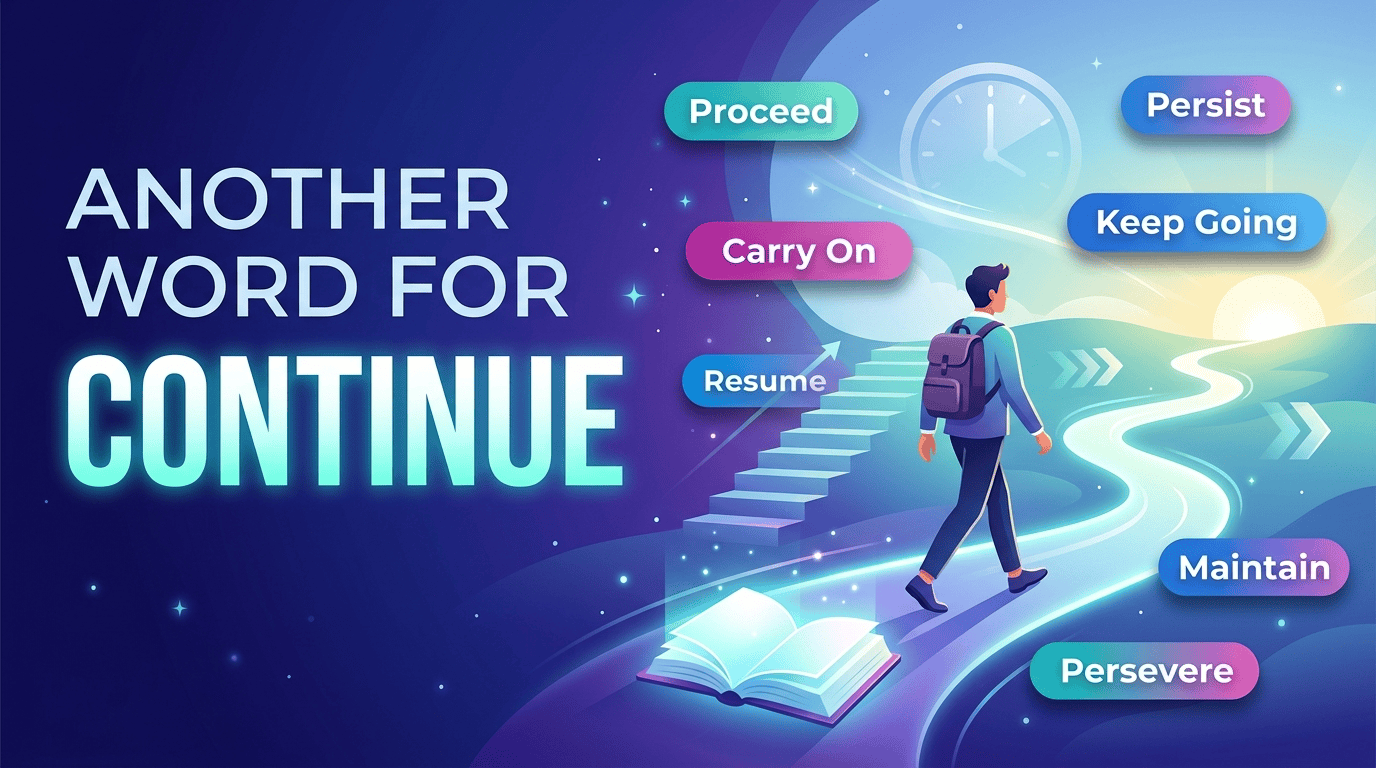
Other words for continue include proceed, carry on, persist, resume, maintain, keep going, advance, pursue, sustain, and go on.
The word continue means to keep doing something or to go on without stopping. We use it in daily conversations, schoolwork, emails, and professional writing. For example, a teacher may ask students to continue their work, or a friend may encourage someone to continue trying after a setback.
However, using the same word again and again can make writing sound repetitive. Learning synonyms for continue helps you express your ideas more clearly and choose words that fit different situations. Some alternatives describe starting again after a break, while others focus on making progress or refusing to give up. In this guide, you will learn 25 useful alternatives to continue, their meanings, example sentences, pronunciation, word history, and antonyms. These words will help you improve your vocabulary and make your English more natural.
1. What Does Continue Mean?
Continue is a verb that means to keep doing something, make something last longer, or carry on after a pause.
Examples:
- Please continue reading the story.
- The rain continued throughout the night.
2. Connotative Meaning of Continue
The word continue usually has a neutral meaning, but it can also suggest positive ideas such as patience, effort, and determination.
Positive use: She continued working toward her goal.
Negative use: The argument continued for hours.
Neutral use: The meeting will continue after lunch.
Its emotional meaning depends on the situation in which it is used.
3. Etymology of Continue
The word continue entered English through Old French continuer, which came from Latin continuare. The Latin word means to join together or make continuous. Over time, continue developed its modern meaning of keeping an action or condition going without interruption.
4. Pronunciation of Continue
Pronunciation: /kənˈtɪn.juː/
Syllables: con tin ue
Part of speech: Verb
The stress falls on the second syllable, “tin.”
5. Word Formation and Affixation
The word continue does not contain a common modern English prefix or suffix that can be easily removed to form its base.
Related forms include:
- Continued: Something that carried on or lasted.
- Continuing: Something that is still happening.
- Continuation: The act or process of carrying on.
- Continuity: The state of remaining connected or unbroken.
- Continuous: Happening without interruption.
6. 25 Other Words for Continue
1. Proceed
Part of speech: Verb
Meaning: To move forward or continue to the next step.
Examples:
- Please proceed to the next question.
- After the break, the class proceeded with the lesson.
2. Carry On
Part of speech: Phrasal verb
Meaning: To keep doing something.
Examples:
- Carry on with your homework.
- The players carried on despite the rain.
3. Persist
Part of speech: Verb
Meaning: To keep trying despite difficulties.
Examples:
- You should persist until you understand the topic.
- She persisted in learning English.
4. Resume
Part of speech: Verb
Meaning: To start again after a pause or interruption.
Examples:
- We will resume the lesson after lunch.
- The match resumed when the rain stopped.
5. Maintain
Part of speech: Verb
Meaning: To keep something at the same level or in the same condition.
Examples:
- Maintain your focus during the test.
- They maintained their efforts throughout the project.
6. Keep Going
Part of speech: Phrase
Meaning: To continue moving or making an effort.
Examples:
- Keep going until you finish the task.
- He kept going even when the work became difficult.
7. Advance
Part of speech: Verb
Meaning: To move forward or make progress.
Examples:
- The team advanced to the next round.
- She advanced her studies by reading more books.
8. Pursue
Part of speech: Verb
Meaning: To keep working toward a goal or interest.
Examples:
- He continued to pursue his dream.
- She pursued her interest in science.
9. Sustain
Part of speech: Verb
Meaning: To keep something going over time.
Examples:
- The team sustained its efforts throughout the season.
- Good habits can sustain your progress.
10. Go On
Part of speech: Phrasal verb
Meaning: To continue an action or activity.
Examples:
- Please go on with your explanation.
- The show went on despite the delay.
11. Persist in
Part of speech: Verb phrase
Meaning: To keep doing something, especially when it is difficult.
Examples:
- She persisted in practicing every day.
- He persisted in asking thoughtful questions.
12. Carry Forward
Part of speech: Phrasal verb
Meaning: To take an activity, idea, or plan into the next stage.
Examples:
- We will carry forward the lessons we learned.
- The new leader carried forward the project.
13. Extend
Part of speech: Verb
Meaning: To make something last longer.
Examples:
- The school extended the deadline.
- They decided to extend the discussion.
14. Last
Part of speech: Verb
Meaning: To continue for a period of time.
Examples:
- The meeting lasted two hours.
- The cold weather lasted all week.
15. Endure
Part of speech: Verb
Meaning: To continue through a difficult experience.
Examples:
- The hikers endured the cold weather.
- She endured many challenges while learning the skill.
16. Persevere
Part of speech: Verb
Meaning: To keep trying despite problems or delays.
Examples:
- Persevere when a subject seems difficult.
- He persevered until he completed the assignment.
17. Follow Through
Part of speech: Phrasal verb
Meaning: To complete an action or plan that you have started.
Examples:
- She followed through on her promise.
- You should follow through with your study plan.
18. Keep Up
Part of speech: Phrasal verb
Meaning: To maintain the same pace, level, or activity.
Examples:
- Keep up your daily reading habit.
- He worked hard to keep up with the class.
19. Carry On With
Part of speech: Phrasal verb
Meaning: To keep doing a particular activity.
Examples:
- She carried on with her research.
- They carried on with the preparations.
20. Remain
Part of speech: Verb
Meaning: To stay in the same state or condition.
Examples:
- Please remain seated until the bell rings.
- The question remained unanswered.
21. Stay
Part of speech: Verb
Meaning: To remain in a place or condition.
Examples:
- Stay focused on your goals.
- The shop stayed open until evening.
22. Develop Further
Part of speech: Verb phrase
Meaning: To continue improving or expanding something.
Examples:
- The writer developed the idea further.
- We need to develop our skills further.
23. Build On
Part of speech: Phrasal verb
Meaning: To use an existing idea or achievement as a starting point for further progress.
Examples:
- Build on what you learned yesterday.
- The team built on its earlier success.
24. Progress
Part of speech: Verb
Meaning: To move forward or improve over time.
Examples:
- The students progressed to harder exercises.
- Her reading skills progressed throughout the year.
25. Persist Through
Part of speech: Verb phrase
Meaning: To keep going despite a difficult period or experience.
Examples:
- The team persisted through a challenging season.
- He persisted through the difficult training period.
7. Are All These Words Exact Synonyms?
No. The best alternative depends on the meaning of continue in your sentence.
| Word | Best use |
| Proceed | Moving to the next step |
| Carry on | Keeping an activity going |
| Persist | Continuing despite difficulty |
| Resume | Starting again after a pause |
| Maintain | Keeping a level or condition |
| Extend | Making something last longer |
| Endure | Getting through a difficult experience |
| Follow through | Completing a planned action |
| Progress | Moving forward or improving |
| Build on | Developing an existing idea |
For example, you can resume a lesson after a break, but you would usually persist with a difficult task. These words are related, but they are not interchangeable in every sentence.
8. Prototype Meaning of Continue
The prototype meaning of continue is to keep an activity going without stopping.
For example, a student who keeps reading a book after finishing one page is continuing to read. This simple action represents the central meaning of the word.
9. Prototype Categorization
| Category | Examples |
| Continuing an activity | Carry on, go on, proceed |
| Starting again | Resume, restart |
| Making progress | Advance, progress |
| Showing determination | Persist, persevere |
| Keeping something stable | Maintain, sustain |
| Making something last longer | Extend, last |
| Completing a plan | Follow through, carry forward |
10. Antonyms of Continue
Antonyms are words with opposite meanings.
- Stop: To end an activity.
- Cease: To bring something to an end.
- Halt: To stop movement or progress.
- Finish: To complete something.
- End: To bring something to a close.
- Discontinue: To stop doing or providing something.
- Abandon: To give up an activity or plan.
- Interrupt: To break the flow of an activity.
- Pause: To stop temporarily.
- Quit: To stop doing something.
Note that pause and interrupt often describe temporary breaks, while finish and discontinue may describe a more complete ending.
11. Frequently Asked Questions
What is the most common synonym for continue?
Proceed and carry on are common alternatives. Proceed often means moving to the next step, while carry on means keeping an activity going.
What is a formal word for continue?
Proceed, maintain, and sustain can work in formal writing, depending on the sentence.
What is another word for continue after a break?
Resume is usually the best choice because it means to start again after a pause.
What is another word for continue trying?
Persist and persevere are good choices when someone keeps trying despite difficulties.
Is keep going the same as continue?
They often have similar meanings. Keep going is more conversational, while continue works in both casual and formal writing.
Conclusion
Learning alternatives to continue can make your writing clearer and more interesting. Words such as proceed, resume, maintain, and extend help you express specific meanings, while persist and persevere show determination. Carry on and go on are useful in everyday conversations, and follow through is helpful when talking about completing plans or promises.
Remember that synonyms do not always have exactly the same meaning. Choose a word that fits the action, situation, and tone of your sentence. With regular practice, you can use these alternatives naturally in school assignments, essays, emails, and daily conversations. Expanding your vocabulary will help you communicate your ideas with greater confidence and precision.

I’m Naz Fatima, a dedicated content writer with expertise in language, synonyms, and well-researched article writing.
My experience in creating clear, engaging, and informative content reflects my commitment to quality, accuracy, and reader value.










