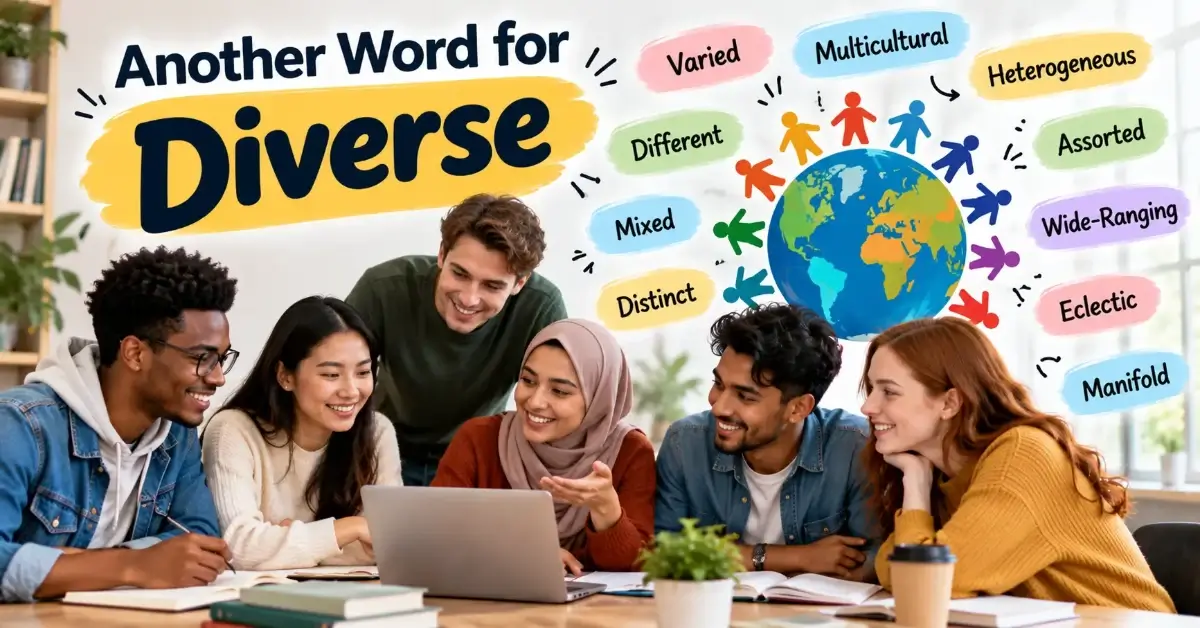
Snippet answer: Another word for diverse can be varied, different, mixed, assorted, wide-ranging, multicultural, heterogeneous, distinct, manifold, or eclectic. The best choice depends on the context.
Introduction
Diverse means made up of many different kinds, people, ideas, or features. Imagine a school where students come from many countries, speak different languages, and bring different traditions. That school has a diverse community. We use this word often when talking about people, cultures, ideas, products, experiences, and choices.
Learning another word for diverse helps English learners describe variety in a clearer way. It also helps writers avoid repeating the same adjective. Some alternatives focus on cultural variety, while others describe difference, range, or mixed types. This article explains the meaning of diverse and useful alternatives for it. You will also learn its grammar, history, pronunciation, word formation, examples, antonyms, and semantic categories.
Meaning of Diverse
Definition
Diverse (adjective): Made up of many different types, kinds, people, ideas, or qualities.
Examples
- The city has a diverse population.
- The company offers a diverse range of products.
Connotative Meaning
Positive tone: Diverse can suggest variety, inclusion, richness, and many useful perspectives.
Negative tone: In some contexts, it may suggest difficulty in bringing very different things together.
Neutral tone: It often simply means that several different types are present.
(Connotation: the extra feeling or idea that a word suggests beyond its basic meaning.)
Etymology
The word diverse has a long history linked to difference and variety.
- Old English (450–1100): The modern word diverse was not used in Old English.
- Middle English (1100–1500): Diverse entered English through Old French during the Middle English period. It meant different, various, or unlike.
- Modern English (1500–Present): The word kept the sense of difference and variety. It comes ultimately from Latin diversus, meaning “turned in different directions” or “different.”
Pronunciation (IPA)
- IPA: /daɪˈvɜːrs/ or /dɪˈvɜːrs/
- Syllables: di-verse
- Main stress: Second syllable
Affixation Pattern of Diverse
- Root: diverse
- Prefix: None in modern English
- Suffix: None in the basic borrowed form
Word Formations
- Diverse — adjective
- Diversely — adverb
- Diversity — noun
- Diversify — verb
- Diversified — adjective/verb
- Diversification — noun
- Diversifying — verb/gerund
30 Other Words for Diverse With Meaning & Examples
1. Varied (Adjective)
Meaning: Made up of many different types or forms.
Examples:
- The restaurant has a varied menu.
- She has varied interests.
2. Different (Adjective)
Meaning: Not the same as something else.
Examples:
- The group includes people from different backgrounds.
- We tried several different methods.
3. Mixed (Adjective)
Meaning: Made from different kinds of things or people.
Examples:
- The class has a mixed group of students.
- We ordered a mixed salad.
4. Assorted (Adjective)
Meaning: Made up of several different types.
Examples:
- The box contains assorted chocolates.
- She bought assorted flowers.
5. Wide-Ranging (Adjective)
Meaning: Covering many different subjects, areas, or types.
Examples:
- They discussed wide-ranging issues.
- Her work has wide-ranging effects.
6. Multicultural (Adjective)
Meaning: Including people or traditions from many cultures.
Examples:
- London is a multicultural city.
- The school held a multicultural festival.
7. Heterogeneous (Adjective)
Meaning: Made up of different kinds of people or things.
Examples:
- The sample was heterogeneous.
- The team is a heterogeneous group.
8. Distinct (Adjective)
Meaning: Clearly different from something else.
Examples:
- The two styles are distinct.
- Each region has a distinct culture.
9. Manifold (Adjective)
Meaning: Many and varied in form or type.
Examples:
- The project has manifold benefits.
- The causes of the problem are manifold.
10. Eclectic (Adjective)
Meaning: Made from ideas or styles chosen from many different sources.
Examples:
- She has an eclectic taste in music.
- The room has an eclectic design.
11. Multifarious (Adjective)
Meaning: Having many different kinds or forms.
Examples:
- The city offers multifarious activities.
- She handles multifarious duties.
12. Various (Adjective)
Meaning: Of several different kinds.
Examples:
- We looked at various options.
- The shop sells various products.
13. Numerous (Adjective)
Meaning: Existing in many forms or large numbers.
Examples:
- The plan has numerous benefits.
- We considered numerous ideas.
14. Broad (Adjective)
Meaning: Covering many types, areas, or subjects.
Examples:
- She has broad experience.
- The course covers a broad range of topics.
15. Inclusive (Adjective)
Meaning: Open to many different people or groups.
Examples:
- The company wants an inclusive workplace.
- The event was welcoming and inclusive.
16. Pluralistic (Adjective)
Meaning: Including many different beliefs, groups, or ways of life.
Examples:
- The country has a pluralistic society.
- The school supports a pluralistic approach.
17. Multinational (Adjective)
Meaning: Involving people, companies, or groups from many nations.
Examples:
- It is a multinational team.
- The firm runs a multinational project.
18. Multilingual (Adjective)
Meaning: Using or involving several languages.
Examples:
- The city has a multilingual population.
- She works in a multilingual office.
19. Cross-Cultural (Adjective)
Meaning: Involving or comparing different cultures.
Examples:
- The study is cross-cultural.
- They joined a cross-cultural exchange.
20. Motley (Adjective)
Meaning: Made up of very different people or things.
Examples:
- A motley crowd filled the room.
- They formed a motley team.
21. Variegated (Adjective)
Meaning: Showing many different types, forms, or colors.
Examples:
- The garden has a variegated look.
- The town has a variegated history.
22. Miscellaneous (Adjective)
Meaning: Made up of different things that do not fit one group.
Examples:
- The drawer contains miscellaneous items.
- She collected miscellaneous notes.
23. Composite (Adjective)
Meaning: Made from several different parts.
Examples:
- The report gives a composite picture.
- The material has a composite structure.
24. Multiplex (Adjective)
Meaning: Having many parts or elements.
Examples:
- The system has a multiplex structure.
- The problem has multiplex causes.
25. Kaleidoscopic (Adjective)
Meaning: Full of many changing colors, forms, or ideas.
Examples:
- The festival was kaleidoscopic.
- The book gives a kaleidoscopic view of city life.
26. Comprehensive (Adjective)
Meaning: Including many or all important parts.
Examples:
- The guide is comprehensive.
- They made a comprehensive plan.
27. Expansive (Adjective)
Meaning: Large in range, scope, or variety.
Examples:
- The museum has an expansive collection.
- She has an expansive knowledge of art.
28. Flexible (Adjective)
Meaning: Able to change or suit different needs.
Examples:
- We need a flexible approach.
- The system supports flexible choices.
29. Rich (Adjective)
Meaning: Full of many valuable details, ideas, or traditions.
Examples:
- The region has a rich culture.
- The book offers a rich mix of ideas.
30. Multidimensional (Adjective)
Meaning: Having many different aspects or features.
Examples:
- The issue is multidimensional.
- She created a multidimensional character.
Prototype Meaning
The prototype meaning of diverse is “made up of many different kinds.” When people hear the word, they often imagine a group with different people, ideas, cultures, styles, or choices. The main idea is variety rather than sameness.
Prototype Categorization
The 30 alternatives can be grouped by meaning. These categories help writers choose a word that fits the exact type of variety they want to describe.
- General variety: varied, different, mixed, assorted, various, numerous, and broad. These work in many everyday situations.
- Cultural and social variety: multicultural, pluralistic, multinational, multilingual, cross-cultural, and inclusive. These often describe people, communities, workplaces, or societies.
- Many forms or types: heterogeneous, manifold, multifarious, motley, variegated, and miscellaneous. These stress that several unlike elements are present.
- Wide scope: wide-ranging, comprehensive, and expansive. These fit topics, knowledge, plans, and collections.
- Blended or combined parts: composite, multiplex, and multidimensional. These describe things made from several parts or aspects.
- Style and richness: eclectic, kaleidoscopic, and rich. These work well for art, culture, music, design, and ideas.
- Difference and adaptability: distinct and flexible. These focus on clear difference or the ability to suit different needs.
Choosing by category helps writers avoid awkward substitutions. For example, multicultural fits a community, while assorted is better for objects or products.
Antonyms of Diverse
Uniform (Adjective)
- Meaning: The same in form, type, or appearance.
Similar (Adjective)
- Meaning: Almost the same in some way.
Identical (Adjective)
- Meaning: Exactly the same.
Homogeneous (Adjective)
- Meaning: Made up of things or people that are very similar.
Limited (Adjective)
- Meaning: Small in range, amount, or variety.
Narrow (Adjective)
- Meaning: Covering only a small range.
Same (Adjective)
- Meaning: Not different.
Consistent (Adjective)
- Meaning: Remaining similar in form, style, or quality.
Short Questions and Answers
What does diverse mean?
Diverse means made up of many different types, people, ideas, cultures, or features.
When should diverse be used?
Use diverse when you want to show that a group or thing contains many different kinds or qualities.
Is diverse positive or negative?
It is usually neutral or positive. It often suggests variety, richness, and inclusion. In some contexts, it may also suggest complexity.
How is it different from similar words?
Diverse is a broad word for variety. Varied stresses different types, multicultural focuses on cultures, heterogeneous is more formal, and eclectic often describes a mix of styles or influences.
Conclusion
Learning another word for diverse gives you more ways to describe variety, difference, and inclusion. Instead of repeating diverse, you can use words such as varied, mixed, multicultural, eclectic, or heterogeneous. Each word adds a slightly different meaning.
A wider vocabulary improves both writing and speaking. It also helps you avoid repetition and makes descriptions more exact. English learners can build confidence by noticing which words fit people, cultures, products, ideas, or styles. Writers can choose simple or formal alternatives to match the context. Try learning a few new words each day and use them in your own sentences. Regular practice will help these alternatives become a natural part of your English.

I am Zeeshan Shaukat professional content writer with a strong interest in language, vocabulary, and meaningful word choices. I create clear, engaging, and informative content that helps readers discover better words and express their ideas more effectively.










