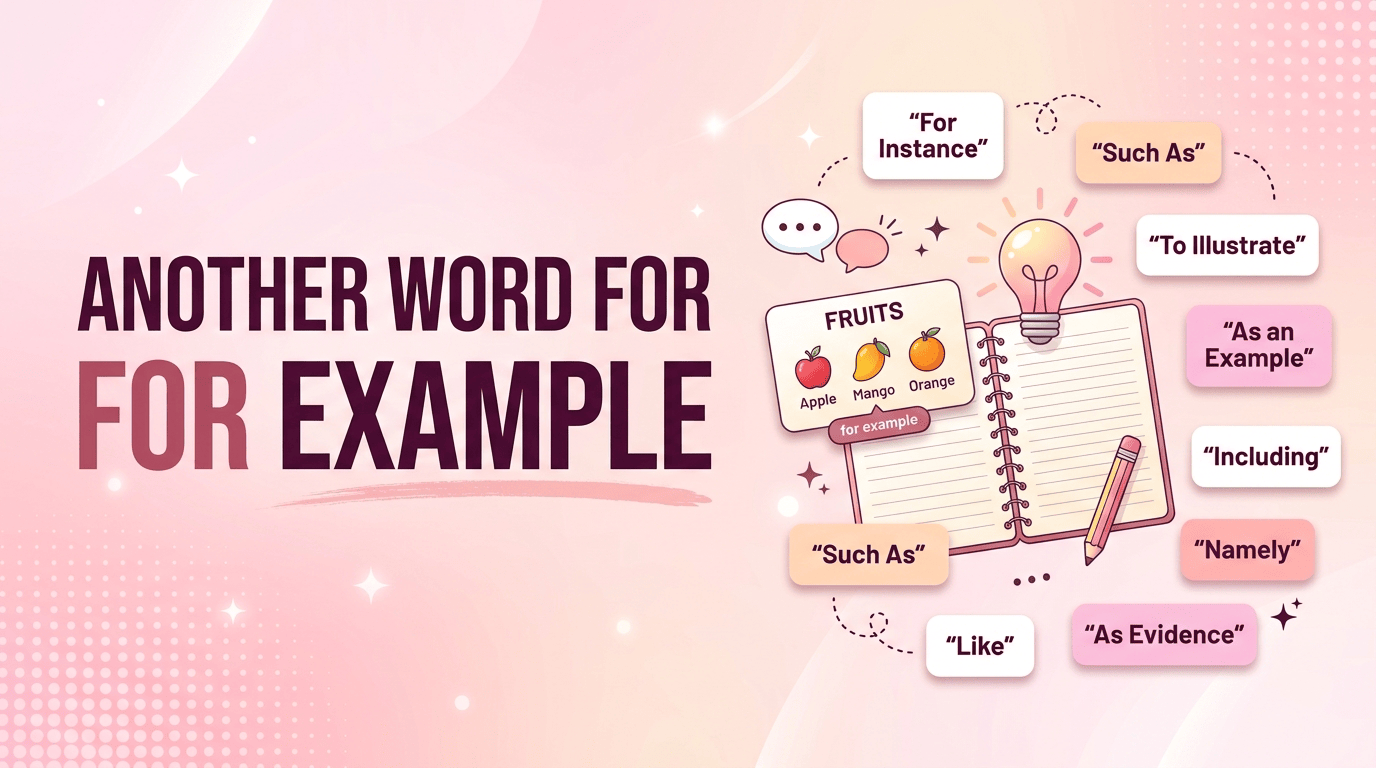
Use alternatives such as for instance, such as, namely, to illustrate, and as an example to introduce examples clearly.
The phrase for example is one of the most useful expressions in English. We use it when we want to give a specific example that explains or supports an idea. Students often use it in essays, assignments, presentations, and everyday conversations. However, repeating for example too often can make writing sound repetitive. Learning different alternatives can make your sentences smoother and more natural. Some expressions are formal, while others are better for casual speech. In this guide, you will learn the meaning, pronunciation, history, related forms, and 23 alternatives to “for example,” along with simple meanings and example sentences.
Meaning of For Example
Definition and Part of Speech
For example is an idiomatic phrase used to introduce a specific person, thing, fact, or situation that illustrates a general statement.
Examples:
- Many fruits contain vitamins; for example, oranges contain vitamin C.
- You can learn a new skill, for example, by taking an online course.
Connotative Meaning
The phrase for example has a neutral and explanatory connotation. It helps make an idea clearer by providing a specific illustration.
Etymology
The phrase for example is made from ordinary English words:
- For comes from Old English for, meaning “because of,” “for the purpose of,” or “in place of.”
- Example entered English through Old French example, from Latin exemplum, meaning “sample” or “model.”
- Modern English: The phrase for example became a standard way to introduce an illustration or instance.
Pronunciation
For example: /fər ɪɡˈzæmpəl/ in common American English.
Syllables: for ex-am-ple
Main stress: am
Affixation Pattern
For example is a fixed phrase rather than a single word, so it does not have a prefix-and-suffix pattern.
Related forms include:
- Example — noun
- Exemplify — verb
- Exemplary — adjective
- For example — introductory phrase
- For instance — synonymous introductory phrase
23 Other Ways to Say For Example
1. For Instance
Part of speech: Introductory phrase
Meaning: Used to introduce a specific example.
- Many animals are social, for instance, elephants.
- You can improve your vocabulary in many ways, for instance, by reading books.
2. Such As
Part of speech: Prepositional phrase
Meaning: Introduces examples from a larger group.
- I enjoy outdoor activities such as hiking and cycling.
- Fruits such as apples and bananas are easy to find.
3. As an Example
Part of speech: Introductory phrase
Meaning: Used to present something as an example.
- As an example, consider a student preparing for an exam.
- As an example, this diagram shows how the process works.
4. To Illustrate
Part of speech: Infinitive phrase
Meaning: Used to introduce something that makes an idea clearer.
- To illustrate, imagine a classroom with no books.
- To illustrate this point, consider the following situation.
5. By Way of Illustration
Part of speech: Formal phrase
Meaning: Used to provide an illustration of an idea.
- By way of illustration, consider this simple case.
- The teacher explained the concept by way of illustration.
6. Namely
Part of speech: Adverb
Meaning: Introduces specific details that identify or explain something.
- Two students were absent, namely, Ali and Hamza.
- We need one thing, namely, more time.
7. Specifically
Part of speech: Adverb
Meaning: Introduces exact or particular information.
- Some sports require special equipment, specifically, protective gear.
- She studies several subjects, specifically, biology and chemistry.
8. In Particular
Part of speech: Adverbial phrase
Meaning: Focuses attention on one specific example or item.
- I enjoy science, in particular, biology.
- Several skills are useful, in particular, communication.
9. As an Illustration
Part of speech: Phrase
Meaning: Introduces something used to explain an idea.
- As an illustration, look at the diagram below.
- As an illustration, this story shows the importance of teamwork.
10. To Give an Example
Part of speech: Phrase
Meaning: Directly introduces a specific example.
- To give an example, imagine a busy city street.
- To give an example, think about how plants respond to sunlight.
11. To Demonstrate
Part of speech: Infinitive phrase
Meaning: Introduces something that shows how an idea works.
- To demonstrate this idea, consider the following experiment.
- To demonstrate the problem, the teacher used a simple model.
12. As Evidence
Part of speech: Phrase
Meaning: Introduces a specific fact that supports a claim.
- As evidence, researchers provided several observations.
- As evidence, the report included detailed records.
13. Take
Part of speech: Informal introductory phrase
Meaning: Used to introduce a particular example.
- Take this situation: a student forgets their homework.
- Take online learning as an example.
14. Consider
Part of speech: Verb
Meaning: Introduces something that can help explain an idea.
- Consider the case of a small business.
- Consider a student who studies every evening.
15. For One
Part of speech: Phrase
Meaning: Introduces one example supporting a statement.
- For one, many students enjoy group activities.
- There are many benefits; for one, it saves time.
16. One Example Is
Part of speech: Sentence phrase
Meaning: Directly presents one specific example.
- One example is the use of solar energy.
- One example is how plants produce food.
17. An Example Is
Part of speech: Sentence phrase
Meaning: Introduces a specific instance.
- An example is the way birds migrate.
- An example is a student practicing every day.
18. To Name One
Part of speech: Idiomatic phrase
Meaning: Gives one example from a larger group.
- There are many famous scientists, to name one, Marie Curie.
- Several languages are widely spoken, to name one, English.
19. Among Them
Part of speech: Prepositional phrase
Meaning: Highlights one or more examples from a previously mentioned group.
- Several countries participated, among them Pakistan.
- Many animals live there, among them elephants.
20. Including
Part of speech: Preposition/participle
Meaning: Introduces examples that are part of a larger group.
- I enjoy many sports, including football and cricket.
- The box contains several tools, including a hammer.
21. In Other Words
Part of speech: Discourse phrase
Meaning: Restates an idea more simply; it is not always a direct synonym for “for example.”
- The task is difficult; in other words, it requires patience.
- The rule is flexible; in other words, it allows some changes.
22. To Put It Another Way
Part of speech: Discourse phrase
Meaning: Restates an idea using different words.
- To put it another way, practice makes the skill stronger.
- To put it another way, the plan needs more preparation.
23. As a Case in Point
Part of speech: Idiomatic phrase
Meaning: Introduces a particular case that clearly supports an idea.
- As a case in point, the recent project succeeded through teamwork.
- As a case in point, this example shows why preparation matters.
Important: These alternatives are not perfectly interchangeable. For instance and as an example are direct alternatives. Such as normally appears before examples in a sentence, while namely introduces specific details. In other words and to put it another way usually restate an idea rather than give an example.
Prototype Meaning
The prototype meaning of for example is “here is a specific case that helps explain the general idea.”
For example:
Many activities improve fitness; for example, walking and cycling.
The phrase connects the general statement with specific examples.
Prototype Categorization
| Function | Alternatives |
| Direct examples | For instance, as an example, to give an example |
| Introducing examples in a list | Such as, including, among them |
| Explaining a specific case | To illustrate, as an illustration, consider |
| Giving exact details | Namely, specifically, in particular |
| Formal illustration | By way of illustration, as a case in point |
| Restating ideas | In other words, to put it another way |
This helps you select the right phrase based on what you are trying to do.
Antonyms and Contrasting Expressions
Because for example is a linking phrase rather than a word describing an object, it does not have a true antonym. However, these expressions can serve contrasting purposes:
In General
Used to discuss a broad idea rather than a specific example.
Generally Speaking
Used when making a broad statement.
Overall
Used to summarize the main idea instead of giving a particular example.
Without Specific Examples
Used when information is discussed generally rather than illustrated with individual cases.
Short Questions and Answers
What is another word for “for example”?
For instance is the closest direct alternative.
What can I use instead of “for example” in an essay?
You can use for instance, such as, to illustrate, namely, or specifically, depending on the sentence.
Is “such as” the same as “for example”?
They can introduce examples, but their grammar differs. Such as usually comes directly before examples.
Is “for instance” formal?
Yes. For instance works well in both formal and everyday English.
What is a formal alternative to “for example”?
To illustrate, namely, and by way of illustration can work in formal writing.
Can I use “e.g.” instead of “for example”?
Yes. e.g. is a written abbreviation of the Latin phrase exempli gratia, meaning “for example.”
Conclusion
Using different alternatives for for example can make your writing more varied and precise. For instance is the closest everyday replacement, while such as is useful when listing examples. In formal writing, phrases such as to illustrate, namely, and specifically can provide a clearer connection between an idea and its supporting details. Other expressions, such as consider and as a case in point, work well when introducing a particular situation. Remember that these expressions have slightly different grammatical uses, so choose one that fits your sentence. Practicing them in essays, school assignments, presentations, and conversations can help you communicate ideas more naturally and confidently.

I’m Naz Fatima, a dedicated content writer with expertise in language, synonyms, and well-researched article writing.
My experience in creating clear, engaging, and informative content reflects my commitment to quality, accuracy, and reader value.










