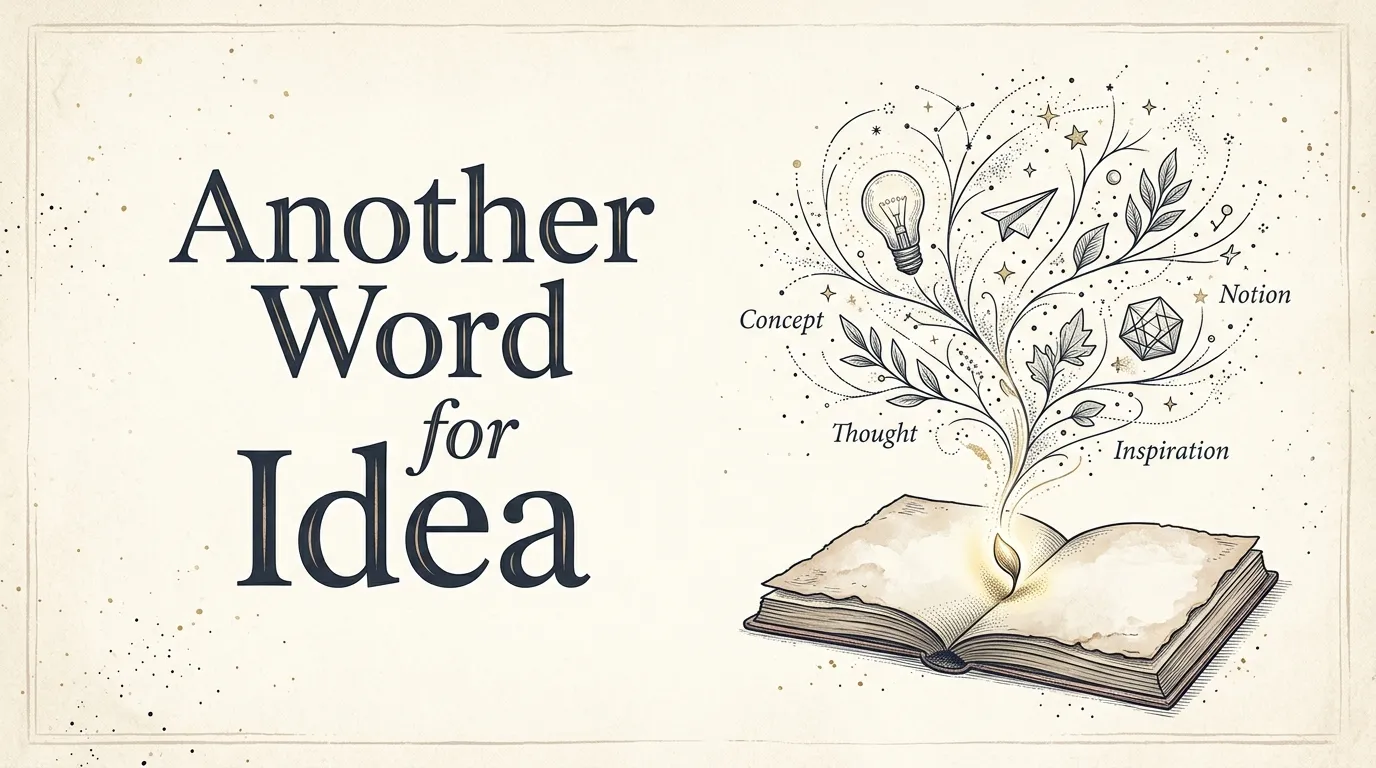
Another word for idea is thought, concept, notion, suggestion, belief, opinion, proposal, insight, theory, or plan. The best synonym depends on the context. Use “concept” for an abstract understanding, “suggestion” for a possible action, “insight” for a deeper understanding, and “proposal” for a plan presented for consideration.
The word “idea” is one of the most common words in English. We use it when sharing thoughts, suggesting solutions, explaining opinions, or planning something new. However, using the same word repeatedly can make your writing sound less varied.
Learning another word for idea can help you communicate more clearly and express your thoughts with greater precision. For example, “concept” works well when discussing an abstract principle, while “suggestion” is useful when offering advice. Similarly, “insight” describes a deeper understanding, and “proposal” refers to a plan presented for consideration.
In this guide, you will discover 27 synonyms for “idea,” with simple meanings and example sentences. You will also learn how to use these alternatives in everyday conversations, academic writing, and professional communication.
What Does “Idea” Mean?
An idea is a thought, concept, belief, or mental picture that forms in someone’s mind. It can be a suggestion, a possible solution, an opinion, or a plan for doing something.
Examples:
- I have an idea for our school project.
- Her idea helped us solve the problem.
- He shared an interesting idea during the meeting.
Connotation of “Idea”
Connotation refers to the feelings or associations connected to a word beyond its basic meaning.
The word “idea” is generally neutral. It can describe something creative, practical, uncertain, or even unrealistic, depending on the context.
- Positive: “She came up with a brilliant idea.”
- Negative: “That idea could create more problems.”
- Neutral: “I understand your idea.”
Etymology of “Idea”
The word “idea” entered English through Latin idea and Old French, ultimately coming from the ancient Greek word idéa, meaning “form,” “pattern,” or “appearance.” The Greek term is associated with the verb idein, meaning “to see.”
Over time, “idea” developed into a word for something understood or imagined by the mind. Today, it can refer to anything from a simple thought to an abstract philosophical concept.
Pronunciation of “Idea”
- IPA: /aɪˈdiːə/
- Syllables: i-de-a (three syllables)
- Stress: The second syllable, “dee,” receives the main stress.
Example: “Her idea was simple but effective.”
Affixation Pattern of “Idea”
The word “idea” does not commonly form new words by adding ordinary English prefixes or suffixes directly. However, several related words are built from the same base.
- Base word: Idea
- Suffix: -al forms “ideal,” an adjective or noun with a related historical origin.
- Suffix: -ism forms “idealism,” a belief or philosophy emphasizing ideals.
- Suffix: -ist forms “idealist,” a person who follows or supports idealism.
- Related word: Ideation the process of forming ideas.
- Related word: Ideational relating to ideas or the process of thinking.
These forms appear in academic, psychological, and professional contexts.
27 Synonyms With Meanings and Examples
1. Thought (Noun)
Meaning: Something that comes into your mind through thinking or reflection.
Examples:
- I had a thought about improving our project.
- Her thoughtful ideas helped the group.
2. Concept (Noun)
Meaning: A general or abstract understanding of something.
Examples:
- The teacher explained the concept clearly.
- Their business concept attracted attention.
3. Notion (Noun)
Meaning: A belief, understanding, or thought about something, sometimes without strong evidence.
Examples:
- He had a strange notion about success.
- The notion of fairness is important in society.
4. Suggestion (Noun)
Meaning: An idea offered for someone to consider.
Examples:
- She made a useful suggestion during the meeting.
- Your suggestion could improve the plan.
5. Belief (Noun)
Meaning: Something that a person accepts as true.
Examples:
- Her belief in education shaped her decisions.
- Many people share the belief that practice improves skills.
6. Opinion (Noun)
Meaning: A personal judgment or view about something.
Examples:
- In my opinion, this is the best solution.
- Everyone shared an opinion about the new rule.
7. Proposal (Noun)
Meaning: A plan or idea presented for others to consider.
Examples:
- The team submitted a proposal for the new project.
- Her proposal received support from the committee.
8. Insight (Noun)
Meaning: A clear or deep understanding of a person, problem, or subject.
Examples:
- The discussion gave us new insight into the issue.
- His insight helped the team make a better decision.
9. Theory (Noun)
Meaning: An explanation or set of principles intended to explain something.
Examples:
- She developed a theory about the results.
- The scientist tested the theory through experiments.
10. Plan (Noun)
Meaning: An arrangement of actions intended to achieve a goal.
Examples:
- We made a plan for the school event.
- His plan helped everyone work together.
11. Hypothesis (Noun)
Meaning: A proposed explanation that can be tested or investigated.
Examples:
- The students formed a hypothesis before the experiment.
- The results supported part of her hypothesis.
12. Viewpoint (Noun)
Meaning: A particular way of thinking about or understanding something.
Examples:
- She explained the issue from a different viewpoint.
- His viewpoint changed after the discussion.
13. Perspective (Noun)
Meaning: A way of looking at or understanding a situation.
Examples:
- Travel gave him a broader perspective.
- Try to understand the problem from her perspective.
14. Inspiration (Noun)
Meaning: A person, experience, or thought that encourages creativity or action.
Examples:
- Nature was the inspiration for her painting.
- The teacher’s words gave me inspiration for my essay.
15. Brainwave (Noun)
Meaning: A sudden, clever idea or solution.
Examples:
- She had a brainwave about how to organize the event.
- His brainwave saved the team a lot of time.
16. Insightfulness (Noun)
Meaning: The quality of showing a deep understanding of something.
Examples:
- The insightfulness of her comments impressed the class.
- His insightfulness helped reveal the main issue.
Note: “Insight” is usually the more natural synonym when referring to a specific idea or understanding.
17. Intuition (Noun)
Meaning: An understanding or feeling that arises without deliberate reasoning.
Examples:
- Her intuition told her to check the figures again.
- He trusted his intuition when making the choice.
18. Impression (Noun)
Meaning: An idea or opinion formed about someone or something.
Examples:
- My first impression was that the task would be easy.
- She gained the impression that the meeting went well.
19. Assumption (Noun)
Meaning: Something accepted as true without complete proof.
Examples:
- We should not make an assumption without checking the facts.
- His assumption about the schedule was incorrect.
20. Interpretation (Noun)
Meaning: An explanation of the meaning of something.
Examples:
- Her interpretation of the poem was interesting.
- Different readers may offer different interpretations.
21. Vision (Noun)
Meaning: A picture of a desired future or an ambitious goal.
Examples:
- The founder had a clear vision for the company.
- Her vision inspired the entire team.
22. Strategy (Noun)
Meaning: A carefully planned approach to achieve a particular goal.
Examples:
- We discussed a strategy for improving our results.
- Their strategy helped them complete the project on time.
23. Approach (Noun)
Meaning: A particular way of dealing with a task or problem.
Examples:
- We tried a different approach to the assignment.
- Her approach made the process easier.
24. Solution (Noun)
Meaning: An answer or method that solves a problem.
Examples:
- The group came up with a creative solution.
- We need a practical solution to this challenge.
25. Observation (Noun)
Meaning: A remark or conclusion based on noticing something.
Examples:
- His observation helped explain the result.
- She shared an important observation about the experiment.
26. Premise (Noun)
Meaning: A statement or assumption on which an argument or line of reasoning is based.
Examples:
- The argument depends on a questionable premise.
- The story begins with the premise that everyone has a hidden talent.
27. Brainstorm (Noun)
Meaning: A spontaneous or creative idea, or a group discussion aimed at generating ideas.
Examples:
- We had a brainstorm about the campaign design.
- The class held a brainstorm to find possible solutions.
Prototype Meaning of “Idea”
A prototype is the clearest or most typical example of a category.
The prototype meaning of “idea” is a thought or mental concept that a person forms or shares.
For example, thinking of a new way to organize a classroom is an idea. Suggesting a different method for solving a maths problem is also an idea. These examples represent the everyday meaning of the word.
Other synonyms describe more specific types of ideas. A “hypothesis” is an explanation that can be tested, a “proposal” is presented for consideration, and an “opinion” expresses a personal view. Recognizing these differences helps you choose words that communicate your meaning accurately.
Prototype Categorization of “Idea”
Synonyms for “idea” can be grouped according to their purpose and meaning.
1. General Thoughts and Concepts
These words describe mental thoughts or broad understandings.
- Thought
- Concept
- Notion
- Impression
2. Suggestions and Plans
These words describe ideas intended to guide action.
- Suggestion
- Proposal
- Plan
- Approach
- Strategy
3. Beliefs and Personal Views
These words describe what people think or accept as true.
- Belief
- Opinion
- Viewpoint
- Perspective
- Assumption
4. Explanations and Understanding
These words describe ways of explaining or understanding something.
- Insight
- Theory
- Hypothesis
- Interpretation
- Premise
- Observation
5. Creative and Future-Focused Ideas
These words are useful when discussing creativity, possibilities, and goals.
- Brainwave
- Inspiration
- Vision
- Brainstorm
- Solution
Antonyms of “Idea”
The word “idea” does not have one exact antonym in every context. However, the following words can express contrasting concepts.
1. Ignorance (Noun)
Meaning: A lack of knowledge or information.
Example: Ignorance of the rules led to confusion.
2. Confusion (Noun)
Meaning: A lack of clarity or understanding.
Example: The unclear instructions caused confusion.
3. Reality (Noun)
Meaning: The actual state of things, rather than a thought or imagined possibility.
Example: The reality was different from what we expected.
4. Fact (Noun)
Meaning: Something that is known or demonstrated to be true, rather than merely suggested as an idea.
Example: We need facts to support our idea.
5. Silence (Noun)
Meaning: The absence of speech or expressed thoughts.
Example: After the question, the room fell into silence.
Note: These words are contextual contrasts, not direct antonyms in every sentence.
Frequently Asked Questions
What is another word for idea?
Common alternatives include thought, concept, notion, suggestion, and perspective. The right word depends on what you want to express.
What is a formal word for idea?
“Concept,” “proposal,” “hypothesis,” and “premise” can be suitable in formal writing. For example, “The researcher tested the hypothesis.”
What is another word for a good idea?
You can say “brilliant idea,” “excellent suggestion,” “creative concept,” or “promising proposal,” depending on the context.
What is another word for idea in academic writing?
“Concept,” “hypothesis,” “theory,” and “premise” are common academic alternatives. Each has a distinct meaning, so choose carefully.
What is the difference between an idea and a concept?
An “idea” can be any thought or suggestion. A “concept” is usually a more general or abstract understanding of something.
What is the difference between an idea and an opinion?
An idea may be a thought, plan, or suggestion. An opinion is a personal judgment or view about something.
Conclusion
Learning another word for idea can improve your vocabulary and help you express your thoughts with greater accuracy. Words such as “thought,” “concept,” “suggestion,” and “insight” are useful alternatives, but they serve different purposes. Use “proposal” when presenting a plan, “hypothesis” when describing a testable explanation, and “perspective”
when discussing a particular way of viewing something. For creative writing, “inspiration” or “brainwave” may be more suitable. The key is to choose a word that matches your meaning and audience. With regular practice, you can make your conversations, essays, and professional writing clearer and more engaging.
Another Word for Established: 25 Useful Alternatives

I’m Mubashra Waleed, a content writer specializing in English vocabulary, synonyms, word meanings. I focus on creating clear, accurate, and engaging content that makes English language learning simple and useful for readers.