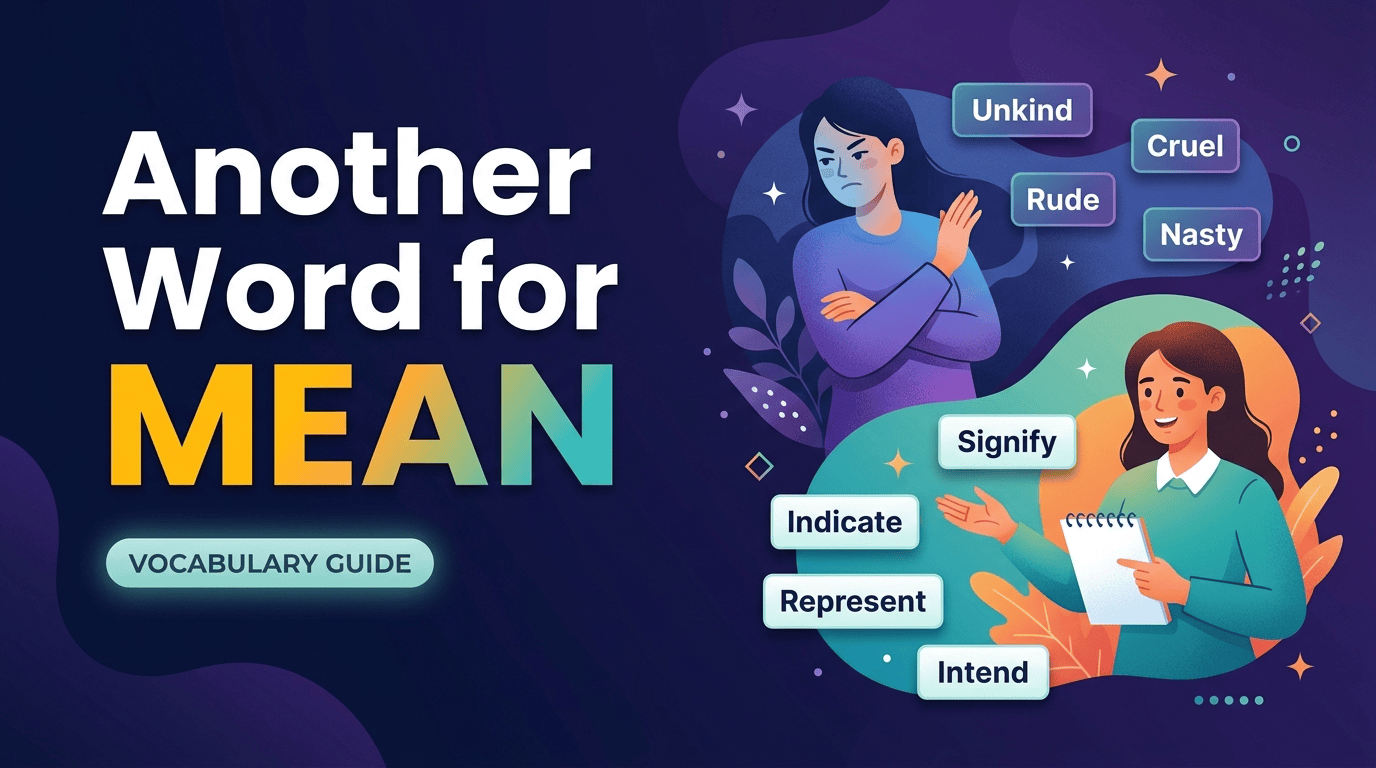
Signify, indicate, imply, intend, represent, denote, refer to, express, cruel, unkind, nasty, harsh, spiteful, malicious, average, ordinary, intend to say, suggest, convey, symbolize, stand for, involve.
What Does Mean Mean?
The word mean has several different meanings in English. It can describe what something signifies, what someone intends, or a person’s unkind behavior. In mathematics, mean can also refer to the average of a group of numbers.
For example, in “What does this word mean?”, mean refers to signify. In “I didn’t mean to hurt you,” it refers to intend. In “He was mean to his brother,” it describes unkind behavior.
Because of these different meanings, the best alternative depends on the sentence.
Examples
- What does this symbol mean?
- She didn’t mean to upset anyone.
- He was mean to his classmates.
- The mean of 4, 6, and 8 is 6.
Connotative Meaning of Mean
Connotation is the feeling or idea associated with a word beyond its basic meaning.
| Use of “mean” | Connotation |
| Signify | Neutral |
| Intend | Usually neutral |
| Unkind | Negative |
| Average | Neutral |
Etymology of Mean
The word mean comes from different historical sources because its modern meanings developed from more than one word.
The verb mean, meaning “intend” or “signify,” comes from Old English mænan. The adjective mean, meaning “low, inferior, or poor,” has a different history and developed through Middle English. The mathematical sense of mean developed from the idea of something being intermediate or average.
Pronunciation
IPA: /miːn/
Syllables: mean
Part of speech: Verb, adjective, and noun
Word Formation
Related forms include:
- Mean — verb/adjective/noun
- Meant — past tense and past participle
- Meaning — noun / present participle
- Meanings — plural noun
- Meanly — adverb, uncommon
22 Other Words for Mean
1. Signify
Part of speech: Verb
To have a particular meaning or represent an idea.
- What does this word signify?
- The symbol signifies peace.
2. Indicate
Part of speech: Verb
To show, point to, or suggest something.
- The results indicate a change.
- A red light indicates danger.
3. Imply
Part of speech: Verb
To suggest an idea without stating it directly.
- His words implied that he was unhappy.
- The message implies something important.
4. Intend
Part of speech: Verb
To have a particular purpose or plan.
- I didn’t intend to offend you.
- She intended to call later.
5. Represent
Part of speech: Verb
To stand for or symbolize something.
- The dove represents peace.
- This color represents hope.
6. Denote
Part of speech: Verb
To directly indicate or refer to something.
- The word denotes a specific type of plant.
- This mark denotes the beginning of a new section.
7. Refer To
Part of speech: Phrasal verb
To describe or point to something.
- What does this word refer to?
- The term refers to a specific process.
8. Express
Part of speech: Verb
To communicate an idea, feeling, or thought.
- Her words expressed gratitude.
- The painting expresses sadness.
9. Convey
Part of speech: Verb
To communicate or make an idea or feeling understood.
- His tone conveyed confidence.
- The image conveys a sense of peace.
10. Suggest
Part of speech: Verb
To communicate an idea indirectly.
- Her expression suggested concern.
- The evidence suggests a different answer.
11. Symbolize
Part of speech: Verb
To represent an idea, quality, or concept.
- The heart symbolizes love.
- The flag symbolizes national identity.
12. Stand For
Part of speech: Phrasal verb
To represent or have a particular meaning.
- What does this abbreviation stand for?
- The letters stand for a longer phrase.
13. Cruel
Part of speech: Adjective
Causing pain or showing a lack of kindness.
- It was cruel to laugh at him.
- The character was cruel to others.
14. Unkind
Part of speech: Adjective
Not friendly, caring, or considerate.
- That was an unkind comment.
- She regretted her unkind words.
15. Nasty
Part of speech: Adjective
Unpleasant, rude, or unkind.
- He made a nasty remark.
- That was a nasty thing to say.
16. Harsh
Part of speech: Adjective
Severe, critical, or unpleasant.
- His words sounded harsh.
- The criticism was harsh.
17. Spiteful
Part of speech: Adjective
Wanting to hurt or upset someone because of anger or resentment.
- His comment was spiteful.
- She ignored the spiteful remark.
18. Malicious
Part of speech: Adjective
Intending to cause harm or trouble.
- The message was malicious.
- Someone spread a malicious rumor.
19. Average
Part of speech: Noun / Adjective
A mathematical value found by adding numbers and dividing by their count.
- The mean, or average, of 10 and 20 is 15.
- The class average was high.
20. Ordinary
Part of speech: Adjective
Normal or not unusual.
- It was an ordinary day.
- The object looked ordinary.
21. Involve
Part of speech: Verb
To include something as a necessary part or consequence.
- The job means working late sometimes.
- Moving house can mean making many changes.
22. Involve or Entail
Part of speech: Verb
To include something as part of a situation or activity.
- This job entails working with children.
- The project involves careful planning.
Important: These alternatives are not interchangeable in every sentence. Signify, denote, and represent usually relate to meaning; intend relates to purpose; cruel, unkind, and malicious describe behavior; and average is used for the mathematical meaning.
Prototype Meaning of Mean
The most common meanings of mean can be grouped into three main ideas:
To Signify
What does this word mean?
Here, mean means signify or refer to.
To Intend
I mean to help you.
Here, mean means intend.
To Be Unkind
He was mean to me.
Here, mean means unkind or cruel.
Categories of Mean
| Meaning | Useful Alternatives |
| Have a meaning | signify, denote, represent |
| Show an idea | indicate, suggest, imply |
| Have an intention | intend, plan |
| Communicate | express, convey |
| Represent | symbolize, stand for |
| Unkind behavior | cruel, unkind, nasty |
| Harmful intention | spiteful, malicious |
| Mathematical meaning | average |
Antonyms of Mean
Kind
Part of speech: Adjective
Caring, friendly, and considerate.
- She was kind to everyone.
Generous
Part of speech: Adjective
Willing to give or share freely.
- He is generous with his time.
Friendly
Part of speech: Adjective
Pleasant and kind toward others.
- The teacher was friendly and helpful.
Benevolent
Part of speech: Adjective
Showing kindness and a desire to help others.
- The organization provided benevolent support.
Common Questions
What is another word for mean when asking for a definition?
Use signify, denote, represent, or refer to.
What is another word for mean when talking about intention?
Use intend, plan, or aim.
What is another word for mean when describing a person?
Use unkind, cruel, nasty, harsh, or spiteful, depending on the situation.
What is another word for mean in math?
Average is the common alternative.
Is “mean” and “signify” the same?
They can be similar when discussing the meaning of a word, symbol, or idea. However, signify is more formal.
Conclusion
The word mean is unusual because it has several completely different uses. When it refers to meaning, words such as signify, denote, represent, and indicate can work well. When it refers to intention, intend is usually the best alternative. When it describes unkind behavior, words such as cruel, unkind, harsh, and spiteful may be more precise. In mathematics, average is the common alternative. Understanding the context allows you to choose the right synonym and make your English more accurate and natural.
SEO Meta Description:
Find another word for mean with 22 useful alternatives for meaning, intention, unkind behavior, and math, including signify, intend, cruel, and average.

I’m Naz Fatima, a dedicated content writer with expertise in language, synonyms, and well-researched article writing.
My experience in creating clear, engaging, and informative content reflects my commitment to quality, accuracy, and reader value.