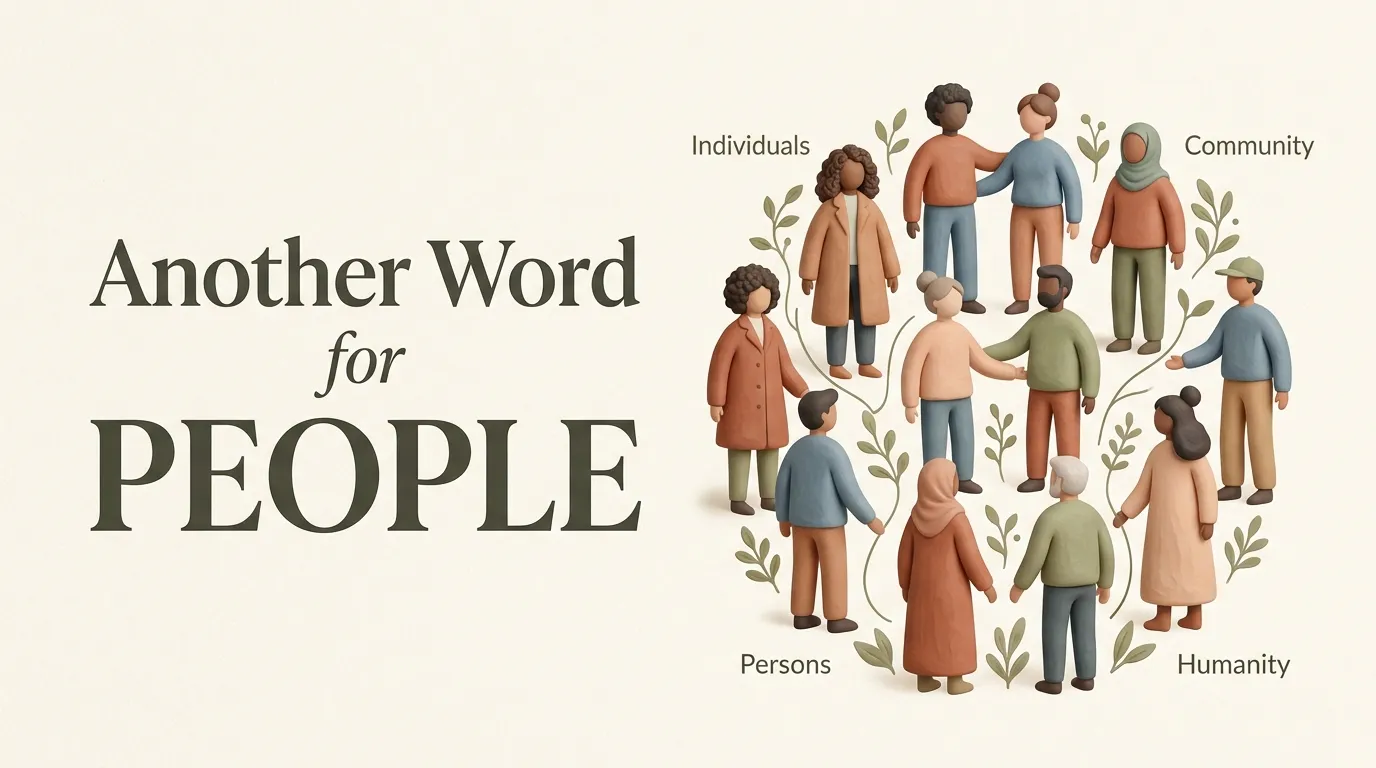
Common alternatives for people include:
- Individuals
- Persons
- Humans
- Human beings
- Population
- Community
- Citizens
- Residents
- Society
- Folks
The best alternative depends on the context. For example, individuals suits formal writing, residents refers to people who live in a place, and community describes people connected by a shared place or interest.
People are part of our daily lives. We meet people at school, work, shops, and public places. We also write about people in essays, stories, reports, and online content. The word people is common because it refers to human beings as a group or in general. However, using the same word again and again can make writing sound dull.
Learning another word for people helps English learners grow their vocabulary and express ideas more clearly. It also helps content writers choose words that fit their topic and audience.
In this guide, we will explore the meaning of people, its grammar, history, pronunciation, and related words. You will also learn 30 alternatives, with simple meanings and examples, to help you speak and write with confidence.
Meaning of People
Definition
People (Plural Noun): Human beings considered as a group or as individuals.
Examples
- Many people visit this park every day.
- People need food, water, and shelter.
Connotative Meaning
Connotation (the feeling or idea a word suggests beyond its basic meaning) depends on how people is used.
- Positive tone: “The people of this town are kind.” This suggests warmth and unity.
- Negative tone: “People can be careless.” This expresses criticism of human behavior.
- Neutral tone: “Many people work in this building.” This simply gives information.
Etymology
The word people comes through Old French pople or peuple, from Latin populus, meaning “a people,” “a nation,” or “a population.” It entered English through French after the Norman Conquest.
- Old English (450–1100): People was not a common native Old English word. Old English used words such as folc, meaning “folk” or “people.”
- Middle English (1100–1500): Forms such as peple became common through Anglo-Norman and Old French influence.
- Modern English (1500–Present): People became the standard plural form of person in most everyday uses. It can refer to a group, a nation, or humanity in general.
Pronunciation (IPA)
- IPA: /ˈpiːpəl/
- Syllables: peo-ple (2 syllables)
Affixation Pattern of People
- Root: People, from Old French pople/peuple and Latin populus.
- Prefix: No common prefix is added to form the standard word people.
- Suffix: The ending -s is not added in the usual plural form; people is already plural in its common meaning.
Word Formations and Related Words
- Person (noun): One human being.
- People (plural noun): Human beings as a group.
- Peoples (plural noun): Different ethnic, national, or cultural groups.
- Personhood (noun): The state or quality of being a person.
- Personal (adjective): Related to an individual person.
- Personally (adverb): In a way that relates to oneself or one’s own view.
- Personality (noun): The qualities that make someone who they are.
- Personify (verb): To give human qualities to something.
- Personification (noun): The act or literary device of giving human qualities to something.
30 Other Words With Meaning and Examples
Some words below are close synonyms, while others fit only certain situations. Choose the word that matches your meaning.
1. Individuals (Noun)
Meaning: Separate people considered one by one.
Examples:
- Each individual has different goals.
- The survey included 100 individuals.
2. Persons (Noun)
Meaning: People, often used in formal or legal language.
Examples:
- Only three persons were in the room.
- Missing persons were reported to the police.
3. Humans (Noun)
Meaning: Human beings as a species.
Examples:
- Humans need sleep to stay healthy.
- Humans have learned to use many tools.
4. Human Beings (Noun Phrase)
Meaning: Members of the human species.
Examples:
- Human beings need social contact.
- All human beings deserve respect.
5. Folks (Noun)
Meaning: People, especially in a friendly or informal way.
Examples:
- The folks next door are very kind.
- Hi, folks! Thanks for coming.
6. Population (Noun)
Meaning: All the people who live in a place or belong to a group.
Examples:
- The city’s population is growing.
- Most of the population lives near the coast.
7. Community (Noun)
Meaning: People who live in the same area or share an interest.
Examples:
- The community worked together to clean the park.
- Our online community shares useful advice.
8. Citizens (Noun)
Meaning: People who legally belong to a country or state.
Examples:
- Citizens voted in the election.
- The law protects the rights of citizens.
9. Residents (Noun)
Meaning: People who live in a particular place.
Examples:
- Local residents use this road every day.
- The building has 80 residents.
10. Society (Noun)
Meaning: People living together within an organized social system.
Examples:
- Education plays an important role in society.
- Society changes over time.
11. The Public (Noun Phrase)
Meaning: People in general, especially as members of a community or audience.
Examples:
- The public needs clear information.
- The museum is open to the public.
12. Humanity (Noun)
Meaning: All human beings considered as one group.
Examples:
- Humanity has made great scientific progress.
- Kindness can bring hope to humanity.
13. Mankind (Noun)
Meaning: Humankind or all human beings; sometimes considered gendered or old-fashioned.
Examples:
- The discovery changed the course of mankind.
- Many inventions have improved life for mankind.
14. Humankind (Noun)
Meaning: All human beings collectively.
Examples:
- Humankind has explored much of the planet.
- Peace is an important goal for humankind.
15. Folk (Noun)
Meaning: People in general, often in a traditional or informal context.
Examples:
- Local folk know the history of this village.
- The story was passed down by country folk.
16. Groups (Noun)
Meaning: Collections of people considered together.
Examples:
- Several groups joined the meeting.
- The teacher divided the people into small groups.
17. Crowds (Noun)
Meaning: Large numbers of people gathered together.
Examples:
- Crowds filled the streets.
- Large crowds watched the parade.
18. Audiences (Noun)
Meaning: Groups of people who watch, listen to, or read something.
Examples:
- The show attracted large audiences.
- Writers should understand their audiences.
19. Participants (Noun)
Meaning: People who take part in an activity or event.
Examples:
- All participants received a certificate.
- The participants shared their ideas.
20. Members (Noun)
Meaning: People who belong to a group, club, or organization.
Examples:
- Club members meet every Friday.
- All members must follow the rules.
21. Attendees (Noun)
Meaning: People who attend an event or meeting.
Examples:
- Attendees received name tags.
- The conference welcomed hundreds of attendees.
22. Guests (Noun)
Meaning: People invited to visit or attend an event.
Examples:
- The guests arrived before dinner.
- The hotel offers free breakfast to its guests.
23. Visitors (Noun)
Meaning: People who go to a place for a short time.
Examples:
- Visitors must sign in at reception.
- The park welcomes thousands of visitors each year.
24. Workers (Noun)
Meaning: People who do jobs or paid work.
Examples:
- Workers arrived early this morning.
- The company hired more workers.
25. Colleagues (Noun)
Meaning: People who work with someone in the same organization or profession.
Examples:
- My colleagues helped me finish the project.
- She discussed the plan with her colleagues.
26. Peers (Noun)
Meaning: People who are similar in age, status, or experience.
Examples:
- Teenagers often learn from their peers.
- He respects the views of his peers.
27. Neighbors (Noun)
Meaning: People who live nearby.
Examples:
- Our neighbors invited us for tea.
- The neighbors helped after the storm.
28. Locals (Noun)
Meaning: People who live in a particular area.
Examples:
- Locals recommended a small restaurant.
- The festival attracts both tourists and locals.
29. Voters (Noun)
Meaning: People who have the right to vote or who vote in an election.
Examples:
- Voters lined up outside the school.
- The candidates spoke to local voters.
30. Nations (Noun)
Meaning: Peoples or communities organized as countries, often with shared identity or history.
Examples:
- Nations worked together on the agreement.
- Many nations celebrate their own cultural traditions.
Prototype Meaning
The most typical meaning of people is human beings considered together. When most readers see the word, they imagine a group of people in a place, such as a family, a crowd, a town, or a society. The word is broad and does not tell us what connects the people. Depending on the sentence, it may refer to people in general, the residents of a place, or members of a particular group.
Prototype Categorization
The 30 alternatives can be grouped by their meaning and use. This helps writers choose a word that gives readers a clearer picture.
- General human beings: individuals, persons, humans, human beings, humanity, humankind, mankind. Use these when talking about people broadly or about human nature.
- People connected by place or identity: population, community, citizens, residents, society, locals, nations, folk. Use these when location, citizenship, culture, or shared identity matters.
- Groups gathered for an event: groups, crowds, audiences, participants, members, attendees, guests, visitors. Use these when describing a meeting, activity, or gathering.
- People connected by work or relationships: workers, colleagues, peers, neighbors, folks. Use these when the relationship between people is important.
- People with a public or civic role: the public, voters. Use these when discussing public opinion, elections, or community issues.
Antonyms of People
People has no exact antonym because it names human beings. However, these words can provide a contrast in specific contexts.
1. Animals (Noun)
Meaning: Living creatures that are not human beings in the usual human-versus-animal distinction.
2. Objects (Noun)
Meaning: Things that are not people.
3. Things (Noun)
Meaning: Objects or matters, rather than human beings.
4. Nobody (Pronoun)
Meaning: No person.
5. No One (Pronoun)
Meaning: Not any person.
Short Questions and Answers
What does people mean?
People means human beings considered as a group or as individuals.
When should people be used?
Use people in everyday speech and writing when referring to human beings in general or to a group of people.
Is people positive or negative?
The word is neutral by itself. The sentence around it gives it a positive, negative, or neutral tone.
How is people different from similar words?
People is broad and common. Individuals highlights separate persons, residents focuses on where people live, and citizens focuses on legal membership in a country.
Conclusion
Learning another word for people helps you express ideas with more care and detail. Words such as individuals, humans, and community may look similar, but each has a different use. Some words describe all human beings, while others refer to people who live in a place, attend an event, or belong to a group.
Choosing the right word makes your writing clearer and helps you avoid repetition. It can also improve your speaking skills and build confidence in English. Try learning a few alternatives each day, then use them in short sentences, messages, or essays. With regular practice, you will find it easier to choose the best word for every situation.
Another Word for Very: 25 Powerful Alternatives

I’m Mubashra Waleed, a content writer specializing in English vocabulary, synonyms, word meanings. I focus on creating clear, accurate, and engaging content that makes English language learning simple and useful for readers.










