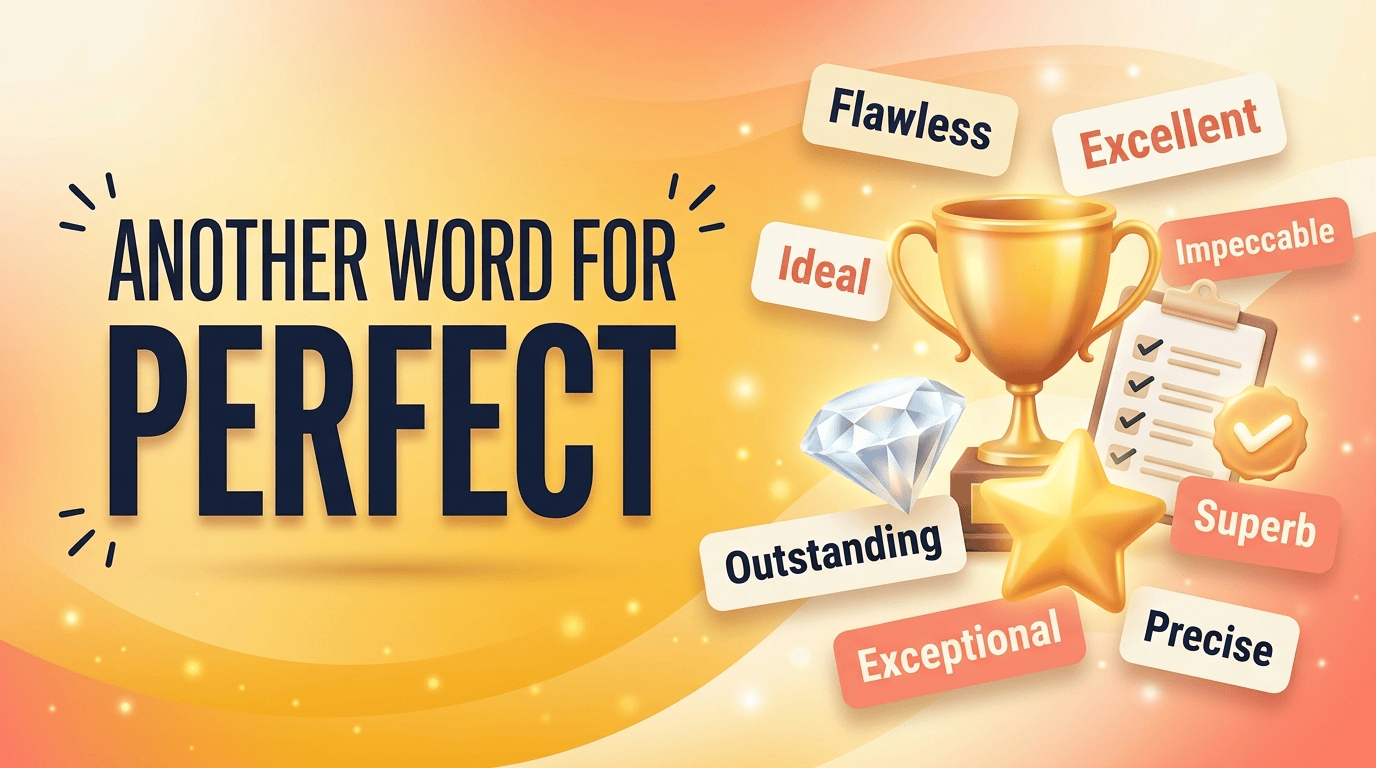
If you need another word for perfect, useful choices include flawless, ideal, excellent, impeccable, outstanding, superb, pristine, faultless, and exemplary.
The word “perfect” describes something that has no faults, reaches a very high standard, or is exactly what is needed. We use it in everyday English for people, objects, ideas, situations, and results. For example, you might say, “This is the perfect answer,” or “The weather is perfect today.”
However, using the same word repeatedly can make writing sound plain. Learning alternatives to perfect gives you more ways to describe excellence, accuracy, beauty, suitability, or completeness.
In this article, you will find 27 useful alternatives to perfect, along with their meanings, parts of speech, examples, connotations, pronunciation, etymology, antonyms, and usage tips.
Meaning of Perfect
Definition and Part of Speech
Perfect means complete, without faults, or as good as possible.
Part of speech: Adjective, noun, or verb
Example 1: She gave a perfect answer.
Example 2: The timing was perfect for the event.
Connotative Meaning
Connotation means the feeling or idea associated with a word beyond its basic meaning.
| Type | Connotation |
| Positive | Excellence, beauty, success, completeness |
| Negative | Can sometimes suggest an unrealistic or impossible standard |
| Neutral | Complete or without a fault |
Etymology of Perfect
The word perfect comes from Latin perfectus, meaning “completed” or “finished.”
- Old English: The modern word perfect was not commonly used in its current form.
- Middle English: It entered English through Old French from Latin.
- Modern English: Perfect developed meanings connected with completeness, excellence, and freedom from faults.
Pronunciation of Perfect
Perfect: /ˈpɜːrfɪkt/ as an adjective
Syllables: per-fect → 2 syllables
Affixation Pattern
Perfect comes from Latin roots rather than being formed from a modern English prefix and root.
- Root: fact/fec-related Latin root meaning “make” or “do”
- Prefix: per-
- Suffix: -ect as part of the inherited Latin form
- Adjective: perfect
- Noun: perfection
- Adverb: perfectly
- Verb: perfect
27 Other Words for Perfect With Meaning & Examples
1. Flawless
Part of speech: Adjective
Meaning: Having no mistakes, faults, or imperfections.
- Her performance was flawless.
- The diamond has a flawless appearance.
2. Ideal
Part of speech: Adjective
Meaning: Exactly suitable or most desirable.
- This is an ideal place for a picnic.
- She found the ideal solution.
3. Excellent
Part of speech: Adjective
Meaning: Extremely good or of very high quality.
- He did an excellent job.
- The restaurant provides excellent service.
4. Impeccable
Part of speech: Adjective
Meaning: Without mistakes or faults.
- Her manners were impeccable.
- He has impeccable taste.
5. Outstanding
Part of speech: Adjective
Meaning: Exceptionally good or impressive.
- She gave an outstanding performance.
- His work was outstanding.
6. Superb
Part of speech: Adjective
Meaning: Extremely impressive or excellent.
- The hotel offers superb service.
- The team gave a superb performance.
7. Faultless
Part of speech: Adjective
Meaning: Without faults or mistakes.
- His reasoning was faultless.
- The machine worked in a faultless manner.
8. Pristine
Part of speech: Adjective
Meaning: Extremely clean, fresh, or untouched.
- The beach was in pristine condition.
- The book was kept in pristine condition.
9. Exemplary
Part of speech: Adjective
Meaning: Excellent enough to serve as a model for others.
- Her behavior was exemplary.
- He showed exemplary leadership.
10. Idealized
Part of speech: Adjective
Meaning: Presented as better or more perfect than reality.
- The movie presents an idealized version of life.
- The painting shows an idealized landscape.
11. Supreme
Part of speech: Adjective
Meaning: Of the highest level or greatest quality.
- She demonstrated supreme confidence.
- The athlete showed supreme skill.
12. Unblemished
Part of speech: Adjective
Meaning: Without marks, damage, or faults.
- He has an unblemished record.
- The surface remained unblemished.
13. Unmatched
Part of speech: Adjective
Meaning: Better than anything similar.
- Her talent is unmatched.
- The company has an unmatched reputation.
14. Exceptional
Part of speech: Adjective
Meaning: Unusually excellent or impressive.
- She showed exceptional talent.
- The school provides exceptional opportunities.
15. Magnificent
Part of speech: Adjective
Meaning: Extremely beautiful, impressive, or excellent.
- The palace looked magnificent.
- They enjoyed a magnificent view.
16. Superb
Part of speech: Adjective
Meaning: Exceptionally good.
- The meal was superb.
- He gave a superb presentation.
Note: “Superb” is listed again here only to highlight its common use; for a clean vocabulary list, the first entry is sufficient.
17. Top-Notch
Part of speech: Adjective
Meaning: Of the highest quality.
- The school has top-notch facilities.
- She received top-notch training.
18. First-Rate
Part of speech: Adjective
Meaning: Extremely good or high quality.
- The hotel provides first-rate service.
- He is a first-rate musician.
19. Spotless
Part of speech: Adjective
Meaning: Completely clean or free from marks.
- The kitchen was spotless.
- Her white shoes were spotless.
20. Complete
Part of speech: Adjective
Meaning: Having all necessary parts; whole.
- The project is complete.
- We now have a complete set.
21. Absolute
Part of speech: Adjective
Meaning: Complete, total, or unrestricted.
- The decision was an absolute success.
- She showed absolute confidence.
22. Unerring
Part of speech: Adjective
Meaning: Showing no mistakes or errors.
- He has an unerring sense of direction.
- Her judgment was unerring.
23. Consummate
Part of speech: Adjective
Meaning: Showing the highest level of skill or ability.
- She is a consummate professional.
- He displayed consummate skill.
24. Polished
Part of speech: Adjective
Meaning: Highly developed, refined, or skillfully presented.
- Her speech was polished.
- The final presentation looked polished.
25. Refined
Part of speech: Adjective
Meaning: Developed to a high standard or made more elegant.
- The design is simple and refined.
- He has refined artistic skills.
26. Optimal
Part of speech: Adjective
Meaning: Best or most effective for a particular purpose.
- We need the optimal solution.
- The machine works at optimal efficiency.
27. Ideal for the Purpose
Part of speech: Phrase
Meaning: Exactly suitable for a particular need.
- This tool is ideal for the purpose.
- The location is ideal for the purpose of the event.
Important: These alternatives are not all interchangeable. Flawless and faultless focus on having no mistakes. Ideal and optimal mean best or most suitable for a purpose. Excellent, superb, and outstanding describe very high quality. Pristine mainly describes cleanliness or untouched condition.
Prototype Meaning
The prototype meaning of perfect is completely free from faults or exactly right for a particular purpose.
For example:
“She gave a perfect answer.”
This means the answer was completely correct.
Another example:
“This is the perfect place for a picnic.”
Here, perfect means ideally suitable.
Prototype Categorization
| Category | Alternatives |
| No faults | flawless, faultless, impeccable, unerring |
| Very high quality | excellent, superb, outstanding, exceptional |
| Best choice | ideal, optimal, first-rate, top-notch |
| Clean or untouched | pristine, spotless, unblemished |
| Highly skilled | exemplary, consummate, polished |
| Complete | complete, absolute |
This grouping helps you choose a synonym based on the exact meaning you want to express.
Antonyms of Perfect
1. Imperfect
Part of speech: Adjective
Meaning: Having faults or flaws.
- The design is imperfect.
- Nobody is completely perfect.
2. Flawed
Part of speech: Adjective
Meaning: Having a weakness or defect.
- The plan was flawed.
- The argument contains a flawed assumption.
3. Faulty
Part of speech: Adjective
Meaning: Not working correctly or containing a fault.
- The machine was faulty.
- The report contained faulty information.
4. Defective
Part of speech: Adjective
Meaning: Having a fault that prevents something from working properly.
- The product was defective.
- They returned the defective item.
5. Poor
Part of speech: Adjective
Meaning: Below an acceptable or expected standard.
- The work was of poor quality.
- He received poor results.
Short Questions and Answers
What is another word for perfect?
Common alternatives include flawless, ideal, excellent, impeccable, outstanding, superb, and faultless.
What is a formal word for perfect?
Impeccable, exemplary, consummate, exceptional, and optimal can work in formal writing depending on context.
What is a simple word for perfect?
Excellent, ideal, flawless, and complete are simple alternatives.
Can “ideal” replace “perfect”?
Sometimes. Ideal usually means best or most suitable, while perfect can also mean completely free from faults.
What is the opposite of perfect?
Common opposites include imperfect, flawed, faulty, defective, and poor.
What is the noun form of perfect?
The noun form is perfection.
Conclusion
The word “perfect” is useful when describing something complete, flawless, or exactly suitable. However, using alternatives can make your English more precise and interesting. Flawless, faultless, and impeccable work well when something has no faults. Ideal and optimal are useful when something is the best choice for a particular purpose. For very high quality, words such as excellent, superb, outstanding, and exceptional are strong choices.
Remember that synonyms can have slightly different meanings. Choosing the right word depends on the situation, tone, and exact idea you want to communicate. Regular practice will help you use these alternatives naturally in both speaking and writing.

I’m Naz Fatima, a dedicated content writer with expertise in language, synonyms, and well-researched article writing.
My experience in creating clear, engaging, and informative content reflects my commitment to quality, accuracy, and reader value.










