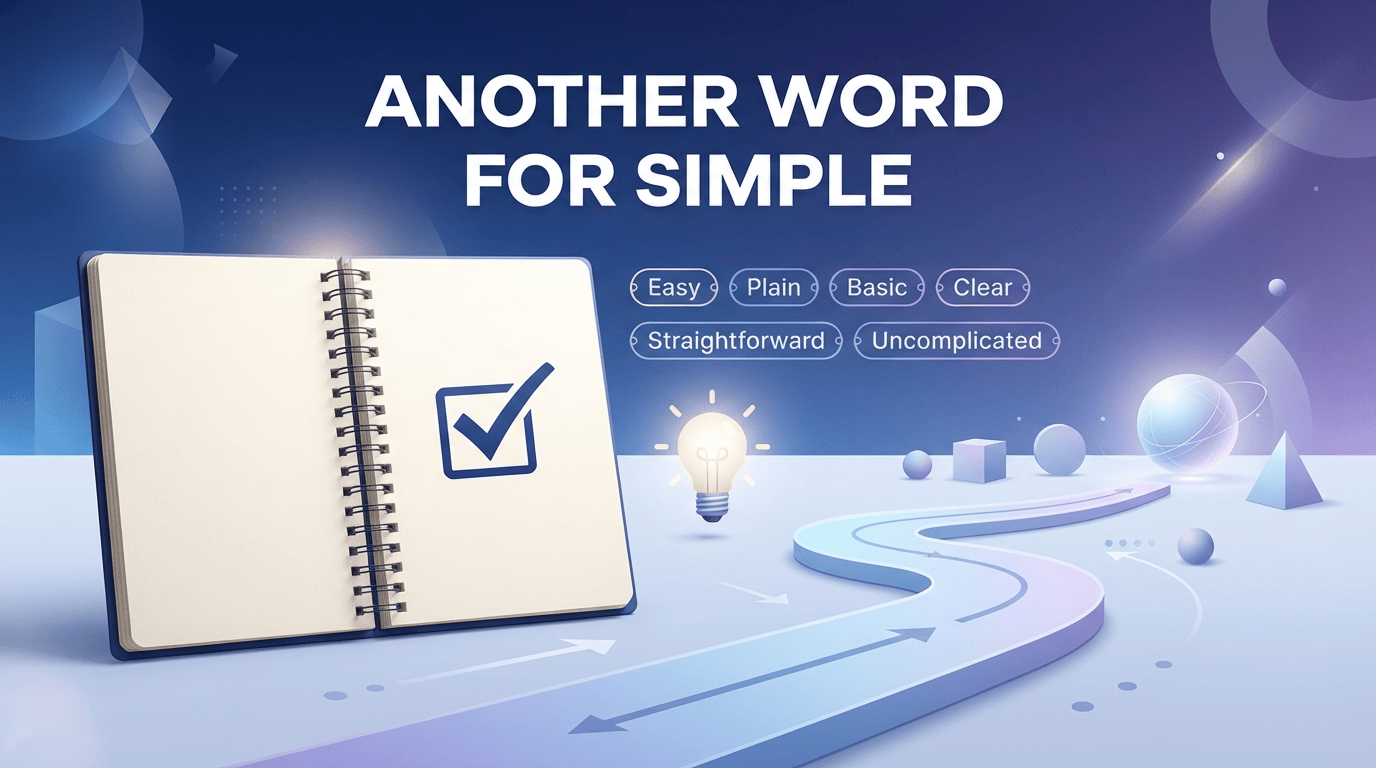
Another word for simple includes easy, basic, plain, clear, straightforward, uncomplicated, effortless, elementary, modest, and minimal.
Simple is a common English word used when something is easy, clear, plain, or not complicated. Imagine a friend explaining how to make tea. If the steps are easy to follow, you might say, “The recipe is simple.” We use this word often because it works in daily speech, school writing, business, and many other settings. However, repeating the same word can make writing less interesting.
Learning another word for simple helps English learners build stronger vocabulary and helps content writers choose words that match the exact meaning they want. This article explains the meaning of simple and explores useful alternatives with examples. It also covers grammar, connotation, etymology, pronunciation, word formation, semantic categories, antonyms, and common usage questions.
Meaning of Simple
Definition
Simple (Adjective):
Something that is easy to understand, do, or use and does not have unnecessary complexity. It can also describe something plain, basic, or without decoration.
Examples
- The instructions are simple and easy to follow.
- She chose a simple black dress for the event.
Connotative Meaning
The connotation of a word is the feeling or idea that a word suggests beyond its basic dictionary meaning.
- Positive tone: Simple can suggest clarity, ease, elegance, and practicality.
- Negative tone: In some contexts, simple can suggest a lack of intelligence, sophistication, or detail.
- Neutral tone: It can simply mean something that is not complicated or has few parts.
The meaning depends strongly on context. For example, “a simple solution” is usually positive, while calling a person “simple” can sound negative or outdated when it suggests limited intelligence.
Etymology
The English word simple entered Middle English through Old French simple, which came from Latin simplus or simplex, meaning “simple,” “plain,” “unmixed,” or literally “one-fold.” The idea of having one or few parts helped the word develop its modern sense of lacking complexity.
- Old English (450–1100): The modern word simple was not an ordinary native Old English form. Its later English history comes through French and Latin.
- Middle English (1100–1500): Simple appeared around the early 13th century through Old French. It could mean innocent, plain, humble, foolish, or lacking complexity.
- Modern English (1500–Present): The word developed broader meanings, including easy to understand, uncomplicated, plain, basic, and consisting of few parts.
Pronunciation (IPA)
- IPA: /ˈsɪm.pəl/
- Syllables: sim-ple
Cambridge gives the US and UK pronunciation as /ˈsɪm.pəl/.
Affixation Pattern of Simple
- Root: simple
- Prefix: None in the basic English word
- Suffix: None in the basic form
- Word formations:
- simpler — adjective, comparative form
- simplest — adjective, superlative form
- simply — adverb
- simplicity — noun
- simpleness — noun
- simplify — verb
- simplification — noun
- simplistic — adjective
- simplistically — adverb
- simpleton — noun
- simple-minded — adjective
The related forms simply, simplicity, simplify, and simplistic developed from the same word family.
30 Other Words for Simple With Meaning & Examples
1. Easy (Adjective)
Meaning: Something that does not require much effort or difficulty.
Examples:
- This exercise is easy to complete.
- The instructions are easy to understand.
2. Basic (Adjective)
Meaning: Something that has the most important or necessary features.
Examples:
- We learned the basic rules of grammar.
- The course teaches basic English skills.
3. Plain (Adjective)
Meaning: Something simple and without decoration or extra features.
Examples:
- She wore a plain white shirt.
- He prefers plain food.
4. Straightforward (Adjective)
Meaning: Something clear and easy to understand or deal with.
Examples:
- The instructions were straightforward.
- It was a straightforward question.
5. Uncomplicated (Adjective)
Meaning: Something that has no unnecessary difficulty or complexity.
Examples:
- We need an uncomplicated solution.
- Her explanation was clear and uncomplicated.
6. Effortless (Adjective)
Meaning: Something that seems to require little or no effort.
Examples:
- She made the difficult task look effortless.
- His writing style feels effortless.
7. Clear (Adjective)
Meaning: Easy to understand or recognize.
Examples:
- Please give me a clear answer.
- The teacher gave a clear explanation.
8. Elementary (Adjective)
Meaning: Basic and suitable for beginners.
Examples:
- The students started with elementary grammar.
- This is an elementary science lesson.
9. Minimal (Adjective)
Meaning: Using only a small amount of something.
Examples:
- The room has minimal decoration.
- The design uses minimal colors.
10. Modest (Adjective)
Meaning: Simple and not showy or expensive.
Examples:
- They live in a modest home.
- She chose a modest dress.
11. Unadorned (Adjective)
Meaning: Having no extra decoration or ornament.
Examples:
- The walls were unadorned.
- He selected an unadorned wooden table.
12. Natural (Adjective)
Meaning: Plain, normal, or not artificial or forced.
Examples:
- She has a natural writing style.
- His answer sounded natural.
13. Direct (Adjective)
Meaning: Clear and expressed without unnecessary detail.
Examples:
- She gave a direct answer.
- His message was short and direct.
14. Uncomplicated (Adjective)
Meaning: Not difficult, confusing, or complex.
Examples:
- The process is uncomplicated.
- We found an uncomplicated way to solve it.
15. Manageable (Adjective)
Meaning: Easy enough to handle or complete.
Examples:
- The workload is manageable.
- We divided the project into manageable steps.
16. Accessible (Adjective)
Meaning: Easy to understand, use, reach, or obtain.
Examples:
- The book uses accessible language.
- The website has an accessible design.
17. Elementary (Adjective)
Meaning: Related to the first or most basic level of learning.
Examples:
- He has elementary knowledge of French.
- The teacher explained the elementary rules first.
18. Unpretentious (Adjective)
Meaning: Simple and not designed to impress others.
Examples:
- The restaurant has an unpretentious atmosphere.
- She lives an unpretentious life.
19. Humble (Adjective)
Meaning: Modest and not proud or showy.
Examples:
- He comes from a humble background.
- They built a humble home.
20. Spartan (Adjective)
Meaning: Very plain and without unnecessary comfort or decoration.
Examples:
- The room had a Spartan design.
- His office was Spartan but practical.
21. Bare (Adjective)
Meaning: Containing only what is necessary.
Examples:
- The room had the bare essentials.
- He gave the bare facts.
22. Fundamental (Adjective)
Meaning: Basic and very important to a subject.
Examples:
- Grammar is fundamental to good writing.
- These are fundamental English skills.
23. Basic-level (Adjective)
Meaning: Suitable for someone at an early stage of learning.
Examples:
- This is a basic-level English course.
- The book contains basic-level exercises.
24. Painless (Adjective)
Meaning: Easy to complete without much difficulty or trouble.
Examples:
- The registration process was painless.
- The update made the change painless.
25. User-friendly (Adjective)
Meaning: Designed so people can use or understand it easily.
Examples:
- The app has a user-friendly design.
- The website is simple and user-friendly.
26. Foolproof (Adjective)
Meaning: Designed to be very easy to use correctly.
Examples:
- The machine has a foolproof system.
- These instructions are almost foolproof.
27. Unembellished (Adjective)
Meaning: Plain and without added decoration or unnecessary details.
Examples:
- She gave an unembellished account of the event.
- The room had an unembellished style.
28. Unsophisticated (Adjective)
Meaning: Lacking complexity, refinement, or advanced features.
Examples:
- The software is unsophisticated but useful.
- It was an unsophisticated design.
29. Spare (Adjective)
Meaning: Plain, limited, or using very few extra elements.
Examples:
- The room had a spare design.
- His writing style is spare and direct.
30. Lucid (Adjective)
Meaning: Clear and easy to understand.
Examples:
- The author gives a lucid explanation.
- Her argument was lucid and well organized.
Prototype Meaning
The most typical meaning of simple is easy to understand, easy to do, or not complicated. When people hear the word, they often imagine something with few steps, few parts, or little difficulty. For example, a simple recipe may need only a few ingredients, while a simple explanation uses clear words and avoids unnecessary detail. Cambridge also lists meanings related to being plain, having few parts, and being natural or ordinary.
Prototype Categorization
The 30 alternatives can be grouped by their main meaning. This helps writers select a synonym that fits the exact context instead of replacing simple with a word that changes the meaning.
- Ease and low difficulty: easy, effortless, manageable, painless, foolproof. These words work when something can be done without much difficulty.
- Clarity and understanding: clear, straightforward, direct, accessible, lucid. These are useful for explanations, instructions, arguments, and communication.
- Basic level or structure: basic, elementary, fundamental, basic-level. These describe something at an early, essential, or introductory stage.
- Plain appearance or design: plain, minimal, unadorned, unembellished, spare, modest, Spartan. These work well when discussing clothes, rooms, art, design, or lifestyle.
- Natural and modest style: natural, humble, unpretentious. These can describe people, behavior, writing, or lifestyles.
- Limited complexity: uncomplicated, unsophisticated. These emphasize a lack of complexity, though unsophisticated can sometimes sound less positive.
- Specialized uses: user-friendly is especially useful for technology and products, while lucid is especially useful for clear writing or explanations.
Antonyms of Simple
1. Complex (Adjective)
Meaning: Having many connected parts or details and requiring careful thought.
2. Complicated (Adjective)
Meaning: Difficult to understand or deal with because of many parts or steps.
3. Difficult (Adjective)
Meaning: Not easy to do, understand, or solve.
4. Elaborate (Adjective)
Meaning: Detailed, carefully developed, or containing many parts.
5. Sophisticated (Adjective)
Meaning: Highly developed, advanced, or complex.
6. Intricate (Adjective)
Meaning: Containing many small or connected details.
Short Questions and Answers
What does simple mean?
Simple usually means easy to understand, easy to do, not complicated, or made of few parts. It can also mean plain or without unnecessary decoration.
When should simple be used?
Use simple when you want to describe something that is easy, clear, basic, plain, or not complicated. The exact meaning depends on the context.
Is simple positive or negative?
Simple can be positive, negative, or neutral. “A simple solution” is usually positive, while describing someone as “simple” to suggest low intelligence can sound negative or outdated.
How is it different from similar words?
Each alternative has a slightly different focus. Easy emphasizes low difficulty, plain emphasizes a lack of decoration, basic emphasizes essential features, straightforward emphasizes clarity, and minimal emphasizes using very little.
Conclusion
Learning another word for simple can make English writing more accurate and interesting. Instead of using the same word again and again, writers can choose alternatives such as easy, basic, clear, plain, straightforward, uncomplicated, or minimal according to the context. These words do not always have exactly the same meaning, so understanding their differences is important.
A strong vocabulary helps English learners express ideas with greater confidence and helps content writers create clear, natural, and engaging articles. It can also make speaking more flexible because the right word can communicate a more precise idea. Practice using a few new alternatives each day. Read them in sentences, write your own examples, and notice how their meanings change with context. With regular practice, vocabulary becomes easier to use naturally.
Another Word for Show: 24 Powerful Alternatives
I’m Naz Fatima, a dedicated content writer with expertise in language, synonyms, and well-researched article writing.
My experience in creating clear, engaging, and informative content reflects my commitment to quality, accuracy, and reader value.










