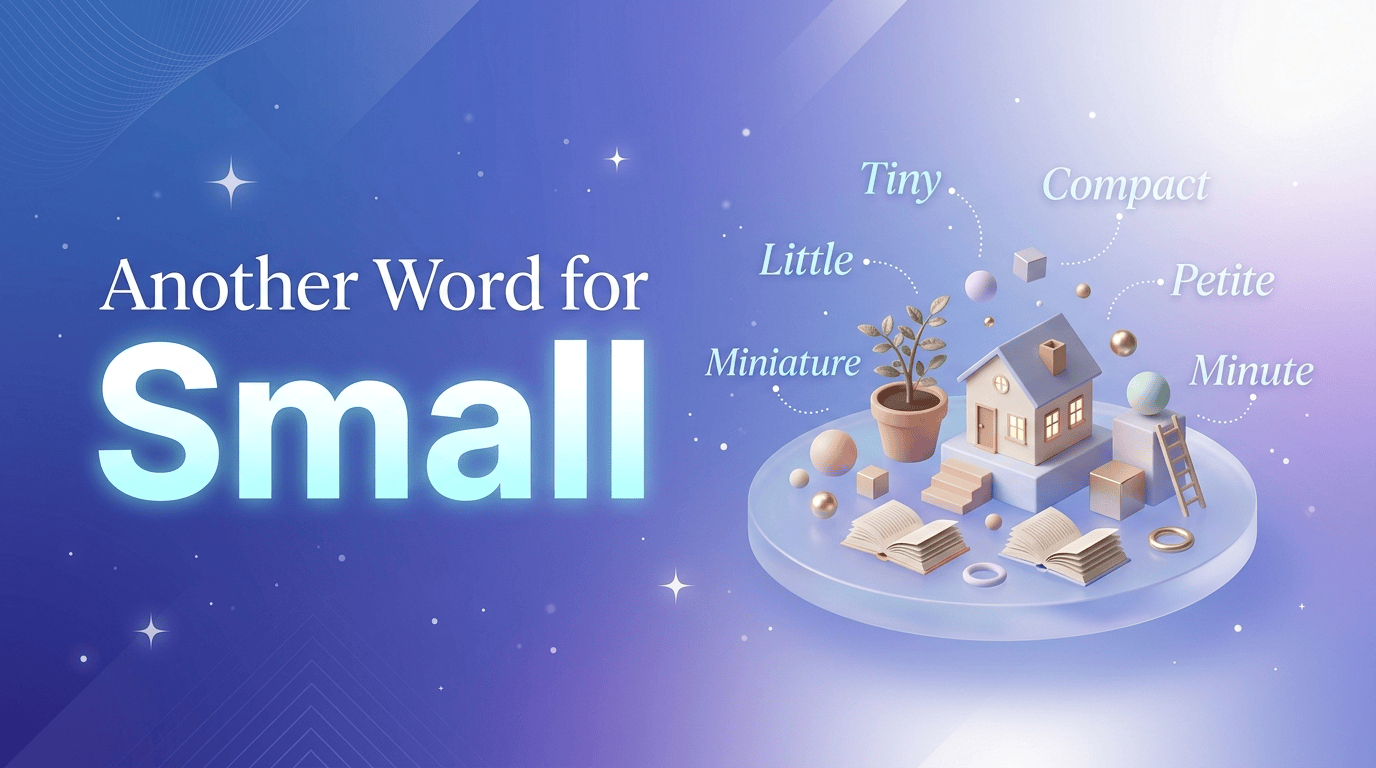
Another word for small is little, tiny, petite, compact, miniature, minor, or slight. The best synonym depends on the size, amount, or importance you want to describe.
The word small is used to describe things that have little size, amount, or importance. We use it in everyday conversations, school assignments, stories, and professional writing. However, using the same word again and again can make writing less interesting. Learning other words for small helps you express your ideas more clearly and creatively.
For example, you can describe a tiny insect, a compact room, a slight change, or a minor problem. Each word has a different meaning and works best in certain situations. Some words describe physical size, while others describe a small amount or something that is not very important.
In this article, you will learn the meaning, pronunciation, origin, and word forms of small. You will also discover 25 useful alternatives, their meanings, example sentences, antonyms, and answers to common questions.
Meaning of Small
Definition and Part of Speech
Small is an adjective that describes something with limited size, quantity, extent, or importance.
Examples:
- She lives in a small house near the park.
- We noticed a small change in the weather.
Connotative Meaning
Connotation is the feeling or idea that a word suggests beyond its basic meaning.
Positive: Cute, cozy, delicate, and compact can suggest that something small is pleasant or useful.
Negative: Tiny or insignificant can suggest that something is too small or not important.
Neutral: Little, small, and slight can describe size or amount without strong feelings.
Etymology of Small
The word small comes from older forms of English and has been used for centuries to describe limited size or amount.
Old English: Related forms such as smæl were used to describe something narrow or slender.
Middle English: The word developed into forms such as smal and gradually took on the familiar meaning of small.
Modern English: Small is now widely used for physical size, quantity, degree, and importance.
Pronunciation of Small
Pronunciation: SMAWL
IPA: /smɔːl/
Syllables: Small has one syllable.
Affixation Pattern of Small
The word small is a simple adjective without a separate prefix or suffix in its basic form.
Root: Small
Prefix: No prefix appears in the basic word.
Suffix: No suffix appears in the basic word.
Related word forms include:
- Smaller, the comparative form used to compare two things.
- Smallest, the superlative form used for the least size in a group.
- Smallness, a noun describing the quality or state of being small.
- Smallish, an adjective meaning somewhat small.
25 Other Words for Small With Meanings and Examples
1. Little
Part of speech: Adjective
Meaning: Small in size, amount, or degree.
Example sentences:
- The little puppy followed its owner.
- We have a little time before the bus arrives.
2. Tiny
Part of speech: Adjective
Meaning: Extremely small in size.
Example sentences:
- A tiny ant walked across the table.
- She found a tiny shell on the beach.
3. Miniature
Part of speech: Adjective
Meaning: Made on a very small scale compared with the real object.
Example sentences:
- He collects miniature cars.
- The museum displayed a miniature castle.
4. Compact
Part of speech: Adjective
Meaning: Small and arranged efficiently without wasting space.
Example sentences:
- They bought a compact washing machine.
- The compact camera fits easily into a bag.
5. Petite
Part of speech: Adjective
Meaning: Small and delicately proportioned, often used for people or clothing.
Example sentences:
- The shop offers petite clothing sizes.
- She chose a petite handbag for the evening.
6. Slight
Part of speech: Adjective
Meaning: Small in amount, degree, or intensity.
Example sentences:
- There was a slight change in his voice.
- I felt a slight headache after studying.
7. Minor
Part of speech: Adjective
Meaning: Not very large, serious, or important.
Example sentences:
- The car had a minor problem.
- We made a few minor changes to the report.
8. Modest
Part of speech: Adjective
Meaning: Limited in size, amount, or level.
Example sentences:
- They live in a modest home.
- The project received a modest budget.
9. Scant
Part of speech: Adjective
Meaning: Barely enough in quantity or amount.
Example sentences:
- There was scant evidence to support the claim.
- The village received scant rainfall that year.
10. Minimal
Part of speech: Adjective
Meaning: As small as possible or only as much as necessary.
Example sentences:
- The design uses minimal decoration.
- The damage to the building was minimal.
11. Petite Sized
Part of speech: Adjective phrase
Meaning: Designed for people who need clothing with shorter or smaller proportions.
Example sentences:
- She looked for petite sized trousers.
- The store has a new petite sized collection.
12. Microscopic
Part of speech: Adjective
Meaning: So small that it usually requires a microscope to be seen clearly.
Example sentences:
- The scientist studied microscopic organisms.
- A microscopic particle was found in the sample.
13. Minute
Part of speech: Adjective
Meaning: Extremely small or difficult to notice.
Example sentences:
- The artist painted minute details on the model.
- There was a minute crack in the glass.
Note that minute meaning extremely small is pronounced my NOOT, unlike minute meaning a unit of time.
14. Diminutive
Part of speech: Adjective
Meaning: Very small in size.
Example sentences:
- The diminutive bird sat on a branch.
- A diminutive cottage stood beside the lake.
15. Narrow
Part of speech: Adjective
Meaning: Having a small distance from one side to the other.
Example sentences:
- We walked through a narrow street.
- The table has narrow legs.
16. Slender
Part of speech: Adjective
Meaning: Thin or narrow in shape.
Example sentences:
- A slender tree grew beside the fence.
- The vase had a slender neck.
17. Petite Little
Part of speech: Adjective phrase
Meaning: Very small in size, although this phrase can sound repetitive.
Example sentences:
- The petite little box held a ring.
- A petite little bird rested on the windowsill.
In polished writing, petite or little alone is usually more natural.
18. Insignificant
Part of speech: Adjective
Meaning: Too small or unimportant to have much effect.
Example sentences:
- The difference was insignificant.
- They ignored an insignificant detail in the first draft.
19. Negligible
Part of speech: Adjective
Meaning: So small that it can almost be ignored.
Example sentences:
- The extra cost was negligible.
- The experiment showed a negligible difference.
20. Trivial
Part of speech: Adjective
Meaning: Small or unimportant enough not to deserve much attention.
Example sentences:
- They argued over a trivial matter.
- The error was trivial and easy to fix.
21. Limited
Part of speech: Adjective
Meaning: Restricted in size, amount, or availability.
Example sentences:
- We have limited space in the classroom.
- The library has a limited number of copies.
22. Reduced
Part of speech: Adjective
Meaning: Made smaller or lower than before.
Example sentences:
- The shop offered reduced prices.
- The new plan requires reduced spending.
23. Underdeveloped
Part of speech: Adjective
Meaning: Not fully developed or grown.
Example sentences:
- The plant had underdeveloped roots.
- The region had an underdeveloped transport system.
24. Compact Sized
Part of speech: Adjective phrase
Meaning: Designed to take up little space.
Example sentences:
- They selected a compact sized desk for the room.
- The compact sized speaker fits on a small shelf.
The phrase compact or compact size is often more natural, depending on the sentence.
25. Wee
Part of speech: Adjective
Meaning: Very small, especially in informal British or Scottish English.
Example sentences:
- The child held a wee kitten.
- We stopped at a wee café near the station.
Important note: These alternatives are not always interchangeable. Tiny and miniature describe physical size, slight describes degree, and minor describes importance or seriousness. Choose a word that matches the meaning of your sentence.
Prototype Meaning of Small
A prototype is the clearest or most typical example of a concept.
The prototype meaning of small is something that takes up little space or has less size than something similar. For example, a small cup holds less liquid than a large cup.
The word can also describe quantity or importance. A small amount of sugar refers to quantity, while a minor mistake refers to importance. Understanding these different uses helps you choose the right synonym.
Prototype Categorization of Small Synonyms
The alternatives for small can be organized into groups based on what they describe.
| Category | Words | Main idea |
| Physical size | Little, tiny, miniature, diminutive, wee | Limited physical dimensions |
| Space and shape | Compact, narrow, slender | Taking up little space or having a thin shape |
| Amount or degree | Slight, scant, minimal, limited | A small quantity or degree |
| Importance | Minor, insignificant, negligible, trivial | Something with little effect or importance |
| Scale and proportion | Petite, minute, microscopic | Very small size or proportions |
| Change or development | Reduced, underdeveloped, modest | Lower size, level, or growth |
These categories help you select a synonym that fits your intended meaning. They also prevent you from using a word about importance when you actually mean physical size.
Antonyms of Small
Antonyms are words with opposite or contrasting meanings.
1. Large
Part of speech: Adjective
Meaning: Big in size, amount, or extent.
Example: They moved into a large house.
2. Big
Part of speech: Adjective
Meaning: Of considerable size or importance.
Example: He carried a big box into the room.
3. Huge
Part of speech: Adjective
Meaning: Extremely large.
Example: A huge tree stood near the entrance.
4. Enormous
Part of speech: Adjective
Meaning: Very large in size or amount.
Example: The building had an enormous garden.
5. Massive
Part of speech: Adjective
Meaning: Very large, heavy, or substantial.
Example: The workers moved a massive stone.
6. Significant
Part of speech: Adjective
Meaning: Important or large enough to have a noticeable effect.
Example: The school made significant improvements.
Short Questions and Answers
1. What is another word for small?
Little, tiny, compact, miniature, and slight are common alternatives.
2. What is a simple word for small?
Little is a simple and common alternative.
3. What is a stronger word for small?
Tiny, minute, and microscopic can express a very small size.
4. What is a professional word for small?
Minimal, minor, limited, and compact are useful in professional writing, depending on the context.
5. What is the opposite of small?
Large, big, huge, enormous, and massive are common opposites.
6. Is tiny the same as small?
Tiny means extremely small, so it usually suggests a smaller size than the word small.
7. What is the noun form of small?
Smallness is the noun form of small.
8. What is the comparative form of small?
Smaller is the comparative form, used to compare two things.
Conclusion
Learning another word for small helps you make your writing more precise and interesting. Words such as tiny, compact, slight, minor, and minimal describe different types of smallness. Some refer to physical size, while others describe quantity, degree, or importance.
The best alternative depends on the context. Use tiny for something extremely small, compact for something designed to save space, and minor for something that is not very serious. Choosing the right word helps readers understand your meaning clearly.
To improve your vocabulary, practice using one new synonym each day. Write a sentence with it and compare its meaning with small. With regular practice, you can build stronger English skills and express your ideas with greater confidence.
Also read this:

I’m Naz Fatima, a dedicated content writer with expertise in language, synonyms, and well-researched article writing.
My experience in creating clear, engaging, and informative content reflects my commitment to quality, accuracy, and reader value.