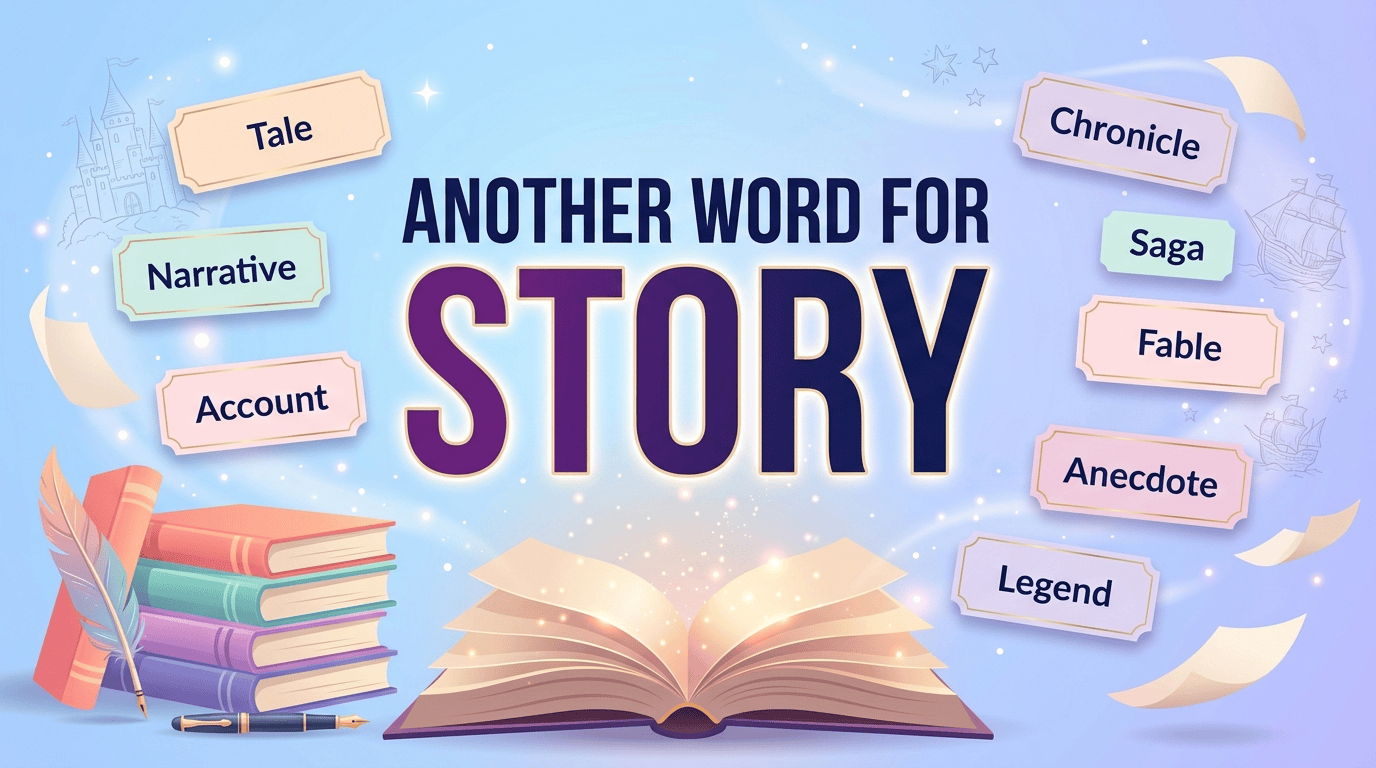
Depending on the context, story can mean a tale, narrative, account, plot, anecdote, legend, report, or history.
The word story is used in many areas of English. It can describe a fictional tale, a real account of events, the plot of a book or movie, or even information shared in conversation. Because story has several meanings, the best alternative depends on what you want to express. For example, tale often refers to a narrative, account can describe a report of real events, and plot focuses on the events that make up a novel or film. Students, writers, and English learners can improve their vocabulary by learning these distinctions. This guide explains the meaning, pronunciation, etymology, related forms, and 24 alternatives for story, with simple meanings and examples.
Meaning of Story
Definition and Part of Speech
Story is mainly a noun. It can mean a narrative about real or imaginary events, an account of something that happened, or the sequence of events in a fictional work.
Examples:
- My grandmother told me an interesting story.
- The movie has a complicated story.
Connotative Meaning
A connotation is the feeling or idea associated with a word beyond its basic meaning.
The word story usually has a neutral or positive connotation because it can suggest entertainment, imagination, memories, or meaningful experiences.
- Positive: Entertaining, memorable, meaningful
- Negative: Sometimes associated with an untrue or exaggerated account
- Neutral: A narrative or account of events
Etymology of Story
The word story has roots in Latin and French.
- Old English: The modern word story was not used in Old English in its present form.
- Middle English: It came from Old French estoire or estorie, from Latin historia, meaning “history” or “account.”
- Modern English: Story developed meanings connected with narratives, accounts, and fictional works.
Interestingly, story and history are historically related words.
Pronunciation of Story
Story: /ˈstɔːri/ in British English and /ˈstɔːri/ in American English.
Syllables: sto-ry
Stress: First syllable
Affixation Pattern
Story is a simple noun rather than a word formed with a modern English prefix or suffix.
Related forms include:
- Story — noun
- Stories — plural noun
- Storyteller — noun
- Storytelling — noun
- Storyline — noun
- Story-based — adjective
24 Other Words for Story With Meaning & Examples
1. Tale
Part of speech: Noun
Meaning: A story, often involving imaginary, traditional, or entertaining events.
- She told us a fascinating tale.
- The children enjoyed the fairy tale.
2. Narrative
Part of speech: Noun
Meaning: A structured account of connected events.
- The novel has a powerful narrative.
- The documentary presents a clear narrative.
3. Account
Part of speech: Noun
Meaning: A description or report of events that happened.
- He gave an account of what happened.
- The newspaper published an account of the event.
4. Plot
Part of speech: Noun
Meaning: The sequence of events that forms the main action of a novel, film, or play.
- The movie has an exciting plot.
- I enjoyed the book’s complicated plot.
5. Chronicle
Part of speech: Noun
Meaning: A detailed record of events in the order they happened.
- The book is a chronicle of the city’s history.
- The documentary chronicles the team’s journey.
6. Anecdote
Part of speech: Noun
Meaning: A short and interesting story about a real event or person.
- She shared a funny anecdote from school.
- His speech included a personal anecdote.
7. Legend
Part of speech: Noun
Meaning: A traditional story that may contain historical or imaginary elements.
- The mountain is connected to an old legend.
- We heard a famous legend about the ancient king.
8. Fable
Part of speech: Noun
Meaning: A short traditional story, often with a moral lesson.
- The teacher read a fable to the class.
- The fable teaches the value of honesty.
9. Myth
Part of speech: Noun
Meaning: A traditional story, often involving gods, heroes, or explanations of natural events.
- The book explores an ancient myth.
- The story is based on a Greek myth.
10. Saga
Part of speech: Noun
Meaning: A long story involving many events or generations.
- The film tells a family saga.
- We read a historical saga about the royal family.
11. Account
Part of speech: Noun
Meaning: A description of an event or experience.
- She gave a detailed account of her journey.
- His account helped explain what happened.
12. Report
Part of speech: Noun
Meaning: Information or a description about an event or situation.
- The journalist wrote a report about the incident.
- The police received a report of the accident.
13. History
Part of speech: Noun
Meaning: A record or account of past events.
- The museum tells the history of the city.
- She wrote a short history of the school.
14. Memoir
Part of speech: Noun
Meaning: A written account of a person’s memories and experiences.
- She published a memoir about her childhood.
- I enjoy reading personal memoirs.
15. Biography
Part of speech: Noun
Meaning: An account of someone’s life written by another person.
- I read a biography of the famous scientist.
- The biography describes his early life.
16. Fiction
Part of speech: Noun
Meaning: Written or spoken stories created from imagination rather than factual events.
- She enjoys reading historical fiction.
- The novel is a work of fiction.
17. Parable
Part of speech: Noun
Meaning: A simple story used to teach a moral or religious lesson.
- The teacher explained the parable.
- The parable teaches an important lesson.
18. Account of Events
Part of speech: Noun phrase
Meaning: A description of what happened.
- The witness gave an account of events.
- The article provides an account of events from that day.
19. Experience
Part of speech: Noun
Meaning: Something that happened to someone and can be described as a personal story.
- She shared her travel experience.
- It was an unforgettable experience.
20. Recollection
Part of speech: Noun
Meaning: A memory or description of something remembered.
- He shared a childhood recollection.
- Her recollection of the event was very clear.
21. Episode
Part of speech: Noun
Meaning: A particular event or part of a larger story or series.
- That was my favorite episode of the show.
- The book describes an important episode in his life.
22. Storyline
Part of speech: Noun
Meaning: The main series of events in a story, movie, or television program.
- The game’s storyline is interesting.
- The show has several connected storylines.
23. Yarn
Part of speech: Noun
Meaning: An informal word for a long or entertaining story.
- Grandpa told us a funny yarn.
- He had a great yarn about his travels.
24. Fictional Narrative
Part of speech: Noun phrase
Meaning: An invented narrative created from imagination.
- The book is a compelling fictional narrative.
- She wrote a short fictional narrative for class.
Note: These alternatives are not always interchangeable. Plot refers specifically to the events of a fictional work, account usually describes real events, narrative emphasizes how events are presented, and tale often has a storytelling or imaginative feeling.
Prototype Meaning
The prototype meaning of story is a connected account of events told or written for information, entertainment, or meaning.
For example:
“She told me a story about her childhood.”
Here, story means a narrative about events from her past.
Prototype Categorization
| Category | Alternatives |
| General narrative | Tale, narrative, account |
| Fiction | Plot, fiction, fictional narrative |
| Traditional stories | Legend, myth, fable, saga |
| Real-life accounts | Report, account, history |
| Personal experiences | Anecdote, experience, recollection |
| Life stories | Memoir, biography |
| Parts of a story | Episode, storyline |
| Informal storytelling | Yarn |
These categories help you choose a synonym that matches the exact meaning of story.
Antonyms and Contrasting Ideas
Story does not have one exact antonym. However, these ideas can contrast with storytelling:
Fact
A verified piece of information rather than a narrative.
Reality
The actual state of things rather than an invented account.
Silence
The absence of spoken or written communication.
Data
Information presented as facts or measurements rather than as a narrative.
Short Questions and Answers
What is another word for story?
Common alternatives include tale, narrative, account, plot, chronicle, and anecdote.
What is a formal word for story?
Narrative, account, chronicle, and report can work well in formal contexts.
What is another word for a short story?
Depending on the type, use tale, anecdote, narrative, fable, or short narrative.
What is another word for a true story?
True account, real-life narrative, memoir, or recollection may work depending on context.
What is another word for a story in a movie?
Plot, narrative, storyline, or storyline are useful choices.
What is the difference between a story and a plot?
A story can include the whole narrative, while a plot specifically focuses on the connected events that drive a fictional work.
Conclusion
The word story has many useful alternatives, but the best choice depends on the type of story you mean. Tale is useful for traditional or entertaining narratives, while narrative works well for structured storytelling. Account and report are useful for real events, while plot and storyline describe parts of fictional works. For traditional stories, words such as myth, legend, fable, and saga can be more precise. Learning these distinctions can make your writing richer and help you avoid repeating the same word. Practice using these alternatives in essays, book reviews, creative writing, and everyday conversations to build a stronger vocabulary.

I’m Naz Fatima, a dedicated content writer with expertise in language, synonyms, and well-researched article writing.
My experience in creating clear, engaging, and informative content reflects my commitment to quality, accuracy, and reader value.










