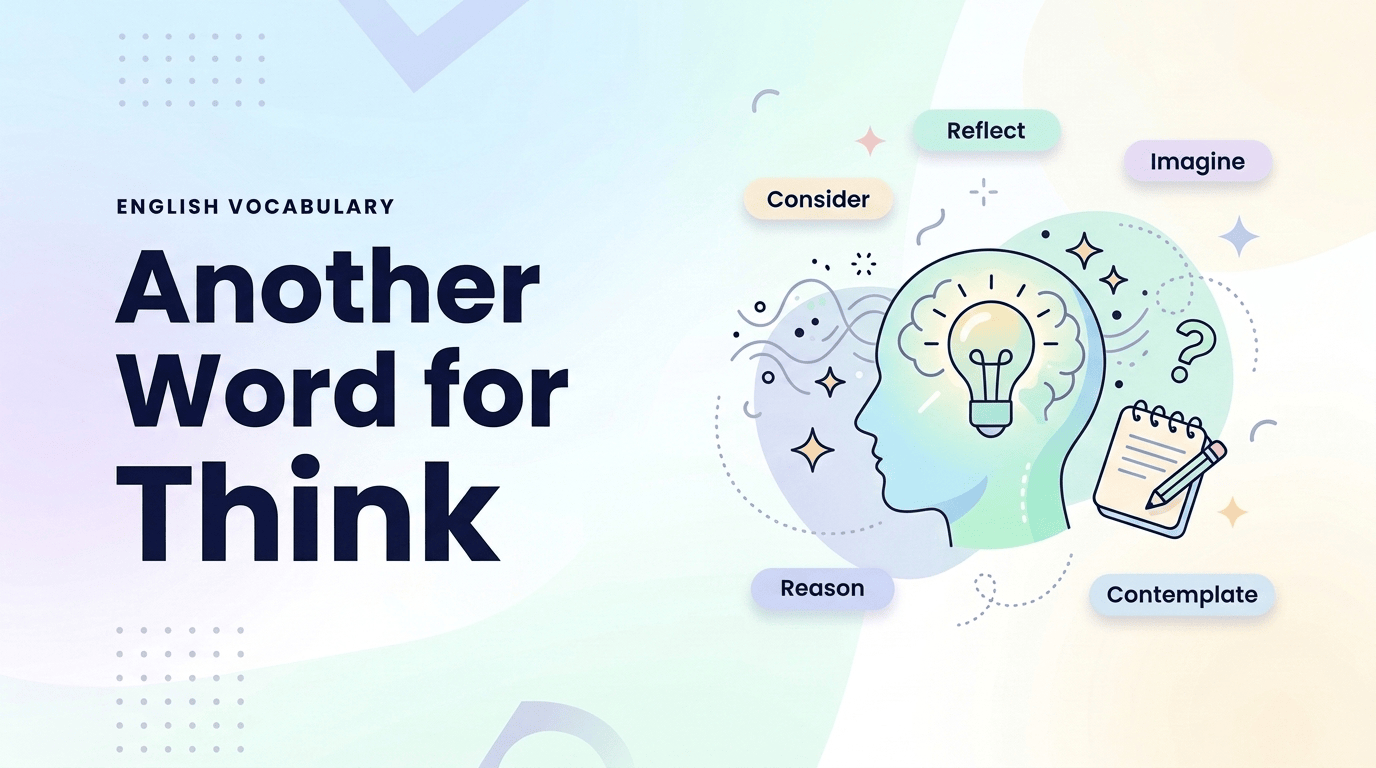
Some common alternatives to think are believe, consider, suppose, imagine, reflect, ponder, reason, contemplate, assume, and wonder.
The word think means to use your mind to form ideas, understand something, or make a decision. We use it every day when we share opinions, solve problems, or talk about our plans. For example, you might think about your future, think of a new idea, or think that a friend is right. However, using the same word again and again can make your writing sound simple or repetitive.
Learning another word for think helps you express your ideas more clearly. Words such as consider, believe, and reflect can add different meanings to your sentences. Some alternatives show an opinion, while others describe deep thought or careful reasoning. In this guide, you will learn useful synonyms for think, their meanings, example sentences, antonyms, pronunciation, and word history.
Meaning and Definition of Think
Think is a verb that means to use your mind to form ideas, consider facts, solve problems, or have an opinion about something.
Examples:
- I think this book is interesting.
- She needs time to think about her choice.
- We should think carefully before making a decision.
25 Synonyms for Think
The best alternative depends on what you want to say.
| No. | Synonym | Meaning | Example Sentence |
| 1 | Believe | To accept something as true | I believe you are right. |
| 2 | Consider | To think carefully about something | Please consider my suggestion. |
| 3 | Suppose | To believe something may be true | I suppose he is busy. |
| 4 | Imagine | To form an idea in your mind | Imagine living in a castle. |
| 5 | Reflect | To think deeply about something | She reflected on her choices. |
| 6 | Ponder | To think about something carefully | He pondered the question. |
| 7 | Contemplate | To think deeply about something | They contemplated their future. |
| 8 | Reason | To use logic to reach a conclusion | We must reason through the problem. |
| 9 | Assume | To accept something as true without proof | Do not assume he knows everything. |
| 10 | Wonder | To feel curious or uncertain | I wonder why she left early. |
| 11 | Judge | To form an opinion | Do not judge people too quickly. |
| 12 | Decide | To reach a choice after thinking | I decided to study tonight. |
| 13 | Evaluate | To judge the value or quality of something | We evaluated all the options. |
| 14 | Analyze | To examine something carefully | Let us analyze the results. |
| 15 | Examine | To look at something closely | Think about the evidence and examine it. |
| 16 | Reckon | To believe or suppose | I reckon we will arrive soon. |
| 17 | Suspect | To believe something may be true | I suspect he forgot the meeting. |
| 18 | Envision | To imagine a possible future | She envisions a better future. |
| 19 | Recall | To bring something back to mind | I recall meeting him before. |
| 20 | Remember | To keep or bring information to mind | Remember what your teacher said. |
| 21 | Deliberate | To consider something carefully | The team deliberated before voting. |
| 22 | Muse | To think quietly or thoughtfully | He mused about his next step. |
| 23 | Hypothesize | To suggest a possible explanation | Scientists hypothesize about the cause. |
| 24 | Conclude | To reach a decision or judgment | We concluded that the plan was best. |
| 25 | Brainstorm | To think of many ideas | We brainstormed ideas for the project. |
Examples of Think in Sentences
Here are more examples showing how to use think naturally.
- I think we should leave early.
- She thinks learning English is useful.
- He stopped to think before answering.
- I often think about my childhood.
- They think the new plan will work.
Connotative Meaning of Think
The word think is usually neutral. Its meaning changes with the situation and the words around it.
- Positive meaning: Thinking can show wisdom, care, and good judgment.
- Neutral meaning: Thinking can simply mean having an idea or opinion.
- Negative meaning: Overthinking can suggest worry or too much mental effort.
For example, “Think carefully before you act” gives helpful advice. “You think you know everything” can express criticism.
Etymology of Think
The word think comes from Old English þencan, which meant to think, consider, or imagine. It developed through Middle English forms such as thenken and gradually became the modern word think. It has long been used to describe mental activity, opinions, and careful consideration.
Pronunciation of Think
Word: Think
IPA: /θɪŋk/
Syllables: One
Pronunciation tip: Begin with the unvoiced “th” sound, as in three, followed by the short vowel sound in sit and the ending sound in sink.
Affixation and Word Formation
The word think can form several related words by adding endings or combining it with other words.
| Word Form | Meaning | Example |
| Thinker | A person who thinks | She is a careful thinker. |
| Thinking | The process of using the mind | Critical thinking helps solve problems. |
| Thought | An idea or the past tense of think | I had a strange thought. |
| Thoughtful | Showing care or careful thought | That was a thoughtful gift. |
| Thoughtless | Not considering others or the results | His thoughtless comment upset her. |
| Rethink | To think about something again | We need to rethink our plan. |
| Overthink | To think about something too much | Try not to overthink the answer. |
Prototype Meaning of Think
The central meaning of think is to use the mind to form an idea, consider information, or reach an opinion. For example, when you think about which book to read, you compare your choices before deciding.
Prototype Categorization of Think
The word think belongs to the category of mental actions. Depending on the context, it can describe several activities.
- Belief: Believe, suppose, assume
- Deep thought: Ponder, reflect, contemplate
- Logical thought: Reason, analyze, evaluate
- Imagination: Imagine, envision, muse
- Decision making: Consider, deliberate, decide
These categories help you choose a word that matches your intended meaning.
Antonyms of Think
Think does not have one perfect opposite in every context. However, these words can express contrasting ideas.
- Ignore: To pay no attention to something.
- Disregard: To treat something as unimportant.
- Forget: To fail to remember something.
- Overlook: To fail to notice something.
- Act impulsively: To act without careful thought.
For example, “She considered every option” contrasts with “She acted impulsively.”
Frequently Asked Questions
1. What is the simplest word for think?
Believe, consider, and suppose are common alternatives. The best choice depends on the sentence.
2. What is a formal word for think?
Contemplate, deliberate, and reflect can sound more formal when describing careful thought.
3. What is another word for think deeply?
Use ponder, reflect, or contemplate when you mean to think carefully or deeply.
4. What is another word for think in an opinion?
Use believe, suppose, or reckon, depending on how certain or informal your statement is.
5. Is thought the past tense of think?
Yes. The past tense of think is thought. For example, “I thought about your idea yesterday.”
Conclusion
Learning another word for think can make your speaking and writing clearer. Words such as believe, consider, and suppose are useful when sharing opinions. If you want to describe deep thought, try ponder, reflect, or contemplate. For logical thinking, words such as reason, analyze, and evaluate may fit better.
Remember that these alternatives are not always interchangeable. The right word depends on the meaning and context of your sentence. Try using different synonyms in your daily conversations, schoolwork, and writing. With practice, you can express your ideas more precisely and make your vocabulary stronger.

I’m Naz Fatima, a dedicated content writer with expertise in language, synonyms, and well-researched article writing.
My experience in creating clear, engaging, and informative content reflects my commitment to quality, accuracy, and reader value.










