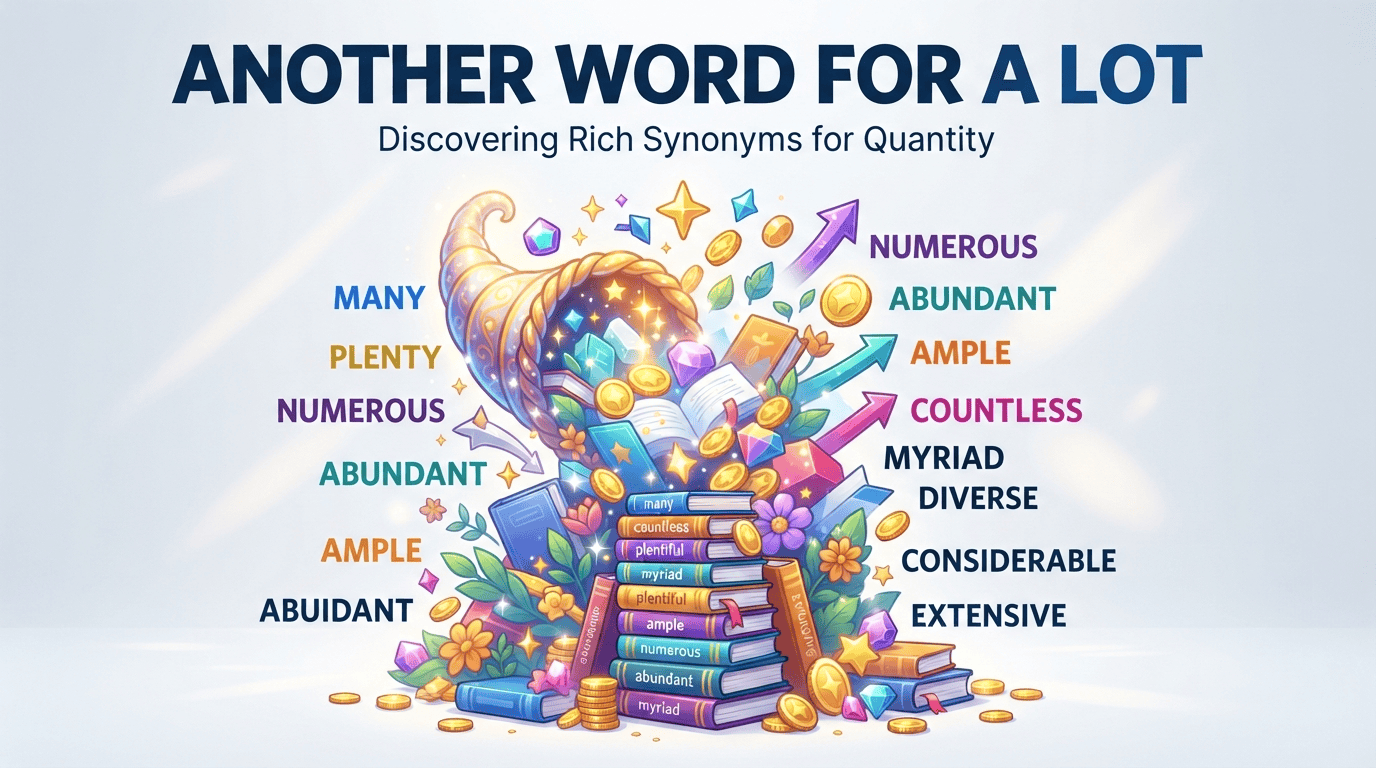
Common alternatives for a lot include many, much, plenty, numerous, abundant, countless, several, ample, tons, heaps, and a great deal.
The phrase “a lot” is very common in everyday English. We use it when we want to say that there is a large amount or a large number of something. For example, you can say, “She has a lot of books,” or “He studies a lot.” While “a lot” is correct, using different words can make your English more varied and precise.
Knowing alternatives is useful for students, English learners, writers, and speakers. Some alternatives work with countable nouns, while others work with uncountable nouns. Some are formal, while others are casual.
In this article, you will learn 25 alternatives to “a lot”, their meanings, parts of speech, and example sentences.
Meaning of A Lot
Definition and Part of Speech
A lot means a large amount or a large number. It is an informal phrase that can work in different ways depending on the sentence.
- As a quantity phrase: a large amount or number.
- As an adverbial phrase: very often or to a great degree.
Example 1: There are a lot of students in the classroom.
Example 2: I a lot enjoy reading.
Note: In natural English, “I enjoy reading a lot” is the more usual form.
Connotative Meaning
Connotation means the feeling or idea a word suggests beyond its basic meaning.
| Type | Connotation |
| Positive | Can suggest plenty or abundance |
| Negative | Can suggest an excessive amount |
| Neutral | Simply means a large amount or number |
Etymology of A Lot
The phrase a lot comes from the older word lot, which referred to an object used for making a choice or deciding something by chance. Over time, lot also developed the meaning of a portion or quantity.
- Old English: Related ideas of portions and shares existed through older Germanic words.
- Middle English: Lot was used for a portion, share, or group.
- Modern English: A lot developed into a common expression meaning “a large amount” or “a large number.”
Pronunciation of A Lot
A lot: /ə ˈlɒt/ in British English
A lot: /ə ˈlɑːt/ in American English
Syllables: a-lot → 2 syllables
Affixation Pattern
A lot is a phrase rather than a word formed with prefixes and suffixes.
- Root word: lot
- Prefix: none
- Suffix: none
- Related forms: lots, a lot of, lots of
Examples:
- a lot of books
- lots of water
- I like it a lot
25 Other Words for A Lot With Meaning & Examples
1. Many
Part of speech: Determiner / pronoun
Meaning: A large number of people or things.
- Many students joined the competition.
- She has many books at home.
2. Much
Part of speech: Determiner / pronoun
Meaning: A large amount of something uncountable.
- There isn’t much water left.
- He doesn’t have much time.
3. Plenty
Part of speech: Pronoun / determiner
Meaning: More than enough of something.
- We have plenty of food.
- There is plenty of time to finish.
4. Numerous
Part of speech: Adjective
Meaning: Existing in large numbers.
- Numerous people attended the event.
- She received numerous messages.
5. Abundant
Part of speech: Adjective
Meaning: Existing in large quantities.
- Fresh fruit is abundant in summer.
- The region has abundant natural resources.
6. Countless
Part of speech: Adjective
Meaning: Too many to count accurately.
- She has helped countless people.
- We saw countless stars in the sky.
7. Several
Part of speech: Determiner / pronoun
Meaning: More than two but not a large or exact number.
- I have visited several cities.
- Several students answered correctly.
8. Ample
Part of speech: Adjective
Meaning: Enough or more than enough.
- We have ample space for everyone.
- There is ample evidence to support the idea.
9. Tons
Part of speech: Informal noun
Meaning: A very large amount.
- She has tons of homework.
- There are tons of interesting books here.
10. Heaps
Part of speech: Informal noun
Meaning: A large amount or quantity.
- He has heaps of energy.
- There are heaps of clothes on the bed.
11. A Great Deal
Part of speech: Noun phrase
Meaning: A large amount, usually with uncountable nouns.
- She has a great deal of patience.
- We learned a great deal from the lesson.
12. A Large Number
Part of speech: Noun phrase
Meaning: Many people or things.
- A large number of students participated.
- A large number of visitors came today.
13. A Great Many
Part of speech: Determiner phrase
Meaning: A very large number of people or things.
- A great many people supported the project.
- A great many books were donated.
14. Loads
Part of speech: Informal noun
Meaning: A very large amount or number.
- We have loads of work to do.
- She has loads of friends.
15. Scores
Part of speech: Noun
Meaning: A large number, especially of people or things.
- Scores of fans attended the match.
- Scores of people visited the museum.
16. Myriad
Part of speech: Noun / adjective
Meaning: A very large or countless number.
- The internet offers a myriad of choices.
- There are myriad ways to solve the problem.
17. Copious
Part of speech: Adjective
Meaning: Existing in large quantities.
- He took copious notes during the lecture.
- The report contains copious details.
18. Plentiful
Part of speech: Adjective
Meaning: Available in large amounts.
- Food was plentiful at the celebration.
- Opportunities are plentiful in the city.
19. Vast
Part of speech: Adjective
Meaning: Extremely large in amount, size, or range.
- The library has a vast collection of books.
- She has vast knowledge of history.
20. Substantial
Part of speech: Adjective
Meaning: Large or considerable in amount.
- They made a substantial investment.
- He has made substantial progress.
21. Considerable
Part of speech: Adjective
Meaning: Large enough to be important or noticeable.
- She has considerable experience.
- The project requires considerable effort.
22. Excessive
Part of speech: Adjective
Meaning: More than is necessary or reasonable.
- Excessive noise can be annoying.
- He spent an excessive amount of money.
23. Overflowing
Part of speech: Adjective
Meaning: Filled with more than can be contained.
- The basket was overflowing with fruit.
- Her notebook was overflowing with ideas.
24. In Abundance
Part of speech: Phrase
Meaning: Existing in large quantities.
- Fresh vegetables are available in abundance.
- Wildlife can be found in abundance there.
25. In Large Quantities
Part of speech: Phrase
Meaning: In very large amounts or numbers.
- The factory produces goods in large quantities.
- These products are sold in large quantities.
Important: These alternatives are not always interchangeable. Many is mainly used with countable nouns, while much is used with uncountable nouns. Informal choices like tons, loads, and heaps are better for casual speech, while numerous, substantial, and considerable are more suitable for formal writing.
Prototype Meaning
The prototype meaning of “a lot” is a large amount or a large number.
For example:
“There are a lot of books on the shelf.”
The basic idea is that the number of books is large.
Prototype Categorization
| Category | Alternatives |
| Large number | many, numerous, countless, scores |
| Large amount | much, a great deal, substantial, considerable |
| More than enough | plenty, ample, abundant |
| Informal | tons, heaps, loads |
| Very large | vast, myriad, copious |
| Excessive | excessive, overflowing |
This grouping helps you choose a word based on the exact meaning and level of formality you need.
Antonyms of A Lot
1. Little
Part of speech: Determiner / pronoun
Meaning: A small amount.
- There is little water left.
- He has little patience.
2. Few
Part of speech: Determiner / pronoun
Meaning: A small number.
- Few students were absent.
- I have few questions.
3. Scarce
Part of speech: Adjective
Meaning: Available in a small amount or number.
- Clean water is scarce in some areas.
- Resources were scarce.
4. Minimal
Part of speech: Adjective
Meaning: Very small in amount.
- The damage was minimal.
- He made minimal changes.
5. None
Part of speech: Pronoun / determiner
Meaning: Not any.
- None of the students were late.
- There is none left.
Short Questions and Answers
What is another word for “a lot”?
Many, much, plenty, numerous, and abundant are common alternatives.
What is a formal word for “a lot”?
Words such as numerous, considerable, substantial, abundant, and copious can work in formal writing.
What is an informal word for “a lot”?
Tons, loads, and heaps are common informal alternatives.
Can “many” replace “a lot”?
Yes, when talking about a large number of countable things.
Example:
A lot of students → Many students
Can “much” replace “a lot”?
Yes, when talking about a large amount of an uncountable noun.
Example:
A lot of water → Much water
Is “a lot” formal English?
It is correct English, but it is generally more common in everyday and informal writing.
Conclusion
The phrase “a lot” is useful and common, but English has many alternatives that can make your speech and writing more precise. Words such as many, much, plenty, numerous, abundant, countless, ample, and considerable can express large amounts or numbers in different ways. Informal choices like tons, loads, and heaps are useful in casual conversations, while formal words such as substantial and copious may fit academic or professional writing better.
The key is to choose the alternative that matches your noun, meaning, and tone. Practice using these words in your daily writing and speaking to build stronger English vocabulary.

I’m Naz Fatima, a dedicated content writer with expertise in language, synonyms, and well-researched article writing.
My experience in creating clear, engaging, and informative content reflects my commitment to quality, accuracy, and reader value.










