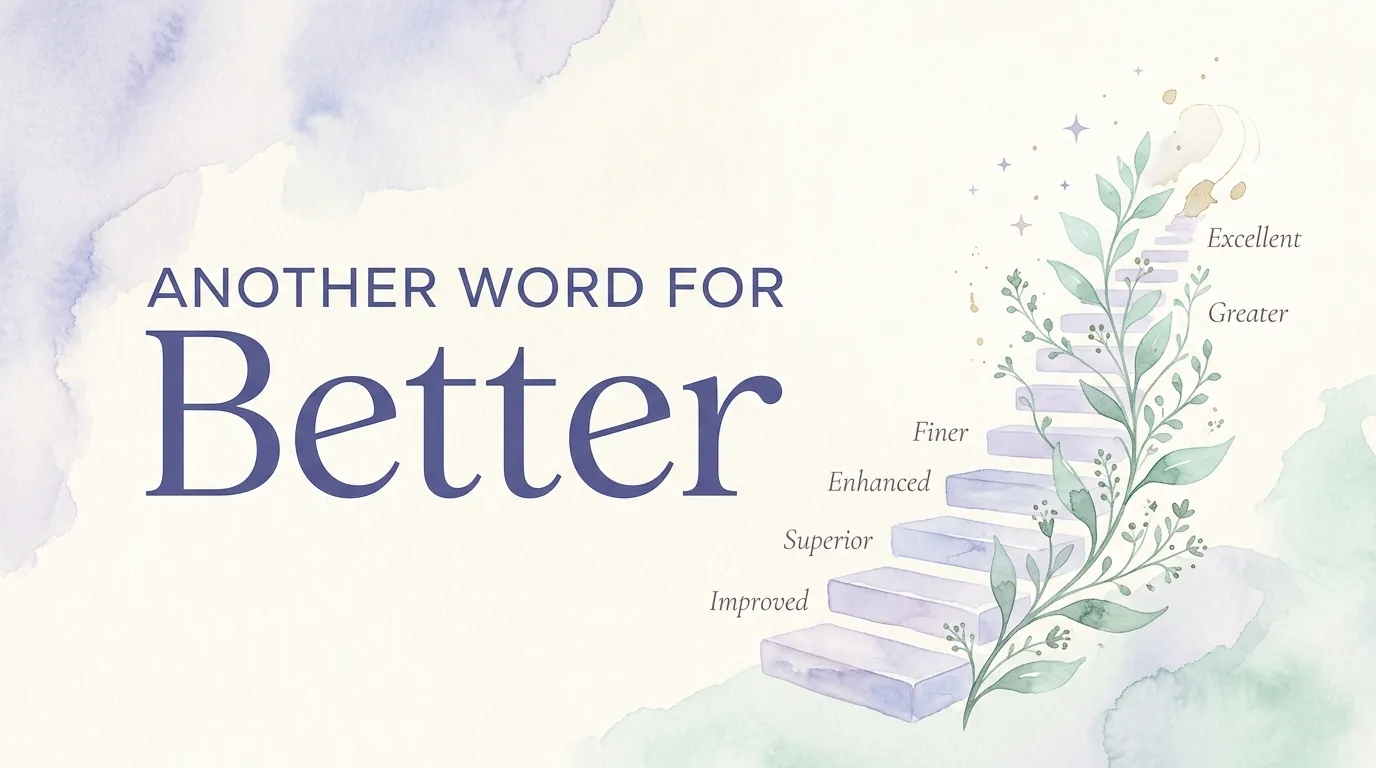
Another word for better can be improved, superior, preferable, stronger, greater, enhanced, more effective, more suitable, favorable, or advanced, depending on the context.
Better means improved, more suitable, or of a higher quality than something else. For example, if you try two phones and find that one works faster, you may say that it is better. We use better every day when comparing people, things, choices, results, or situations. It is one of the most common words in English because it can describe improvement as well as comparison.
However, using the same word too often can make writing less varied. Learning another word for better helps English learners express comparisons more clearly and choose words that fit different situations. It also helps content writers create natural and engaging content.
This article explains the meaning, grammar, history, pronunciation, and word formation of better, along with 27 useful alternatives, examples, semantic categories, antonyms, and common questions.
Meaning of Better
Definition
Better (Adjective/Adverb/Verb/Noun): Higher in quality, more suitable, more effective, or improved compared with something else.
Examples
- This solution is better than the previous one.
- She feels better after getting some rest.
Connotative Meaning
The word better usually carries a positive idea because it suggests improvement or a more favorable comparison.
- Positive tone: It can suggest progress, improvement, quality, or success.
- Negative tone: In some contexts, comparing something as better can imply that another option is weaker or less suitable.
- Neutral tone: It can simply describe a difference in quality or condition.
(Connotation: the feeling or idea that a word suggests beyond its basic meaning.)
Etymology
Better comes from Old English betera, the comparative form of bet, meaning “good.”
- Old English (450–1100): Betera was used as the comparative form of good, meaning “more good” or “more favorable.”
- Middle English (1100–1500): The word developed into forms such as betere and better.
- Modern English (1500–Present): Better became the standard comparative form of good and well, with meanings related to improvement, quality, health, and preference.
Pronunciation (IPA)
- IPA: /ˈbetər/
- Syllables: bet-ter
Affixation Pattern of Better
- Root: bet- related to the idea of good or improvement
- Prefix: None
- Suffix: None in the modern word
- Word formations:
- better: adjective/adverb/verb/noun
- bettered: verb
- bettering: verb
- best: superlative form of good/well
- betterment: noun
- better-known: adjective phrase
- better-quality: adjective phrase
27 Other Words With Meaning & Examples
1. Improved (Adjective)
Meaning: Made better than it was before.
Examples:
- The new version has improved features.
- Her writing has greatly improved.
2. Superior (Adjective)
Meaning: Higher in quality, value, or performance.
Examples:
- This material is superior to the older one.
- The new model offers superior performance.
3. Preferable (Adjective)
Meaning: More desirable or suitable than another choice.
Examples:
- A quiet room is preferable for studying.
- This option is preferable to the first one.
4. Enhanced (Adjective)
Meaning: Improved by adding useful features or qualities.
Examples:
- The update provides enhanced security.
- The product has enhanced performance.
5. Stronger (Adjective)
Meaning: More powerful, effective, or capable.
Examples:
- The new argument is stronger.
- She developed a stronger understanding of the topic.
6. Greater (Adjective)
Meaning: Larger, higher, or more important in degree or amount.
Examples:
- The new system provides greater flexibility.
- This method offers greater accuracy.
7. More Effective (Adjective Phrase)
Meaning: Producing a better or more useful result.
Examples:
- Exercise can be a more effective way to manage stress.
- We need a more effective solution.
8. More Efficient (Adjective Phrase)
Meaning: Working better while using less time, energy, or resources.
Examples:
- The new process is more efficient.
- This machine is more efficient than the old one.
9. More Suitable (Adjective Phrase)
Meaning: More appropriate for a particular purpose or situation.
Examples:
- This book is more suitable for beginners.
- We need a more suitable location.
10. More Favorable (Adjective Phrase)
Meaning: More positive or helpful than another option.
Examples:
- The company received more favorable results.
- We are looking for more favorable conditions.
11. Advanced (Adjective)
Meaning: More developed, modern, or sophisticated.
Examples:
- The laboratory uses advanced technology.
- She enrolled in an advanced course.
12. Superior-Quality (Adjective)
Meaning: Having a higher level of quality.
Examples:
- The store sells superior-quality products.
- Customers expect superior-quality materials.
13. Optimal (Adjective)
Meaning: Best or most effective for a particular purpose.
Examples:
- We need the optimal solution.
- The machine works at an optimal level.
14. Ideal (Adjective)
Meaning: Perfectly suitable for a particular purpose or situation.
Examples:
- This location is ideal for a small business.
- Morning is an ideal time to study.
15. Preferable (Adjective)
Meaning: More desirable than another option.
Examples:
- Online payment may be preferable for some customers.
- The second plan is preferable to the first.
16. More Beneficial (Adjective Phrase)
Meaning: Providing more useful or positive results.
Examples:
- Regular practice is more beneficial than occasional study.
- The new approach may be more beneficial.
17. More Valuable (Adjective Phrase)
Meaning: Having greater usefulness, importance, or worth.
Examples:
- Practical experience can be more valuable than theory alone.
- Her advice was more valuable than expected.
18. More Effective (Adjective Phrase)
Meaning: More successful at producing the desired result.
Examples:
- The revised strategy is more effective.
- This method is more effective for beginners.
19. More Powerful (Adjective Phrase)
Meaning: Having greater strength, influence, or ability.
Examples:
- The new computer has a more powerful processor.
- The updated tool is more powerful.
20. Finer (Adjective)
Meaning: Of higher quality or greater excellence.
Examples:
- The restaurant offers finer dishes.
- She selected a finer material for the dress.
21. Preferable (Adjective)
Meaning: More acceptable, suitable, or desirable.
Examples:
- A direct answer is preferable here.
- The second option is preferable for this task.
22. Upgraded (Adjective)
Meaning: Improved by replacing or adding better features.
Examples:
- The hotel has upgraded rooms.
- We bought an upgraded version of the device.
23. Refined (Adjective)
Meaning: Improved by making something more effective, precise, or polished.
Examples:
- The writer developed a refined style.
- The company introduced a refined design.
24. Optimized (Adjective)
Meaning: Improved to work as effectively as possible.
Examples:
- The website has an optimized design.
- The software is optimized for mobile devices.
25. More Appropriate (Adjective Phrase)
Meaning: More suitable for a particular situation or purpose.
Examples:
- This example is more appropriate for children.
- We need a more appropriate response.
26. More Desirable (Adjective Phrase)
Meaning: More wanted, attractive, or preferred.
Examples:
- The second option is more desirable.
- Flexible hours are more desirable for many workers.
27. More Positive (Adjective Phrase)
Meaning: Showing greater benefit, hope, approval, or improvement.
Examples:
- The company received more positive feedback.
- Her new attitude is more positive.
Prototype Meaning
The most typical meaning of better is having higher quality or being more improved than something else. When people hear this word, they usually think of a comparison in which one person, thing, method, or situation has improved or is more desirable than another.
Prototype Categorization
The 27 alternatives can be grouped into meaningful semantic categories:
- General improvement: improved, enhanced, upgraded, refined, optimized describe something that has become better than before.
- Higher quality: superior, finer, superior-quality emphasize higher quality or excellence.
- Greater effectiveness: more effective, more efficient, more powerful, stronger focus on performance and results.
- Suitability and preference: preferable, more suitable, more appropriate, more desirable, ideal work when comparing choices or options.
- Value and benefit: more beneficial, more valuable, greater emphasize usefulness, importance, or worth.
- Development and sophistication: advanced, optimal, optimized are useful for technology, systems, methods, and processes.
- Positive comparison: more favorable, more positive focus on improved conditions, reactions, or outcomes.
This categorization helps writers choose a word based on the exact meaning they want instead of using better repeatedly.
Antonyms of Better
Worse (Adjective/Adverb)
Lower in quality, condition, or effectiveness.
Inferior (Adjective)
Lower in quality or value than something else.
Poorer (Adjective)
Of lower quality or in a less favorable condition.
Weaker (Adjective)
Having less strength, power, or effectiveness.
Declining (Adjective)
Becoming worse or decreasing in quality or condition.
Deteriorated (Adjective)
Having become worse than before.
Short Questions and Answers
What does better mean?
Better means improved, higher in quality, more effective, or more suitable than something else.
When should better be used?
Use better when comparing two or more things, people, choices, conditions, or results, or when describing an improvement.
Is better positive or negative?
Better usually has a positive meaning because it suggests improvement or a favorable comparison. However, the exact tone depends on context.
How is it different from similar words?
Better is a broad comparative word. Superior focuses on higher quality, preferable focuses on choice, improved focuses on change, and more effective focuses on results.
Conclusion
Learning another word for better can make your English more precise and varied. Words such as improved, superior, preferable, enhanced, advanced, refined, optimal, and more effective can express different types of improvement or comparison. The best alternative depends on what you are describing.
For example, improved works well for something that has changed, superior highlights higher quality, and preferable describes a better choice. Using these alternatives can reduce repetition and make essays, articles, emails, and conversations sound more natural. A wider vocabulary also helps you express ideas with greater accuracy. Try learning a few alternatives each day and use them in your own sentences. With regular practice, you can build stronger English vocabulary and communicate your ideas with greater confidence.
Another Word for Many: 22 Powerful Alternatives

I’m Mubashra Waleed, a content writer specializing in English vocabulary, synonyms, word meanings. I focus on creating clear, accurate, and engaging content that makes English language learning simple and useful for readers.










