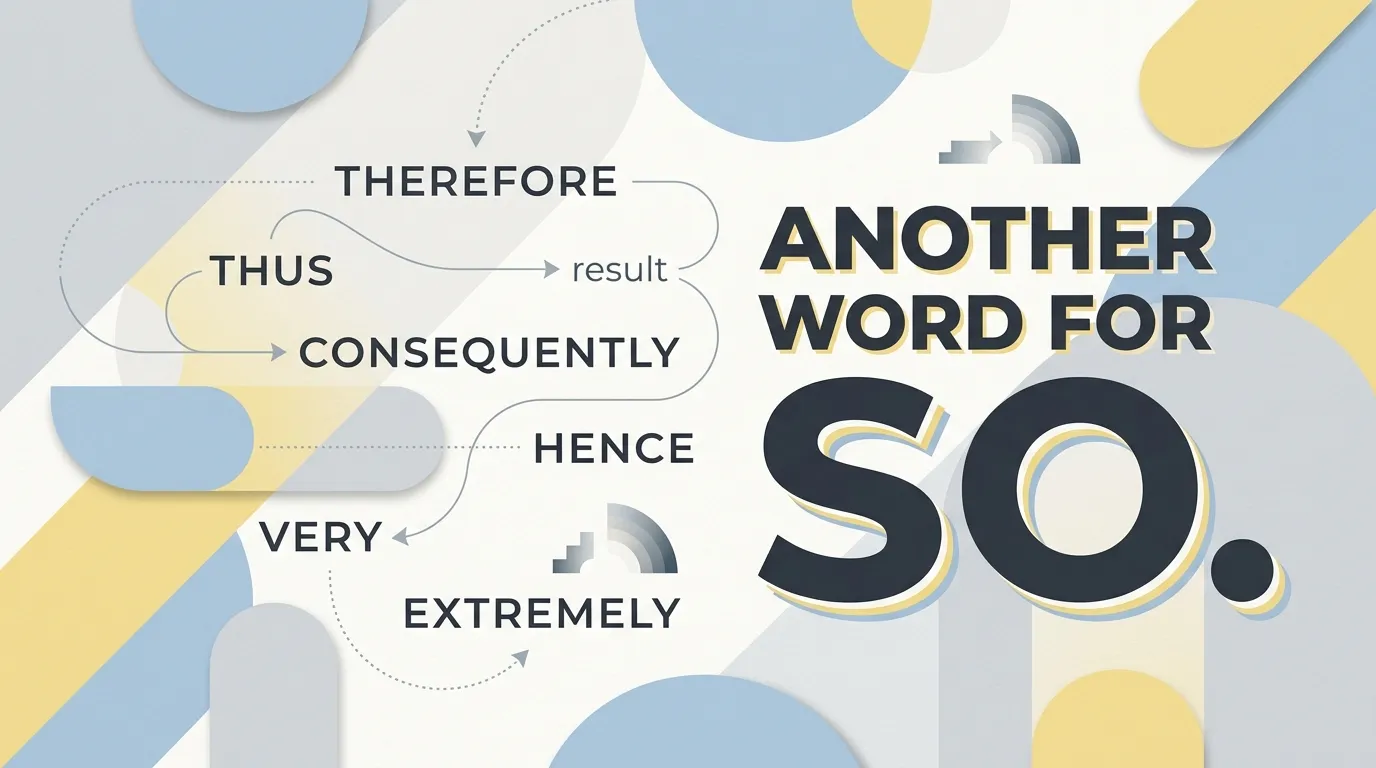
Some useful alternatives for “so” include:
- Therefore
- Thus
- Hence
- Consequently
- Accordingly
- Very
- Extremely
- Really
- Therefore
- Incredibly
The best alternative depends on whether “so” means “therefore,” “very,” “in this way,” or “to such a degree.”
Meaning of “So”
Definition
So is a common English word with several meanings. It can show a result, describe a high degree, or explain the way something happens.
For example:
- It was raining, so we stayed home.
- She was so happy.
- Do it so that everyone can understand.
Examples
- He was tired, so he went to bed early.
- The movie was so interesting that I watched it twice.
- Please arrange the books so they are easy to find.
Connotative Meaning
The word “so” is usually neutral, but its feeling changes with context.
- Positive: She was so kind to everyone.
- Negative: He was so careless with his work.
- Neutral: It was so cold that we stayed indoors.
Etymology of “So”
The word “so” has a very old history in English.
- Old English: swā was used to mean “in this way” or “to such a degree.”
- Middle English: The form developed into so and remained common in everyday speech.
- Modern English: “So” now has several grammatical uses, including showing results, degree, manner, and purpose.
Pronunciation of “So”
IPA: /soʊ/
Syllables: 1
Pronunciation: soh
It is a short, one-syllable word that is easy to pronounce and very common in spoken English.
Affixation Pattern
So is a simple function word and does not normally take prefixes or suffixes.
- Root/base: so
- Prefix: none
- Suffix: none
- Part of speech: adverb, conjunction, and sometimes a discourse marker
Common grammatical uses include:
- Adverb: She is so happy.
- Conjunction: It was late, so we left.
- Discourse marker: So, what should we do next?
Other Words With Meaning & Examples
1. Therefore: Adverb
Meaning: For that reason or as a result.
Examples:
- It was raining; therefore, the match was canceled.
- She studied hard; therefore, she passed the test.
2. Thus: Adverb
Meaning: In this way or as a result.
Examples:
- He forgot the key and thus could not enter.
- The plan was carefully designed and thus worked well.
3. Hence: Adverb
Meaning: For this reason or as a result.
Examples:
- The road was blocked; hence, we took another route.
- She was unwell, hence her absence.
4. Consequently: Adverb
Meaning: As a result of something.
Examples:
- He missed the bus and consequently arrived late.
- The store closed early; consequently, we went home.
5. Accordingly: Adverb
Meaning: In a way that matches a situation or result.
Examples:
- The weather changed, so we acted accordingly.
- The rules were updated, and the team adjusted accordingly.
6. Very: Adverb
Meaning: To a high degree.
Examples:
- The test was very easy.
- She is very happy today.
7. Extremely: Adverb
Meaning: To a very high degree.
Examples:
- The weather was extremely hot.
- The book was extremely useful.
8. Really: Adverb
Meaning: To a high or significant degree.
Examples:
- The movie was really good.
- I am really tired today.
9. Highly: Adverb
Meaning: To a great degree.
Examples:
- She is highly skilled at her job.
- This book is highly recommended for beginners.
10. Particularly: Adverb
Meaning: More than usual or especially.
Examples:
- I was particularly impressed by the design.
- The lesson was particularly helpful.
11. Especially: Adverb
Meaning: More than others or mainly.
Examples:
- I enjoy fruit, especially strawberries.
- The advice was especially useful for beginners.
12. Incredibly: Adverb
Meaning: To an unusually high degree.
Examples:
- The view was incredibly beautiful.
- She was incredibly helpful.
13. Remarkably: Adverb
Meaning: To an unusually noticeable degree.
Examples:
- The child was remarkably calm.
- The project was remarkably successful.
14. Exceptionally: Adverb
Meaning: To a greater degree than usual.
Examples:
- The restaurant was exceptionally busy.
- He performed exceptionally well.
15. Clearly: Adverb
Meaning: In an obvious or easy-to-understand way.
Examples:
- She clearly understood the instructions.
- The evidence clearly supports the idea.
16. Therefore, Accordingly: Result Expression
Meaning: Used to connect an action or fact with its result.
Examples:
- The deadline was moved; therefore, we changed our schedule.
- The instructions were unclear, so we responded accordingly.
17. In This Way: Phrase
Meaning: By using a particular method.
Examples:
- Arrange the items in this way.
- In this way, everyone can understand the process.
18. In That Way: Phrase
Meaning: Using the method already mentioned.
Examples:
- Do it in that way to avoid mistakes.
- He explained the problem in that way.
19. To Such a Degree: Phrase
Meaning: To a particular or very high level.
Examples:
- The storm was severe to such a degree that flights were delayed.
- She was surprised to such a degree that she could not speak.
20. As a Result: Phrase
Meaning: Because of something that happened.
Examples:
- He practiced daily. As a result, his skills improved.
- The store was closed. As a result, we returned home.
21. For This Reason: Phrase
Meaning: Because of the reason just given.
Examples:
- The road was unsafe. For this reason, we stayed home.
- She needed more time. For this reason, the meeting was postponed.
22. In Consequence: Phrase
Meaning: As a result of something.
Examples:
- The company changed its policy and, in consequence, reduced costs.
- He ignored the warning and suffered in consequence.
23. In Such a Manner: Phrase
Meaning: In a particular way.
Examples:
- The instructions were written in such a manner that beginners could follow them.
- She organized the files in such a manner that they were easy to find.
24. To This Extent: Phrase
Meaning: To this particular degree or level.
Examples:
- I did not expect the problem to continue to this extent.
- The changes improved the service to this extent.
Prototype Meaning of “So”
The most basic idea behind “so” is connection or degree.
It often connects one idea to another:
Cause → Result
It was raining, so we stayed inside.
It can also show degree:
Degree → Description
The bag was so heavy.
Or it can describe manner:
Action → Way
Arrange the books so everyone can find them.
Prototype Categorization
The different uses of “so” can be grouped into several semantic categories:
- Result: therefore, thus, hence, consequently
- Degree: very, extremely, really, highly
- Manner: in this way, in that way
- Reason: for this reason, as a result
- Emphasis: especially, particularly, incredibly
- Formal result expressions: accordingly, in consequence
Antonyms of “So”
Because “so” has several meanings, its antonyms depend on the context.
- Not at all: opposite of “so” meaning to a high degree
- Otherwise: can contrast with “so” when describing a particular way
- Nevertheless: contrasts with result-based connections in some contexts
- Barely: opposite of a high degree
- Slightly: opposite of strong degree
Short Questions and Answers
What is another word for “so”?
Depending on the meaning, alternatives include therefore, thus, hence, very, extremely, really, and consequently.
What is a formal word for “so”?
Therefore, thus, hence, and consequently are common formal alternatives.
What is another word for “so” meaning “very”?
You can use very, extremely, highly, incredibly, or remarkably.
What is another word for “so” meaning “therefore”?
Use therefore, thus, hence, consequently, or accordingly.
Is “thus” the same as “so”?
They can have the same meaning when “so” means “therefore” or “as a result,” but “thus” is generally more formal.
Conclusion
The word “so” is short but has many uses in English. It can show a result, express degree, describe a manner, or connect ideas. Words such as therefore, thus, hence, consequently, very, extremely, and really can replace it in specific situations. However, not every alternative works in every sentence.
Choosing the right word depends on the meaning you want to express and the level of formality you need. Learning these alternatives can help English learners, students, bloggers, and content writers make their writing clearer and more varied. Understanding the context is the key to choosing the most natural replacement for “so.”
Another Word for Better: 27 Strong Alternatives

I’m Mubashra Waleed, a content writer specializing in English vocabulary, synonyms, word meanings. I focus on creating clear, accurate, and engaging content that makes English language learning simple and useful for readers.










