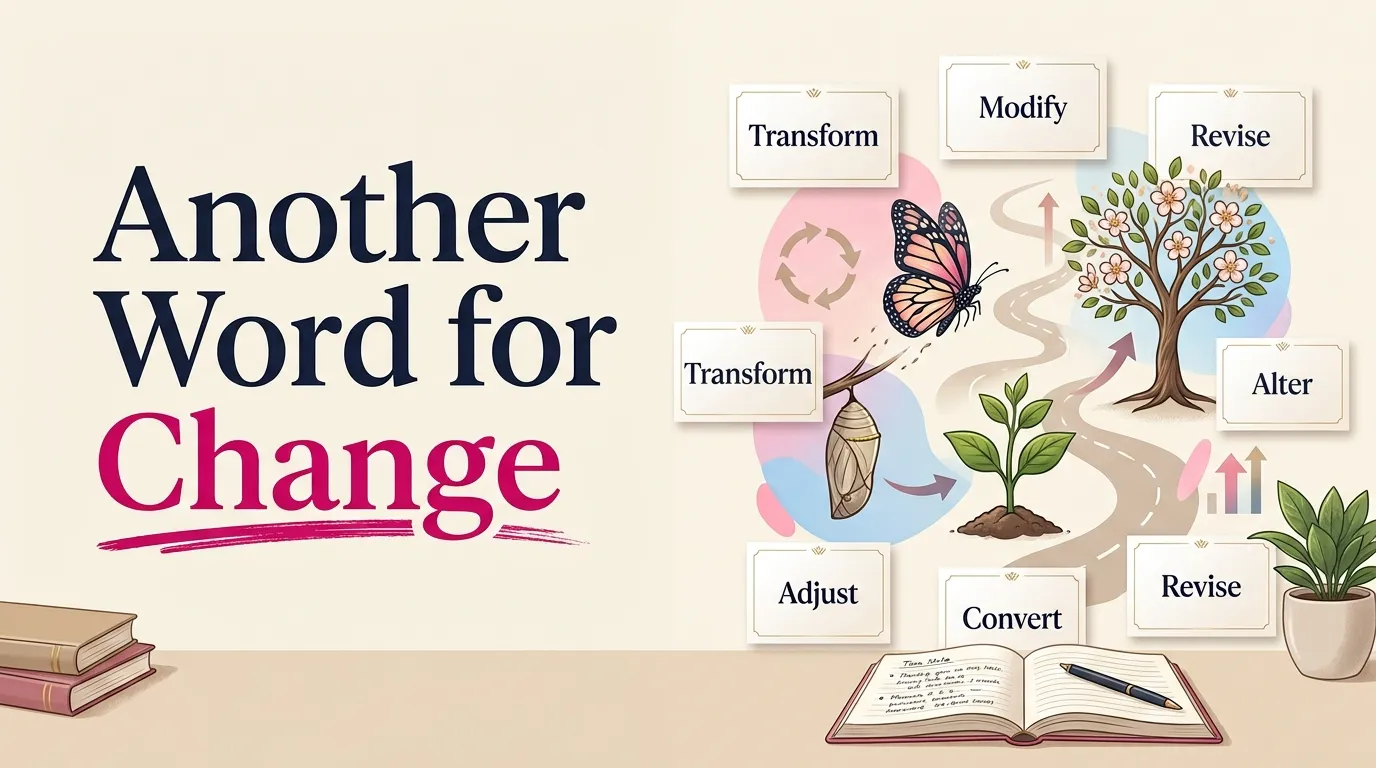
Some useful alternatives for change are:
- Alter: to make something different
- Modify: to make a small adjustment
- Transform: to change greatly
- Adjust: to make a small change
- Revise: to improve or update
- Convert: to change into another form
- Replace: to take the place of something
- Vary: to become or make different
- Shift: to move from one state or position to another
- Adapt: to change to fit new conditions
Change means making something different or becoming different. Imagine moving to a new school. You may meet new people, follow a new schedule, and learn new subjects. These are all forms of change. The word is very common because change happens in daily life, work, education, technology, and relationships. However, using the same word many times can make writing sound repetitive.
Learning another word for change helps English learners and content writers express the exact type of change they mean. For example, modify suggests a small adjustment, while transform suggests a major change.
In this article, we will explore the meaning of change, its grammar, history, pronunciation, and word formation. We will also examine 23 useful alternatives with examples, semantic categories, antonyms, and common questions.
Meaning of Change
Definition
Change (Verb/Noun):
To make something different, or the process of becoming different.
Examples
- Technology can change the way we work.
- There has been a major change in the company’s plans.
Connotative Meaning
Positive tone: Change can suggest growth, improvement, progress, or a fresh start.
Negative tone: Change can suggest loss, uncertainty, disruption, or difficulty.
Neutral tone: It can simply describe something becoming different.
(Connotation: the feeling or idea that a word suggests beyond its basic meaning.)
Etymology
The word change entered English through Old French and ultimately comes from Latin roots connected with exchange and alteration.
- Old English (450–1100): English used other native words and expressions for ideas such as turning, shifting, or becoming different. The modern form of change was not yet established.
- Middle English (1100–1500): Change entered English through Anglo-French and Old French forms related to changier, meaning “to alter” or “exchange.”
- Modern English (1500–Present): Change developed into a very broad word used for physical, personal, social, financial, and abstract changes.
Pronunciation (IPA)
- IPA: /tʃeɪndʒ/
- Syllables: one syllable
Affixation Pattern of Change
- Root: change
- Prefix: None
- Suffix: None in the basic word
- Word formations:
- Change: noun/verb
- Changed: adjective/past participle
- Changing: adjective/present participle
- Changeable: adjective
- Changer: noun
- Exchange: noun/verb
- Interchange: noun/verb
- Unchanged: adjective
- Changeable: adjective
23 Other Words With Meaning & Examples
1. Alter (Verb)
Meaning: To make something different without completely replacing it.
Examples:
- We need to alter the design slightly.
- She altered her plans after the meeting.
2. Modify (Verb)
Meaning: To make small changes to improve or adjust something.
Examples:
- The designer modified the logo.
- You can modify the settings later.
3. Transform (Verb)
Meaning: To change something greatly into a new form.
Examples:
- Technology has transformed modern education.
- The renovation transformed the old house.
4. Adjust (Verb)
Meaning: To make a small change so something works better.
Examples:
- Please adjust the chair.
- We need to adjust the schedule.
5. Revise (Verb)
Meaning: To change something in order to improve or update it.
Examples:
- The writer revised the article.
- We need to revise the original plan.
6. Convert (Verb)
Meaning: To change something from one form, use, or system into another.
Examples:
- They converted the garage into an office.
- You can convert the file into a PDF.
7. Replace (Verb)
Meaning: To remove something and put another thing in its place.
Examples:
- We need to replace the broken screen.
- She replaced the old chair with a new one.
8. Vary (Verb)
Meaning: To make or become different in amount, level, or type.
Examples:
- Prices vary from store to store.
- You can vary the colors in the design.
9. Shift (Verb/Noun)
Meaning: To move from one position, condition, or idea to another.
Examples:
- Public opinion began to shift.
- There was a shift in the company’s strategy.
10. Adapt (Verb)
Meaning: To change something so it works in a new situation.
Examples:
- We must adapt to new technology.
- She adapted the lesson for younger students.
11. Evolve (Verb)
Meaning: To develop gradually into something different.
Examples:
- The internet continues to evolve.
- Her writing style evolved over time.
12. Reform (Verb/Noun)
Meaning: To change a system or practice in order to improve it.
Examples:
- The organization plans to reform its policies.
- The government introduced several reforms.
13. Revamp (Verb/Noun)
Meaning: To improve something by making major changes.
Examples:
- The company decided to revamp its website.
- The store received a complete revamp.
14. Renew (Verb)
Meaning: To make something fresh, active, or effective again.
Examples:
- They decided to renew the old building.
- The campaign helped renew interest in the product.
15. Update (Verb/Noun)
Meaning: To make something current by adding new information or features.
Examples:
- Please update the software.
- The website needs an update.
16. Replace (Verb)
Meaning: To use something new instead of something old or existing.
Examples:
- They will replace the damaged equipment.
- We should replace this outdated system.
17. Rework (Verb)
Meaning: To change something by working on it again.
Examples:
- The designer reworked the homepage.
- We need to rework this section of the report.
18. Reshape (Verb)
Meaning: To change the form, structure, or character of something.
Examples:
- Technology is reshaping the workplace.
- The new policy could reshape the industry.
19. Diversify (Verb)
Meaning: To make something more varied or include different types.
Examples:
- The company wants to diversify its products.
- Farmers are trying to diversify their crops.
20. Substitute (Verb/Noun)
Meaning: To use one person or thing instead of another.
Examples:
- You can substitute honey for sugar.
- The teacher found a substitute for the absent instructor.
21. Transition (Verb/Noun)
Meaning: To move from one state, stage, or condition to another.
Examples:
- The company is transitioning to digital services.
- The transition to a new system took several months.
22. Develop (Verb)
Meaning: To grow or change gradually over time.
Examples:
- Her skills developed through practice.
- The idea developed into a successful project.
23. Metamorphose (Verb)
Meaning: To change completely into a different form or nature.
Examples:
- The small project metamorphosed into a major business.
- The landscape metamorphosed over many years.
Prototype Meaning
The prototype meaning of change is to become different or make something different. When people hear the word, they often imagine an existing thing moving from one condition, form, or state to another. The change may be small, such as adjusting a setting, or major, such as transforming an entire organization. The broad meaning makes change useful in many situations.
Prototype Categorization
The 23 alternatives can be grouped into meaningful categories:
- Small changes: alter, modify, adjust, and revise suggest limited or controlled changes.
- Major changes: transform, revamp, reshape, and metamorphose suggest large or significant changes.
- Gradual development: evolve and develop describe changes that happen over time.
- Replacement: replace and substitute focus on putting one thing in the place of another.
- Adaptation: adapt describes changing to work well in new conditions.
- Updating and improvement: renew, update, and rework focus on making something newer or better.
- System or policy changes: reform is often used for changes intended to improve systems or practices.
- Movement or adjustment: shift and transition describe movement from one state, position, or stage to another.
- Form or variety changes: convert, vary, and diversify describe changes in form, type, or range.
This categorization helps writers choose a word that shows how much something changed and what kind of change occurred.
Antonyms of Change
1. Remain (Verb)
Meaning: To stay in the same condition or place.
2. Stay (Verb)
Meaning: To continue without moving or changing.
3. Maintain (Verb)
Meaning: To keep something in its existing condition.
4. Preserve (Verb)
Meaning: To protect something from being changed or damaged.
5. Keep (Verb)
Meaning: To continue having or using something without replacing it.
6. Stabilize (Verb)
Meaning: To make or keep something steady and less likely to change.
Short Questions and Answers
What does change mean?
Change means to make something different or to become different.
When should change be used?
Use change when describing a difference in condition, appearance, behavior, position, plans, or other qualities.
Is change positive or negative?
Change is neutral. It can be positive, negative, or simply different depending on the situation.
How is change different from transform?
Change is a broad word that can describe a small or large difference. Transform usually suggests a major or dramatic change.
What is the difference between change and modify?
Change has a broad meaning, while modify usually suggests making a smaller or more specific adjustment.
What is another word for change in writing?
Depending on the context, useful choices include alter, modify, revise, adjust, transform, shift, update, and adapt.
Conclusion
Learning another word for change can make your vocabulary stronger and your writing more precise. Words such as alter, modify, adjust, revise, transform, adapt, evolve, and reshape do not all mean exactly the same thing, but each can describe a particular type of change. Choosing the right alternative helps readers understand whether something changed slightly, gradually, or completely.
It also helps writers avoid repeating the word change throughout an article, essay, or report. For English learners, studying these words in sentences is a useful way to remember them. Try using one new alternative each day in your own writing or conversation. With regular practice, you can build a richer vocabulary and communicate your ideas with greater clarity and confidence.
Another Word for Established: 25 Useful Alternatives

I’m Mubashra Waleed, a content writer specializing in English vocabulary, synonyms, word meanings. I focus on creating clear, accurate, and engaging content that makes English language learning simple and useful for readers.










