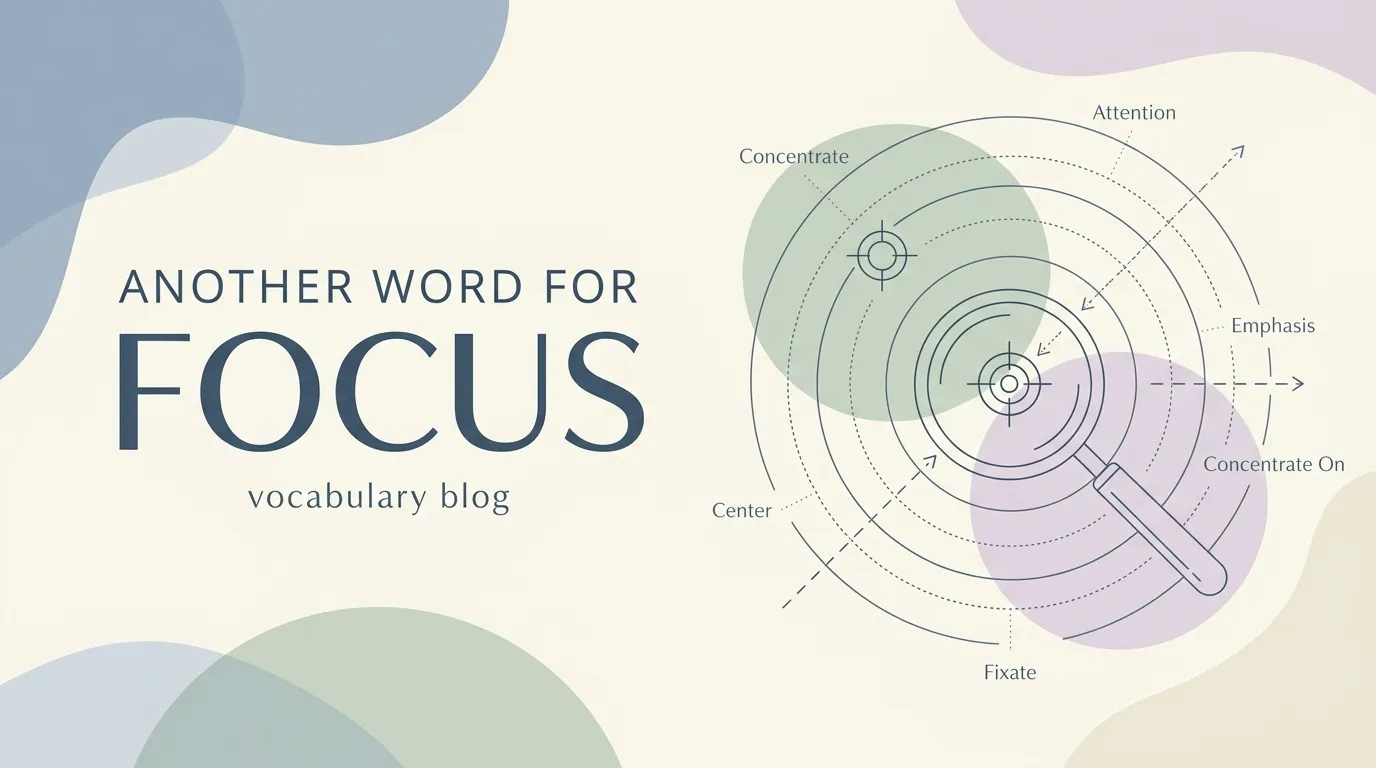
Alternatives for focus include:
- Concentrate
- Attention
- Concentration
- Emphasize
- Center
- Highlight
- Prioritize
- Target
- Direct
- Mindfulness
The best alternative depends on whether focus is being used as a verb, noun, or idea of attention and priority.
Meaning of “Focus”
Definition
Focus means giving special attention to something or directing your thoughts, effort, or activity toward a particular subject, goal, or task. As a noun, it can also mean the central point of attention.
Examples
- Try to focus on your homework.
- The main focus of the meeting was customer service.
- She focused her attention on the new project.
Connotative Meaning
The word focus is usually neutral or positive because it suggests attention and purpose.
- Positive: Her focus helped her complete the project.
- Neutral: The discussion focused on education.
- Negative: His focus on small details delayed the work.
Etymology of “Focus”
The word “focus” comes from Latin.
- Latin: focus meant “hearth” or “fireplace.”
- Early Modern English: The word was adopted in scientific contexts, especially in relation to the point where rays meet.
- Modern English: It developed broader meanings related to attention, concentration, central importance, and visual clarity.
Pronunciation of “Focus”
IPA: /ˈfoʊ.kəs/
Syllables: 2
Pronunciation: FOH-kus
The stress falls on the first syllable.
Affixation Pattern
Focus is a base word that can form several related words.
- Root/base: focus
- Prefix: none
- Suffix: -ed, -ing, -es, -ed
- Noun: focus, focusing
- Verb: focus, focuses, focused, focusing
- Adjective: focused, unfocused
Examples:
- She focuses on her studies.
- He stayed focused during the meeting.
- The team is focusing on quality.
Other Words With Meaning & Examples
1. Concentrate: Verb
Meaning: To give your full attention to something.
Examples:
- Please concentrate on the instructions.
- She concentrated on finishing her assignment.
2. Concentration: Noun
Meaning: The ability to give close attention to something.
Examples:
- The task requires strong concentration.
- Noise made it difficult to maintain concentration.
3. Attention: Noun
Meaning: Careful thought or notice given to something.
Examples:
- Please pay attention to the details.
- The teacher gave special attention to the new students.
4. Attend: Verb
Meaning: To give attention to something.
Examples:
- You should attend carefully to the instructions.
- The manager attended to the customer’s concerns.
5. Emphasize: Verb
Meaning: To give special importance to something.
Examples:
- The report emphasizes the need for better planning.
- The teacher emphasized the importance of practice.
6. Highlight: Verb
Meaning: To make something especially noticeable or important.
Examples:
- The report highlights several key problems.
- She highlighted the most important points.
7. Center: Verb
Meaning: To direct attention or activity toward something.
Examples:
- The discussion centered on education.
- The campaign centers on improving customer service.
8. Prioritize: Verb
Meaning: To treat something as more important than other things.
Examples:
- We need to prioritize our most important tasks.
- She prioritized her studies over other activities.
9. Target: Verb
Meaning: To direct an action or effort toward a particular person, group, or goal.
Examples:
- The campaign targets young customers.
- The program targets common learning difficulties.
10. Direct: Verb
Meaning: To aim attention, effort, or resources toward something.
Examples:
- She directed her attention toward the speaker.
- The company directed more resources toward research.
11. Aim: Verb
Meaning: To direct an effort toward a particular goal.
Examples:
- The project aims to improve customer service.
- He aimed his efforts at solving the problem.
12. Fixate: Verb
Meaning: To focus excessively on one thing.
Examples:
- Do not fixate on small mistakes.
- He tends to fixate on minor details.
13. Engage: Verb
Meaning: To become actively involved or interested in something.
Examples:
- The activity engaged the students’ attention.
- She became fully engaged in the discussion.
14. Observe: Verb
Meaning: To watch or examine something carefully.
Examples:
- The students observed the experiment carefully.
- She observed the details before making a decision.
15. Study: Verb
Meaning: To examine or learn something carefully.
Examples:
- He studied the data before making a decision.
- She studied the instructions carefully.
16. Examine: Verb
Meaning: To look at something carefully to understand it.
Examples:
- The researchers examined the results.
- She examined the document for errors.
17. Inspect: Verb
Meaning: To examine something closely.
Examples:
- The engineer inspected the equipment.
- She inspected the report before submitting it.
18. Spotlight: Verb
Meaning: To give special attention or publicity to something.
Examples:
- The article spotlights local businesses.
- The event spotlights young artists.
19. Feature: Verb
Meaning: To give something an important place or role.
Examples:
- The website features new products.
- The article features several useful examples.
20. Regard: Verb
Meaning: To consider or pay attention to something.
Examples:
- We regard customer feedback as important.
- She regarded the warning seriously.
21. Consider: Verb
Meaning: To think carefully about something.
Examples:
- Please consider all the available options.
- She considered the problem from several angles.
22. Highlight: Noun
Meaning: The most important or noticeable part of something.
Examples:
- The highlight of the presentation was the final demonstration.
- The report’s highlight was its clear analysis.
23. Priority: Noun
Meaning: Something considered more important than other things.
Examples:
- Customer satisfaction is our top priority.
- Finishing the project became her main priority.
24. Centralize: Verb
Meaning: To bring attention, control, or activity toward a central point.
Examples:
- The organization centralized its operations.
- The plan centralizes decision-making.
25. Orient: Verb
Meaning: To direct someone or something toward a particular purpose or goal.
Examples:
- The training is oriented toward practical skills.
- The program is oriented toward student success.
26. Address: Verb
Meaning: To give attention to a problem, subject, or need.
Examples:
- The meeting addressed several important issues.
- The company must address customer complaints.
27. Dedicate: Verb
Meaning: To give time, effort, or attention to something.
Examples:
- She dedicated her time to learning English.
- He dedicated several hours to the project.
28. Immerse: Verb
Meaning: To become deeply involved in an activity or subject.
Examples:
- She immersed herself in her studies.
- He immersed himself in learning the new software.
Prototype Meaning of “Focus”
The core meaning of focus is directing attention toward one particular thing.
For example:
She focused on her studies.
This means she directed her attention and effort toward studying.
The same basic idea appears in other uses:
- Attention: focus on a topic
- Effort: focus on a goal
- Importance: the focus of a discussion
- Vision: bring an image into focus
- Priority: focus resources on a problem
Prototype Categorization
The alternatives for focus can be grouped into several semantic categories:
- Concentration: concentrate, attention, concentration
- Importance: emphasize, highlight, spotlight
- Priority: prioritize, priority, target
- Careful examination: study, examine, inspect, observe
- Direction: direct, aim, center, orient
- Involvement: engage, immerse, dedicate
- Problem-solving: address, consider, regard
- Excessive attention: fixate
Antonyms of “Focus”
Common opposites of focus include:
- Ignore: to give no attention
- Neglect: to fail to give proper attention
- Distract: to draw attention away
- Overlook: to fail to notice something
- Disregard: to treat something as unimportant
- Scatter: to spread attention or effort across different things
Short Questions and Answers
What is another word for focus?
Common alternatives include concentrate, attention, emphasize, highlight, prioritize, center, direct, and target.
What is a formal word for focus?
Depending on context, concentrate, emphasize, prioritize, address, and direct can work well in formal writing.
What is another word for focus as a noun?
Useful noun alternatives include attention, concentration, priority, emphasis, and center.
What is another word for focus on?
Depending on the sentence, you can use concentrate on, emphasize, prioritize, center on, address, or pay attention to.
What is the opposite of focus?
Common opposites include ignore, neglect, distract, overlook, and disregard.
Conclusion
The word focus is widely used when talking about attention, concentration, goals, priorities, and important subjects. Depending on the context, alternatives such as concentrate, emphasize, highlight, prioritize, direct, target, and address can make writing more precise. Some words describe careful attention, while others emphasize importance, direction, or involvement.
For example, concentrate works well for mental attention, prioritize suggests deciding what matters most, and highlight means making something especially noticeable. Understanding these differences helps English learners and content writers choose the most natural word for each situation. By using the right alternative, your writing can become clearer, more varied, and more effective.
Another Word for Happy: 23 Ways to Express Joy

I’m Mubashra Waleed, a content writer specializing in English vocabulary, synonyms, word meanings. I focus on creating clear, accurate, and engaging content that makes English language learning simple and useful for readers.










