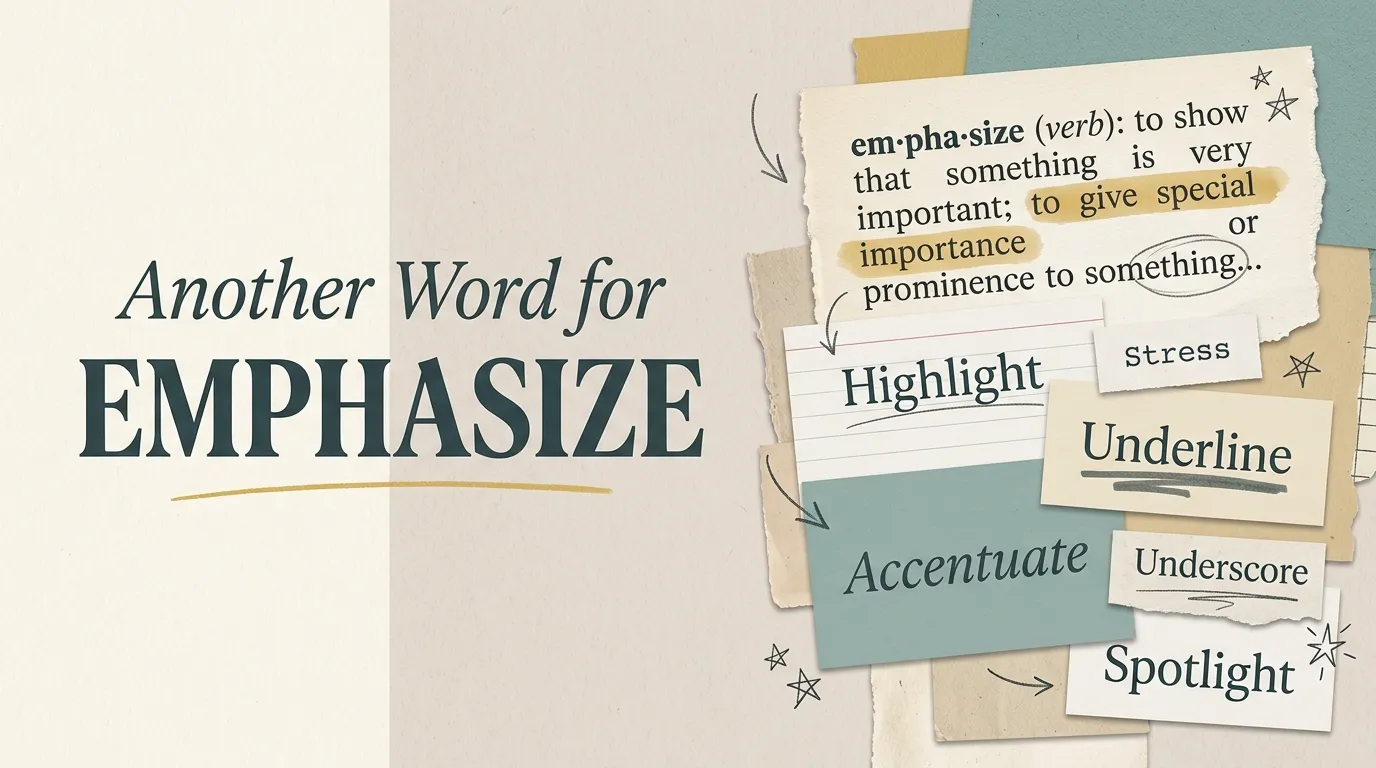
| Alternative | Meaning |
| Highlight | Draw special attention to something |
| Stress | Give extra importance to something |
| Underscore | Show that something is especially important |
| Accentuate | Make something more noticeable |
| Reinforce | Strengthen an idea or message |
| Spotlight | Give special attention to something |
| Point out | Direct attention toward something |
| Emphasize | Give extra importance |
| Magnify | Make something seem more noticeable |
| Prioritize | Treat something as especially important |
The best alternative for “emphasize” depends on whether you mean to stress importance, draw attention, make something noticeable, or reinforce an idea.
Meaning of “Emphasize”
Definition
Emphasize means to give special importance, attention, or prominence to something. It is often used when a speaker or writer wants people to notice or understand a particular idea.
Examples
- The teacher emphasized the importance of regular practice.
- The report emphasizes the need for better planning.
- She emphasized that everyone should follow the rules.
Connotative Meaning
Emphasize usually has a neutral or positive meaning because it helps make important information clear.
- Positive: The presentation emphasized the benefits of teamwork.
- Neutral: The article emphasizes several key points.
- Negative: The report emphasized the problems without discussing solutions.
Etymology of “Emphasize”
The word “emphasize” comes from the Greek and Latin tradition of expressing something with special force.
- Greek: emphainein meant “to show” or “make evident.”
- Latin: Related forms developed around the idea of making something clear or prominent.
- Modern English: Emphasize came to mean giving special importance or force to an idea, word, or detail.
The British spelling is commonly written as “emphasise.”
Pronunciation of “Emphasize”
IPA: /ˈem.fə.saɪz/
Syllables: 3
Pronunciation: EM-fuh-size
The stress falls on the first syllable.
Affixation Pattern
Emphasize is formed with the noun emphasis and the suffix -ize, which commonly forms verbs.
- Base: emphasis
- Suffix: -ize
- Part of speech: verb
- Noun: emphasis
- Adjective: emphatic
- Adverb: emphatically
Examples:
- The teacher emphasized the main idea.
- The main emphasis was on quality.
- She gave an emphatic response.
Other Words With Meaning & Examples
1. Highlight: Verb
Meaning: To make something especially noticeable or important.
Examples:
- The report highlights the main problems.
- She highlighted the most important details.
2. Stress: Verb
Meaning: To give particular importance to something.
Examples:
- The teacher stressed the importance of practice.
- He stressed that safety should come first.
3. Underscore: Verb
Meaning: To show that something is especially important.
Examples:
- The results underscore the need for change.
- Her comments underscored the importance of teamwork.
4. Accentuate: Verb
Meaning: To make something more noticeable or prominent.
Examples:
- The lighting accentuated the room’s design.
- The report accentuates the main differences.
5. Reinforce: Verb
Meaning: To make an idea, message, or feeling stronger.
Examples:
- The examples reinforce the main argument.
- The teacher used activities to reinforce the lesson.
6. Spotlight: Verb
Meaning: To give special attention or publicity to something.
Examples:
- The article spotlights local businesses.
- The event spotlights young artists.
7. Point Out: Phrasal Verb
Meaning: To direct someone’s attention to something.
Examples:
- She pointed out an important mistake.
- The guide pointed out several useful features.
8. Call Attention To: Phrase
Meaning: To make someone notice something important.
Examples:
- The campaign calls attention to environmental issues.
- The report calls attention to several safety concerns.
9. Draw Attention To: Phrase
Meaning: To make something noticeable or important.
Examples:
- The headline draws attention to the main issue.
- The design draws attention to the product.
10. Feature: Verb
Meaning: To give something a prominent or important position.
Examples:
- The website features customer reviews.
- The article features several useful examples.
11. Magnify: Verb
Meaning: To make something appear more important or noticeable.
Examples:
- The media coverage magnified the issue.
- The image magnifies small details.
12. Amplify: Verb
Meaning: To make an idea, message, or effect stronger.
Examples:
- Social media can amplify important messages.
- The campaign amplified the concerns of local residents.
13. Prioritize: Verb
Meaning: To treat something as more important than other things.
Examples:
- The company prioritizes customer satisfaction.
- We should prioritize the most urgent tasks.
14. Promote: Verb
Meaning: To support or encourage an idea, activity, or cause.
Examples:
- The program promotes healthy habits.
- The campaign promotes awareness of the issue.
15. Advocate: Verb
Meaning: To publicly support an idea, policy, or cause.
Examples:
- She advocates better access to education.
- The organization advocates environmental protection.
16. Assert: Verb
Meaning: To state something confidently and clearly.
Examples:
- The writer asserts that education is essential.
- He asserted the importance of careful planning.
17. Insist: Verb
Meaning: To state something firmly or repeatedly.
Examples:
- She insisted that the instructions were clear.
- The coach insisted on regular practice.
18. Maintain: Verb
Meaning: To continue to state or support an opinion or position.
Examples:
- The researcher maintains that more evidence is needed.
- He maintained that the decision was correct.
19. Express: Verb
Meaning: To communicate an idea, feeling, or opinion.
Examples:
- The speaker expressed the importance of cooperation.
- She expressed her concern about the situation.
20. Specify: Verb
Meaning: To state something clearly and precisely.
Examples:
- The instructions specify the required steps.
- The contract specifies the terms of the agreement.
21. Clarify: Verb
Meaning: To make an idea easier to understand.
Examples:
- The teacher clarified the main point.
- The diagram clarifies the process.
22. Stress the Importance of: Phrase
Meaning: To strongly show that something matters.
Examples:
- The doctor stressed the importance of rest.
- The manager stressed the importance of meeting deadlines.
23. Give Prominence to: Phrase
Meaning: To give something a noticeable or important position.
Examples:
- The design gives prominence to the main product.
- The article gives prominence to customer experiences.
24. Bring to the Fore: Phrase
Meaning: To make something particularly noticeable or important.
Examples:
- The discussion brought the issue to the fore.
- The report brought several concerns to the fore.
25. Give Weight to: Phrase
Meaning: To treat something as important or significant.
Examples:
- The committee gave weight to the evidence.
- The decision gave considerable weight to public feedback.
Prototype Meaning of “Emphasize”
The central meaning of emphasize is to make something stand out as important.
For example:
The teacher emphasized the main point.
This means the teacher made the main point especially important or noticeable.
The same idea appears in different forms:
- Attention: highlight an important detail
- Importance: stress a key point
- Visibility: spotlight an issue
- Strength: reinforce an argument
- Priority: prioritize an important task
Prototype Categorization
The alternatives for “emphasize” can be grouped into several semantic categories:
- Highlighting: highlight, spotlight, feature
- Stress and importance: stress, underscore, give weight to
- Making noticeable: accentuate, magnify, draw attention to
- Strengthening ideas: reinforce, amplify
- Showing priority: prioritize, promote
- Strong statements: assert, insist, maintain
- Making clear: clarify, specify, point out
Antonyms of “Emphasize”
Common opposites of emphasize include:
- Downplay: make something seem less important
- Minimize: reduce the apparent importance of something
- Ignore: give no attention to something
- Overlook: fail to notice something
- Conceal: keep something from being noticed
- Neglect: fail to give proper attention
Short Questions and Answers
What is another word for emphasize?
Common alternatives include highlight, stress, underscore, accentuate, reinforce, spotlight, and point out.
What is a formal word for emphasize?
Underscore, accentuate, reinforce, and give prominence to can work well in formal writing.
What is another word for emphasize in an essay?
Useful choices include highlight, stress, underscore, demonstrate, reinforce, and draw attention to.
What is another word for emphasize importance?
You can use stress the importance of, underscore, highlight, prioritize, or give weight to.
What is the opposite of emphasize?
Common antonyms include downplay, minimize, ignore, overlook, and neglect.
Conclusion
The word emphasize is useful when you want to show that an idea, detail, or issue deserves special attention. Depending on the context, alternatives such as highlight, stress, underscore, accentuate, reinforce, and spotlight can make your writing more varied. Some alternatives focus on making something noticeable, while others show importance, strengthen an argument, or communicate a firm position.
For example, highlight works well when drawing attention to information, underscore is common in formal writing, and reinforce suggests making an existing idea stronger. Choosing the right synonym depends on the exact meaning and tone of your sentence.
Another Word for Focus: 28 Useful Alternatives

I’m Mubashra Waleed, a content writer specializing in English vocabulary, synonyms, word meanings. I focus on creating clear, accurate, and engaging content that makes English language learning simple and useful for readers.