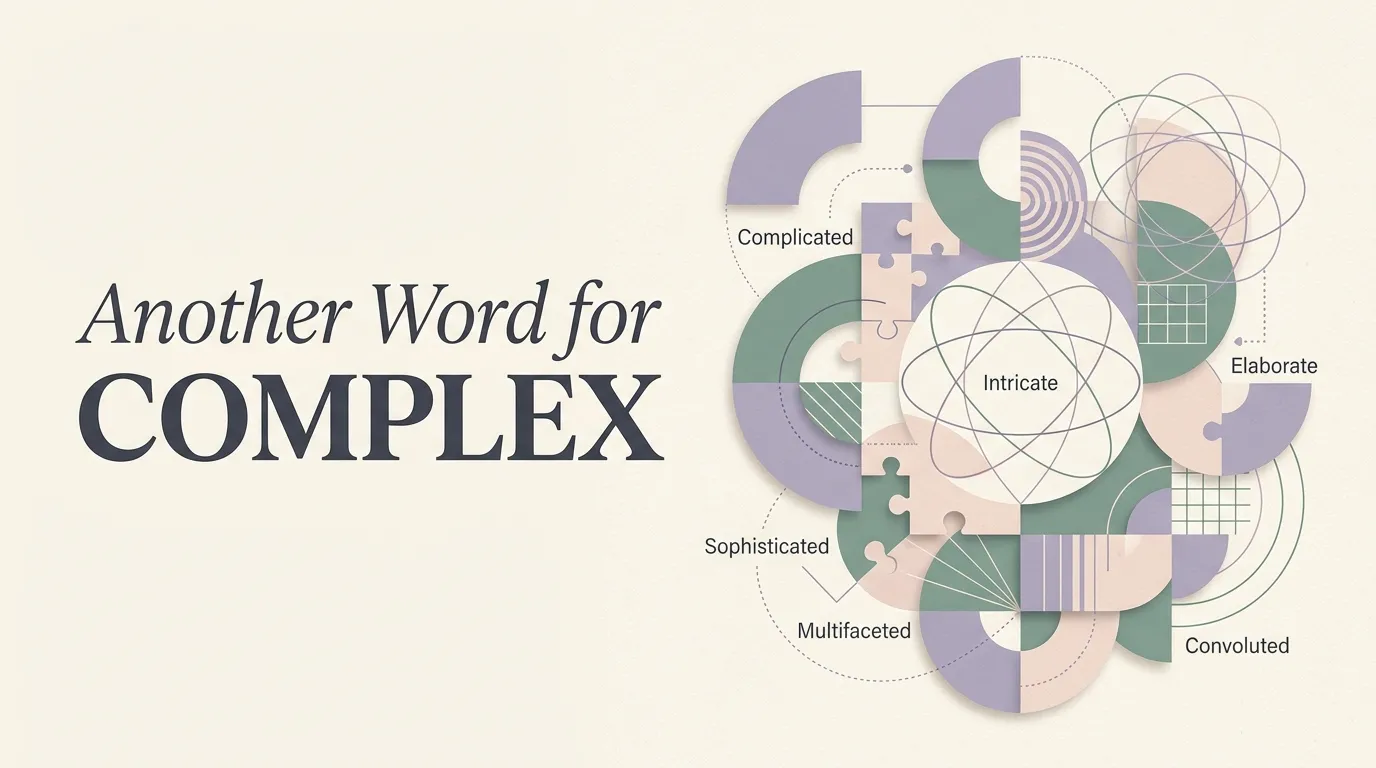
Alternatives for complex include complicated, intricate, sophisticated, elaborate, difficult, involved, multifaceted, convoluted, challenging, and comprehensive.
Meaning of “Complex”
Definition
Complex means having many connected parts, details, or factors that make something difficult to understand, manage, or explain. It can describe ideas, systems, problems, situations, or structures.
Examples
- The scientist studied a complex problem.
- The machine has a complex design.
- She had to solve a complex mathematical question.
Connotative Meaning
The word complex can have a neutral, positive, or negative meaning depending on context.
- Positive: The artist created a complex and detailed design.
- Neutral: The system has a complex structure.
- Negative: The application process is too complex for beginners.
Etymology of “Complex”
The word “complex” comes from Latin.
- Latin: complexus meant “entwined” or “embraced together.”
- Middle English: Related forms entered English through French and Latin influences.
- Modern English: Complex came to describe things made of many connected parts or ideas that are difficult to understand.
Pronunciation of “Complex”
IPA: /kəmˈpleks/
Syllables: 2
Pronunciation: kuhm-PLEKS
The stress falls on the second syllable.
Affixation Pattern
Complex is not normally formed by adding a modern English prefix or suffix. It comes from a Latin root related to the idea of combining or intertwining.
- Base: complex
- Prefix: none in modern English
- Suffix: none
- Part of speech: adjective and noun
Related forms include:
- Complexity: noun
- Complexly: adverb
- Complexities: plural noun
Examples:
- The problem is complex.
- The complexity of the system surprised us.
- The issue was explained complexly.
Other Words With Meaning & Examples
1. Complicated: Adjective
Meaning: Difficult to understand or deal with because it has many parts.
Examples:
- The instructions are complicated.
- They faced a complicated problem.
2. Intricate: Adjective
Meaning: Having many small details or carefully connected parts.
Examples:
- The artist created an intricate pattern.
- The machine has an intricate design.
3. Sophisticated: Adjective
Meaning: Highly developed, advanced, or complicated.
Examples:
- The company uses sophisticated technology.
- The system has sophisticated security features.
4. Elaborate: Adjective
Meaning: Detailed and carefully developed.
Examples:
- They prepared an elaborate plan.
- The building has an elaborate interior.
5. Difficult: Adjective
Meaning: Not easy to understand, do, or solve.
Examples:
- The problem was difficult to solve.
- She found the instructions difficult to follow.
6. Involved: Adjective
Meaning: Complicated because many details or steps are included.
Examples:
- The process is more involved than expected.
- Planning the event was an involved task.
7. Multifaceted: Adjective
Meaning: Having many different aspects or parts.
Examples:
- Climate change is a multifaceted issue.
- She has a multifaceted role in the organization.
8. Convoluted: Adjective
Meaning: Extremely complicated and difficult to understand.
Examples:
- The explanation was unnecessarily convoluted.
- The legal process can be convoluted.
9. Challenging: Adjective
Meaning: Difficult but requiring effort or skill.
Examples:
- The project was challenging but rewarding.
- She faced a challenging assignment.
10. Confusing: Adjective
Meaning: Difficult to understand or follow.
Examples:
- The instructions were confusing.
- The situation became confusing quickly.
11. Sophisticate: Noun
Meaning: A person with advanced knowledge or experience.
Examples:
- He is a technology sophisticate.
- The audience included many industry sophisticates.
12. Complicated: Adjective
Meaning: Containing many connected details or difficulties.
Examples:
- The case is complicated.
- It was a complicated decision.
13. Detailed: Adjective
Meaning: Containing many specific pieces of information.
Examples:
- She wrote a detailed report.
- The guide provides detailed instructions.
14. Nuanced: Adjective
Meaning: Showing subtle differences or several layers of meaning.
Examples:
- The issue requires a nuanced explanation.
- He gave a nuanced view of the topic.
15. Layered: Adjective
Meaning: Containing several levels, aspects, or meanings.
Examples:
- The novel has a layered story.
- The problem has a layered structure.
16. Multifactorial: Adjective
Meaning: Caused or influenced by many different factors.
Examples:
- The problem has a multifactorial cause.
- The decision was influenced by multifactorial considerations.
17. Comprehensive: Adjective
Meaning: Including many or all important parts.
Examples:
- The report provides a comprehensive analysis.
- We need a comprehensive solution.
18. Extensive: Adjective
Meaning: Covering a large amount or range of information or activity.
Examples:
- The project required extensive research.
- She has extensive knowledge of the subject.
19. Sophisticated: Adjective
Meaning: Advanced or highly developed.
Examples:
- The software uses sophisticated algorithms.
- The company developed a sophisticated system.
20. Complexified: Adjective
Meaning: Made more complicated or difficult.
Examples:
- The new rules complexified the process.
- Extra requirements complexified the project.
21. Knotty: Adjective
Meaning: Very difficult to solve or understand.
Examples:
- They discussed a knotty legal problem.
- The issue is particularly knotty.
22. Arduous: Adjective
Meaning: Very difficult and requiring a lot of effort.
Examples:
- The research was an arduous process.
- They completed the arduous task successfully.
23. Formidable: Adjective
Meaning: Very difficult or challenging.
Examples:
- The team faced a formidable problem.
- Learning the system can be a formidable task.
24. Labyrinthine: Adjective
Meaning: Extremely complicated, like a maze.
Examples:
- The organization has a labyrinthine structure.
- The legal procedure was labyrinthine.
25. Sophisticating: Adjective
Meaning: Making something more advanced or refined.
Examples:
- The new software is sophisticating the process.
- Modern tools are sophisticating data analysis.
26. Intricate: Adjective
Meaning: Very detailed and complicated.
Examples:
- The jewelry has an intricate design.
- The system requires intricate planning.
27. Multifaceted: Adjective
Meaning: Having many different sides or aspects.
Examples:
- Education is a multifaceted subject.
- The project requires a multifaceted approach.
Prototype Meaning of “Complex”
The core meaning of complex is having many connected parts or aspects.
For example:
The problem is complex.
This means the problem has several connected factors and may not have a simple solution.
The meaning can relate to:
- Difficulty: a complicated task
- Detail: an intricate design
- Multiple aspects: a multifaceted issue
- Advanced development: sophisticated technology
- Many factors: a multifactorial problem
Prototype Categorization
The alternatives for “complex” can be grouped into several semantic categories:
- General difficulty: complicated, difficult, challenging
- Detailed structure: intricate, elaborate, detailed
- Many aspects: multifaceted, layered, comprehensive
- Advanced systems: sophisticated, extensive
- Very difficult: convoluted, knotty, arduous, formidable
- Maze-like complexity: labyrinthine
- Subtle complexity: nuanced
Antonyms of “Complex”
Common opposites of complex include:
- Simple: easy to understand or do
- Straightforward: easy to understand
- Basic: simple or fundamental
- Clear: easy to understand
- Simple-minded: lacking complexity
- Uncomplicated: not difficult or complicated
Short Questions and Answers
What is another word for complex?
Common alternatives include complicated, intricate, sophisticated, elaborate, difficult, involved, multifaceted, and challenging.
What is a formal word for complex?
Depending on context, intricate, multifaceted, sophisticated, comprehensive, and nuanced can work well in formal writing.
What is another word for complex problem?
Useful alternatives include complicated problem, challenging problem, intricate issue, multifaceted issue, and knotty problem.
What is a positive word for complex?
Sophisticated, intricate, nuanced, and multifaceted can have positive or neutral meanings when complexity is viewed as valuable.
What is the opposite of complex?
Common antonyms include simple, straightforward, basic, clear, and uncomplicated.
Conclusion
The word complex describes something with many connected parts, details, or factors. It can refer to a difficult problem, an advanced system, a detailed design, or an issue with many sides. Useful alternatives include complicated, intricate, sophisticated, elaborate, multifaceted, nuanced, and challenging. The best choice depends on what kind of complexity you want to describe.
For example, intricate is useful for detailed designs, multifaceted works well for subjects with many aspects, and sophisticated often describes advanced systems or methods. Learning these distinctions helps English learners and writers choose more precise vocabulary and avoid repeating the same word.
Another Word for Emphasize: 25 Powerful Alternatives

I’m Mubashra Waleed, a content writer specializing in English vocabulary, synonyms, word meanings. I focus on creating clear, accurate, and engaging content that makes English language learning simple and useful for readers.