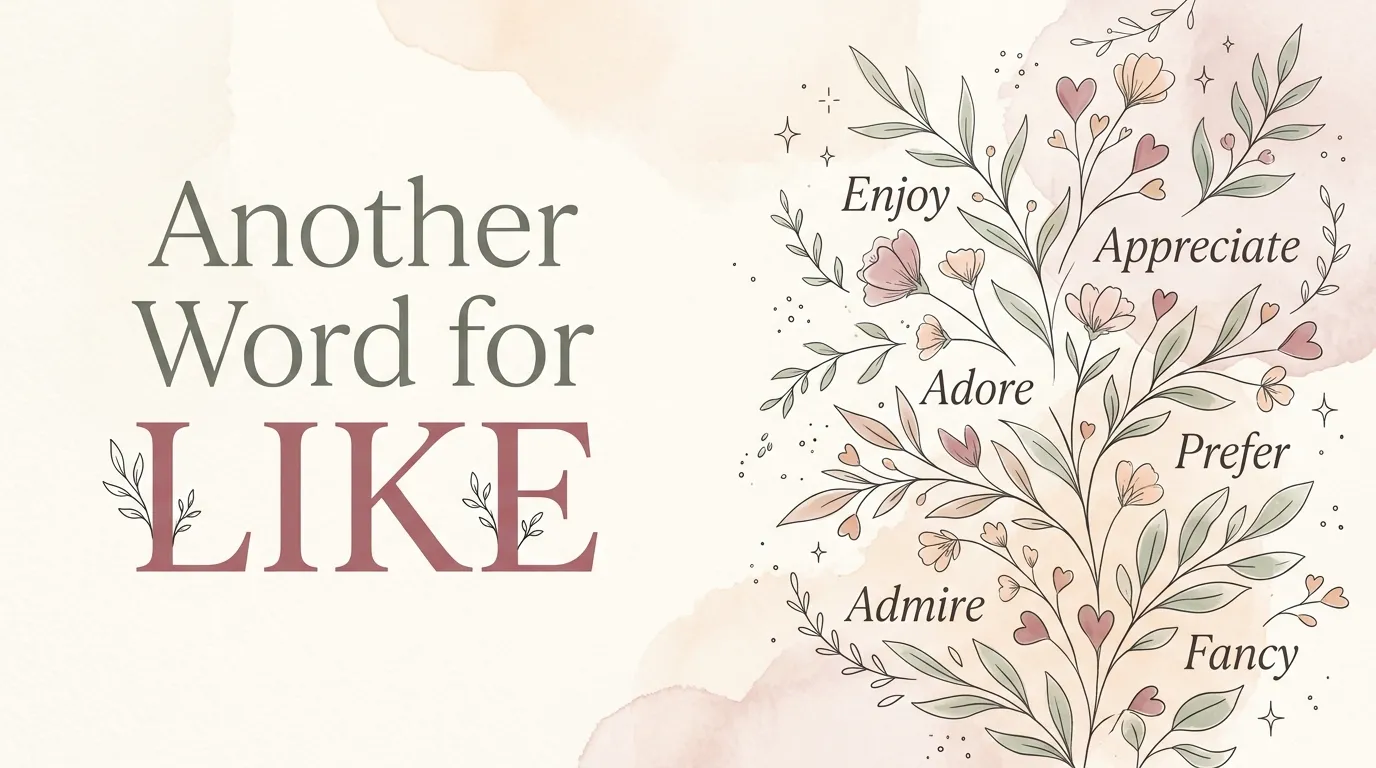
Depending on the meaning, alternatives for “like” include:
- Enjoy
- Love
- Prefer
- Appreciate
- Admire
- Favor
- Relish
- Adore
- Fancy
- Treasure
The right alternative depends on whether “like” means to enjoy something, to prefer something, to admire someone, or to describe similarity.
Meaning of “Like”
Definition
Like is a common English word with several meanings. As a verb, it can mean to enjoy or have a positive feeling toward something. It can also describe similarity, preference, or examples depending on how it is used.
Examples
- I like this book.
- She likes listening to music.
- This fabric feels like silk.
- You can choose a color like blue or green.
Connotative Meaning
The word “like” is usually neutral or positive, but its meaning changes with context.
- Positive: I really like this design.
- Neutral: This phone looks like the older model.
- Preference: I like tea more than coffee.
Etymology of “Like”
The word “like” has a long history in English.
- Old English: gelīc meant “similar” or “alike.”
- Middle English: The form developed into lik and like, with meanings connected to similarity and preference.
- Modern English: Like developed several uses as a verb, adjective, preposition, conjunction, noun, and other grammatical forms.
Pronunciation of “Like”
IPA: /laɪk/
Syllables: 1
Pronunciation: like
It is a one-syllable word with a long “i” sound.
Affixation Pattern
Like is a simple base word that can form several related words.
- Root/base: like
- Prefix: dislike-
- Suffixes: -ing, -ed, -ly, -ness
- Verb: like, likes, liked, liking
- Adjective: likable, likeable
- Adverb: likewise
- Noun: likeness
Examples:
- I like the design.
- She liked the movie.
- He is a likable person.
- The two paintings have a strong likeness.
Other Words With Meaning & Examples
1. Enjoy: Verb
Meaning: To get pleasure or satisfaction from something.
Examples:
- I enjoy reading in my free time.
- She enjoys spending time with her family.
2. Love: Verb
Meaning: To have a very strong positive feeling toward someone or something.
Examples:
- I love this song.
- She loves learning new languages.
3. Prefer: Verb
Meaning: To like one thing more than another.
Examples:
- I prefer tea to coffee.
- She prefers working in the morning.
4. Appreciate: Verb
Meaning: To recognize and value the good qualities of something.
Examples:
- I appreciate your help.
- She appreciates the effort you made.
5. Admire: Verb
Meaning: To respect or have a high opinion of someone or something.
Examples:
- I admire her dedication.
- They admire the artist’s work.
6. Favor: Verb
Meaning: To prefer or support one option over another.
Examples:
- Many customers favor this design.
- She favors simple solutions.
7. Relish: Verb
Meaning: To enjoy something greatly.
Examples:
- He relishes the opportunity to learn.
- She relished every moment of the experience.
8. Adore: Verb
Meaning: To like or love someone or something very much.
Examples:
- She adores her new puppy.
- They adore spending time outdoors.
9. Fancy: Verb
Meaning: To like or want something, especially in informal British English.
Examples:
- Do you fancy a cup of tea?
- She fancies the blue dress.
10. Treasure: Verb
Meaning: To value something greatly.
Examples:
- She treasures the memories of her childhood.
- They treasure their time together.
11. Cherish: Verb
Meaning: To value someone or something deeply.
Examples:
- He cherishes his family traditions.
- She cherishes the memories of that day.
12. Delight In: Phrase
Meaning: To get great pleasure from something.
Examples:
- She delights in helping others.
- He delights in exploring new places.
13. Take Pleasure In: Phrase
Meaning: To enjoy something.
Examples:
- They take pleasure in creating art.
- She takes pleasure in helping students.
14. Be Fond Of: Phrase
Meaning: To like someone or something.
Examples:
- I am fond of classical music.
- She is very fond of her old books.
15. Be Partial To: Phrase
Meaning: To have a preference for something.
Examples:
- I am partial to spicy food.
- She is partial to traditional designs.
16. Favor: Verb
Meaning: To choose or prefer something.
Examples:
- The customer favored the simpler option.
- The designer favors neutral colors.
17. Value: Verb
Meaning: To consider something important or worthwhile.
Examples:
- We value honest feedback.
- She values her education.
18. Respect: Verb
Meaning: To have a positive opinion of someone’s qualities or actions.
Examples:
- I respect her commitment to the project.
- They respect his professional experience.
19. Support: Verb
Meaning: To approve of or help a person, idea, or activity.
Examples:
- Many people support the new project.
- She supports the idea of flexible learning.
20. Savor: Verb
Meaning: To enjoy something slowly and fully.
Examples:
- He savored every bite of the meal.
- She savored the peaceful moment.
21. Enjoyment: Noun
Meaning: The feeling of pleasure from something.
Examples:
- The activity was a source of enjoyment.
- Reading gives her great enjoyment.
22. Liken: Verb
Meaning: To say that one person or thing is similar to another.
Examples:
- The writer likened the city to a living organism.
- She likened the experience to a long journey.
23. Resemble: Verb
Meaning: To look or be similar to someone or something.
Examples:
- The new design resembles the original.
- The child resembles her mother.
24. Similar To: Phrase
Meaning: Having qualities that are almost the same as something else.
Examples:
- This product is similar to the older model.
- Her writing style is similar to his.
Prototype Meaning of “Like”
The core meaning of “like” depends on its grammatical use.
When it is a verb, the central idea is having a positive feeling or enjoying something:
I like this book.
When it expresses similarity, it means that two things share certain qualities:
The cloud looks like a flower.
When it expresses preference, it shows what someone would rather have or choose:
I like tea more than coffee.
Prototype Categorization
The alternatives for “like” can be grouped into several semantic categories:
- Enjoyment: enjoy, relish, savor, delight in
- Strong positive feeling: love, adore, treasure, cherish
- Preference: prefer, favor, be partial to
- Appreciation: appreciate, value, admire
- Respect and approval: respect, support
- Similarity: resemble, liken, similar to
- Fondness: be fond of, fancy
Antonyms of “Like”
The opposite of like depends on its meaning.
- Dislike: to have a negative feeling toward something
- Hate: to strongly dislike something
- Reject : to refuse to accept something
- Avoid: to stay away from something
- Disapprove: to have a negative opinion of something
- Differ: to be unlike or different
Short Questions and Answers
What is another word for like?
Common alternatives include enjoy, love, prefer, appreciate, admire, favor, relish, and adore.
What is a formal word for like?
Depending on context, appreciate, admire, value, prefer, or favor can work well in formal writing.
What is another word for like in an essay?
Useful choices include prefer, appreciate, admire, value, favor, and support, depending on the intended meaning.
What is another word for like meaning “similar to”?
You can use resemble, similar to, akin to, or liken to, depending on the sentence.
What is the opposite of like?
Common antonyms include dislike, hate, reject, avoid, and disapprove.
Conclusion
The word like is extremely common in English and can express several different ideas. It can mean enjoying something, preferring one thing, admiring someone, or showing similarity. Words such as enjoy, appreciate, admire, prefer, favor, and value can make writing more precise when “like” means having a positive opinion.
For stronger feelings, love, adore, cherish, and treasure may be appropriate. When “like” refers to similarity, words such as resemble and similar to are better choices. Understanding the exact meaning of “like” in a sentence helps you select the most accurate alternative and create clearer, more varied English writing.
Another Word for Love: 28 Meaningful Alternatives

I’m Mubashra Waleed, a content writer specializing in English vocabulary, synonyms, word meanings. I focus on creating clear, accurate, and engaging content that makes English language learning simple and useful for readers.










