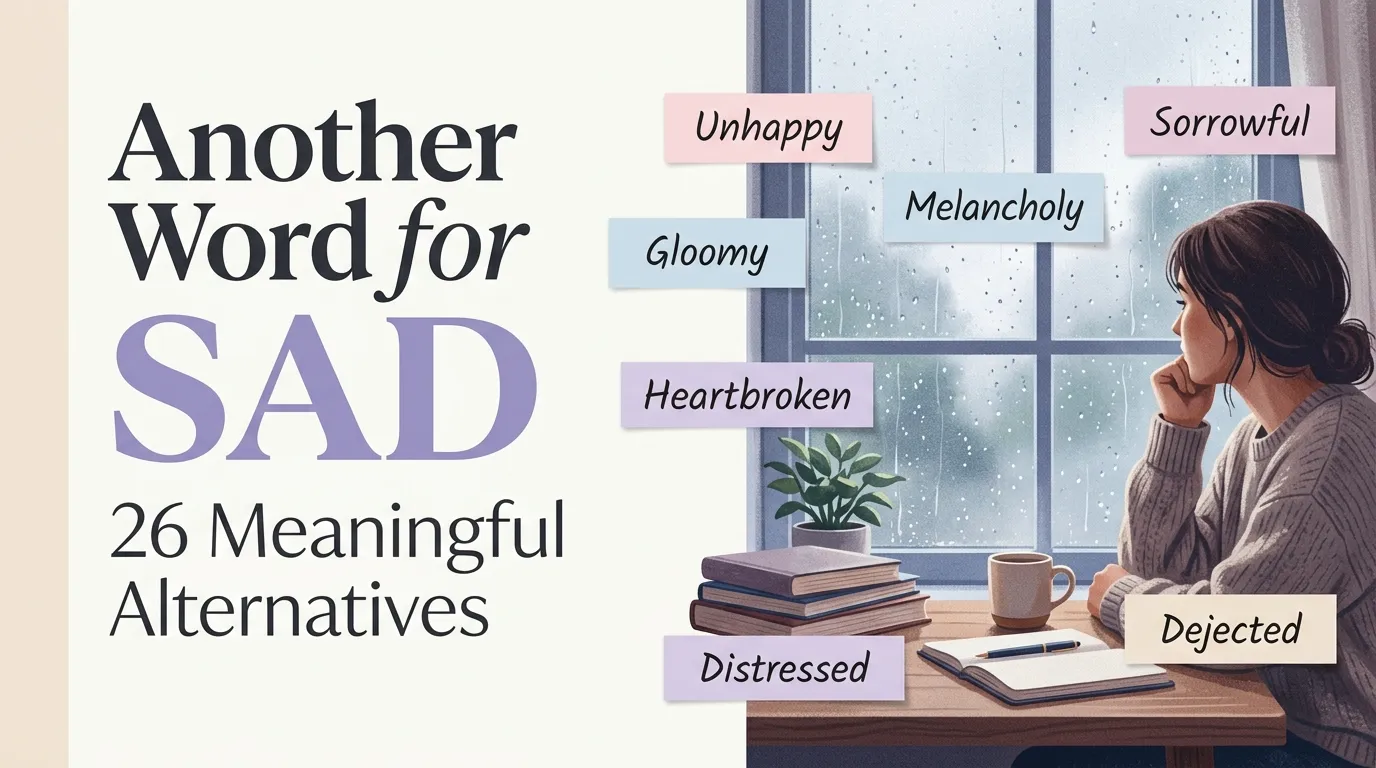
Another word for sad: unhappy, sorrowful, miserable, gloomy, upset, melancholy, heartbroken, downcast, dejected, and distressed.
The best alternative depends on the strength and type of sadness you want to describe.For formal writing, words such as sorrowful, melancholy, and distressed can be useful.
The word sad is one of the most common words used to describe an unhappy or painful emotional state. We may feel sad after losing something important, experiencing disappointment, missing someone, or going through a difficult situation. For example, you might say, “She felt sad after hearing the news.”
Although sad is simple and natural, using the same word repeatedly can make your writing less expressive. Learning alternatives allows you to describe different levels and types of sadness more accurately. This is especially useful for ESL learners, students, bloggers, authors, and content writers.
In this article, you will learn the meaning, examples, connotations, etymology, pronunciation, affixation pattern, alternatives, prototype meaning, semantic categories, antonyms, and common questions about sad.
Meaning of Sad
Definition
Sad means feeling unhappy, sorrowful, disappointed, or emotionally distressed.
Examples
She felt sad after saying goodbye to her friend.
He was sad about the unexpected news.
The movie had a sad ending.
Connotative Meaning
The word sad usually has a negative emotional connotation because it describes unhappiness or emotional pain.
Negative: He felt sad after losing an important opportunity.
Neutral: The story has a sad ending.
Sympathetic: She looked sad, so her friend tried to comfort her.
Etymology of Sad
The word sad has an interesting history.
Old English: Sæd originally had meanings connected with being full, satisfied, or settled.
Middle English: Its meaning gradually changed toward seriousness, heaviness, and sorrow.
Modern English: Sad developed its familiar meaning of feeling unhappy or sorrowful.
This change in meaning is an example of how words can gradually develop new meanings over time.
Pronunciation of Sad
Sad is pronounced:
/sæd/
Syllables
Sad has one syllable.
It sounds like: sad
Affixation Pattern of Sad
The base word is:
sad
Common related forms include:
- Sad: adjective
- Sadly: adverb
- Sadness: noun
- Sadden: verb
- Saddened: adjective/past participle
- Saddening: adjective/present participle
These forms allow the idea of sadness to be expressed in different grammatical structures.
Other Words With Meaning & Examples
1. Unhappy: Adjective
Meaning: Feeling or showing a lack of happiness.
She felt unhappy with the decision.
He looked unhappy after hearing the news.
2. Sorrowful: Adjective
Meaning: Feeling or expressing deep sadness.
She gave a sorrowful smile.
The song has a sorrowful tone.
3. Miserable: Adjective
Meaning: Extremely unhappy or uncomfortable.
He felt miserable after the disappointing result.
The long wait made everyone miserable.
4. Gloomy: Adjective
Meaning: Feeling or creating a sense of sadness and low spirits.
She was in a gloomy mood.
The rainy weather made the afternoon feel gloomy.
5. Melancholy: Adjective/Noun
Meaning: A quiet, thoughtful, or lasting feeling of sadness.
The music created a melancholy atmosphere.
He experienced a feeling of melancholy while remembering the past.
6. Upset: Adjective
Meaning: Unhappy or emotionally disturbed because of something unpleasant.
She was upset about the argument.
He became upset after hearing the criticism.
7. Heartbroken: Adjective
Meaning: Extremely sad because of a serious emotional loss or disappointment.
She was heartbroken after losing someone important to her.
He felt heartbroken when his plans failed.
8. Dejected: Adjective
Meaning: Very unhappy and lacking confidence or enthusiasm.
The players looked dejected after the loss.
She felt dejected after receiving the rejection letter.
9. Downcast: Adjective
Meaning: Looking or feeling unhappy and discouraged.
He appeared downcast after the meeting.
Her downcast expression showed her disappointment.
10. Distressed: Adjective
Meaning: Very worried, upset, or emotionally troubled.
She was visibly distressed by the news.
The child became distressed during the difficult situation.
11. Disappointed: Adjective
Meaning: Unhappy because something did not happen as expected.
He was disappointed with the final result.
She felt disappointed when the event was canceled.
12. Disheartened: Adjective
Meaning: Having lost hope, confidence, or enthusiasm.
The team felt disheartened after several setbacks.
She became disheartened by the lack of progress.
13. Dismal: Adjective
Meaning: Very gloomy, depressing, or lacking hope.
The team received some dismal news.
The situation looked dismal at first.
14. Forlorn: Adjective
Meaning: Lonely, abandoned, or deeply unhappy.
The character looked forlorn and lonely.
He sat with a forlorn expression.
15. Woeful: Adjective
Meaning: Showing or expressing great sadness or distress.
She gave a woeful account of the experience.
His woeful expression revealed his disappointment.
16. Mournful: Adjective
Meaning: Expressing deep sadness, especially after a loss.
The song had a mournful melody.
Her voice sounded mournful.
17. Somber: Adjective
Meaning: Serious, quiet, and lacking happiness.
The meeting had a somber atmosphere.
Everyone became somber after hearing the announcement.
18. Low: Adjective
Meaning: Feeling unhappy, discouraged, or lacking energy.
I have been feeling low lately.
He seemed a little low after the disappointment.
19. Blue: Adjective
Meaning: Informally feeling sad or unhappy.
She was feeling a little blue today.
He gets blue when he thinks about the past.
20. Heavyhearted: Adjective
Meaning: Feeling deep sadness or emotional heaviness.
She left the meeting heavyhearted.
He was heavyhearted after saying goodbye.
21. Somberly: Adverb
Meaning: In a serious, gloomy, or sad manner.
She spoke somberly about the difficult experience.
The announcement was delivered somberly.
22. Regretful: Adjective
Meaning: Feeling sorry or sad about something that happened or something you did.
He felt regretful about his decision.
She was regretful after the disagreement.
23. Tearful: Adjective
Meaning: Showing signs of crying or sadness.
She gave a tearful goodbye.
His eyes became tearful during the emotional speech.
24. Morose: Adjective
Meaning: Very unhappy and unwilling to talk or interact.
He became morose after the disappointing news.
The character remained morose throughout the story.
25. Pensive: Adjective
Meaning: Deeply thoughtful, often because of sadness or concern.
She became pensive while looking through old photographs.
He sat quietly with a pensive expression.
26. Dispirited: Adjective
Meaning: Having lost enthusiasm, confidence, or hope.
The workers felt dispirited after the setback.
She was dispirited by the unexpected failure.
Prototype Meaning
The prototype meaning of sad is feeling unhappy because of loss, disappointment, loneliness, or another difficult experience.
Imagine someone receiving disappointing news and becoming quiet, emotional, and less cheerful than usual. This represents the central idea of sadness.
However, sadness can have different levels. Someone may feel slightly blue, deeply sorrowful, extremely miserable, or heartbroken after a major emotional loss.
Prototype Categorization
The alternatives for sad can be divided into different semantic groups:
- General sadness: unhappy, upset, low
- Deep sadness: sorrowful, mournful, heavyhearted
- Extreme sadness: miserable, heartbroken, distressed
- Disappointment: disappointed, disheartened, dispirited
- Gloomy mood: gloomy, somber, morose, dismal
- Loneliness: forlorn
- Thoughtful sadness: melancholy, pensive
- Informal sadness: blue
- Visible sadness: tearful, downcast
These categories help you choose a word that describes the exact emotional situation instead of simply repeating sad.
Antonyms of Sad
1. Happy: Adjective
Meaning: Feeling pleasure, joy, or satisfaction.
She looked happy after receiving the good news.
2. Cheerful: Adjective
Meaning: Happy, positive, and pleasant.
He remained cheerful throughout the day.
3. Joyful: Adjective
Meaning: Feeling or expressing great happiness.
The celebration was a joyful occasion.
4. Content: Adjective
Meaning: Feeling satisfied and peaceful with a situation.
She felt content with her decision.
5. Upbeat: Adjective
Meaning: Positive, cheerful, and hopeful.
He remained upbeat despite the difficult circumstances.
6. Optimistic: Adjective
Meaning: Expecting positive or favorable results.
She is optimistic about the future.
Another Word for Simple: 30 Easy Alternatives
Short Questions and Answers
What does sad mean?
Sad means feeling unhappy, sorrowful, disappointed, or emotionally distressed.
When should sad be used?
Use sad when describing a general feeling of unhappiness or emotional disappointment.
Is sad positive or negative?
Sad generally has a negative emotional connotation because it describes unhappiness.
What is another word for sad?
Common alternatives include unhappy, sorrowful, miserable, gloomy, melancholy, upset, heartbroken, dejected, and downcast.
What is a stronger word for sad?
Words such as heartbroken, miserable, distressed, sorrowful, and mournful can express stronger forms of sadness depending on the context.
Is melancholy the same as sad?
Melancholy describes a thoughtful, often quiet or lasting feeling of sadness, while sad is a much broader and more common word.
What is the difference between sad and upset?
Sad generally describes unhappiness, while upset can include sadness, worry, anger, or emotional disturbance caused by a particular event.
Conclusion
The word sad is simple and widely used, but English has many alternatives that can express different shades of unhappiness. Words such as unhappy, sorrowful, gloomy, melancholy, dejected, heartbroken, distressed, and mournful can make your writing more specific and expressive.
Some alternatives describe general sadness, while others communicate disappointment, loneliness, deep sorrow, or a gloomy mood. For casual English, words like blue or low can sound natural, while sorrowful, melancholy, and distressed may work better in formal or descriptive writing. Choosing the right alternative helps you communicate emotions more clearly and avoid unnecessary repetition.

I’m Mubashra Waleed, a content writer specializing in English vocabulary, synonyms, word meanings. I focus on creating clear, accurate, and engaging content that makes English language learning simple and useful for readers.