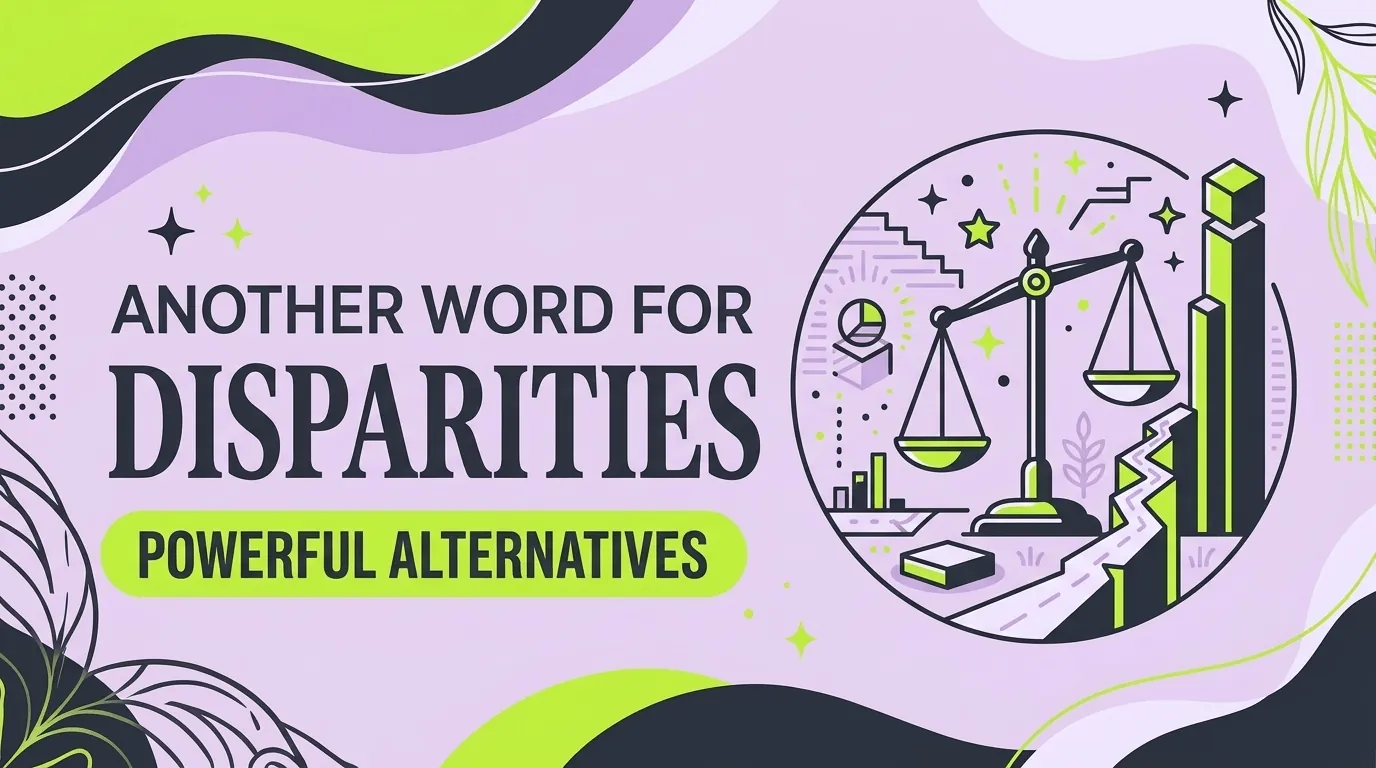
Other words for “disparities” include differences, inequalities, gaps, imbalances, variations, distinctions, discrepancies, and unequal conditions.
“Disparities” is a common English word used to describe significant differences between people, groups, or things. It often refers to unequal access to resources, opportunities, income, education, or healthcare. For example, disparities in education may mean that some students have better learning opportunities than others. The word is useful in academic writing, research, news reports, and social discussions. However, repeating “disparities” too often can make your writing sound repetitive.
Learning other words for “disparities” helps you explain differences more clearly and accurately. For example, “inequalities” highlights unfair differences, while “variations” describes differences that may be natural or expected. These alternatives are helpful for students, English learners, bloggers, and content writers. In this article, you will learn the meaning, pronunciation, history, grammar, synonyms, and antonyms of “disparities,” along with simple examples.
Meaning and Definition
Disparities is the plural form of “disparity.” It refers to noticeable or significant differences between people, groups, situations, or results. The word often suggests inequality or a lack of balance.
Examples:
- The report revealed disparities in healthcare access.
- Income disparities affect many communities.
- Researchers studied disparities in school performance.
- The policy aims to reduce regional disparities.
Connotative Meaning
“Disparities” often has a negative or serious tone because it commonly refers to unequal opportunities, resources, or treatment.
For example, “income disparities” suggests that some people earn much more than others. However, in some contexts, the word can simply describe a measurable difference without claiming that the difference is unfair.
Etymology of Disparities
The word “disparity” comes from Latin roots associated with being unlike or unequal.
Old English: The modern word “disparity” was not a common Old English term. Similar ideas were expressed through words related to difference and inequality.
Middle English: The word entered English through French and Latin influences, particularly in formal writing.
Modern English: “Disparity” became widely used to describe differences in status, amount, quality, opportunity, and treatment. “Disparities” is its plural form.
Pronunciation
Disparities: /dɪˈspær.ə.tiz/
Syllables: Dis • par • i • ties
The word has four syllables. The main stress falls on the second syllable.
Affixation Pattern and Word Formation
“Disparities” comes from the noun “disparity.”
- Disparate: Clearly different or unlike.
- Disparity: A significant difference or inequality.
- Disparities: More than one difference or inequality.
- Disparately: In a different or unequal manner, although this form is uncommon.
- Disparateness: The condition of being different, an uncommon word.
The prefix “dis” has roots associated with separation or difference, while “ity” forms a noun describing a state or condition.
25 Synonyms for Disparities
| Alternative | Meaning | Example |
| 1. Differences | Ways in which things are not the same | The study identified differences in learning outcomes. |
| 2. Inequalities | Differences in status, resources, or opportunities | The program aims to reduce income inequalities. |
| 3. Gaps | Missing links or differences between levels | There are gaps in access to education. |
| 4. Imbalances | Lack of equality or proportion | The report highlighted imbalances in funding. |
| 5. Variations | Changes or differences within a group | Researchers observed variations in test scores. |
| 6. Distinctions | Features that make things different | The article explains distinctions between the two systems. |
| 7. Discrepancies | Differences between information or results that should agree | The audit found discrepancies in the records. |
| 8. Unequal conditions | Situations in which people do not have equal circumstances | Unequal conditions can affect student progress. |
| 9. Divisions | Separations between groups or categories | Economic divisions can influence access to services. |
| 10. Contrasts | Clear differences between two or more things | The report showed contrasts in regional development. |
| 11. Divergences | Differences in direction, opinion, or results | The researchers noticed divergences in their findings. |
| 12. Inconsistencies | Differences that do not follow a steady pattern | The data contained inconsistencies across regions. |
| 13. Disproportions | Differences in size or amount that are out of balance | The study found disproportions in resource allocation. |
| 14. Unevenness | A lack of equality or smoothness | Unevenness in funding affected local schools. |
| 15. Disparateness | The state of being different or separate | The report discussed the disparateness of the two systems. |
| 16. Unequal distribution | A situation where resources are not shared equally | Unequal distribution of resources affected rural areas. |
| 17. Glaring differences | Differences that are very obvious | Glaring differences appeared in the survey results. |
| 18. Variances | Differences from an expected amount or standard | The analysis measured variances in performance. |
| 19. Differentials | Differences in rates, levels, or amounts | Wage differentials were discussed in the report. |
| 20. Divides | Significant separations between groups | The digital divide limits access to technology. |
| 21. Mismatches | Things that do not fit or correspond | The study found mismatches between skills and job needs. |
| 22. Incongruities | Differences that seem unsuitable or inconsistent | The report identified incongruities in the policy. |
| 23. Gaps in equality | Areas where equal treatment or opportunity is missing | The new plan addresses gaps in equality. |
| 24. Uneven distributions | Patterns in which things are not spread equally | Uneven distributions of services affected remote communities. |
| 25. Discrepant results | Findings that differ from one another | The researchers examined the discrepant results. |
Prototype Meaning
The prototype meaning of “disparities” is significant differences or inequalities between people, groups, or things.
For example, disparities in income mean that different groups earn noticeably different amounts. Disparities in education may refer to unequal access to schools, learning materials, or qualified teachers.
Prototype Categorization
“Disparities” belongs to the category of plural nouns. It is commonly used in several contexts.
- Economic disparities: Differences in income or wealth.
- Educational disparities: Differences in learning opportunities or outcomes.
- Health disparities: Differences in health outcomes or access to care.
- Social disparities: Differences in status, treatment, or opportunities.
- Regional disparities: Differences between locations or communities.
Antonyms of Disparities
There is no single perfect antonym for “disparities.” The best opposite depends on the context.
- Equality: The state of having equal rights or opportunities.
- Parity: The condition of being equal in status, amount, or value.
- Similarity: The quality of being alike.
- Uniformity: The condition of being consistent or the same.
- Balance: A state in which different parts are properly proportioned.
- Equivalence: The state of having equal value or meaning.
- Fairness: The quality of treating people justly.
Example: “The new policy aims to promote equality and reduce disparities.”
Frequently Asked Questions
1. What is another word for disparities?
Common alternatives include differences, inequalities, gaps, imbalances, and discrepancies. The best choice depends on the context.
2. What is a stronger word for disparities?
“Inequalities” is useful when discussing unfair differences in resources or opportunities. “Discrepancies” is better when comparing information that does not match.
3. What is a simple word for disparities?
“Differences” is the simplest alternative. Use “gaps” when you mean a noticeable difference between two levels or groups.
4. Is disparities a noun or an adjective?
“Disparities” is a plural noun. The singular form is “disparity,” which means a significant difference or inequality.
5. How can I use disparities in a sentence?
Example: “The research examined disparities in access to education across different communities.”
Conclusion
“Disparities” describes significant differences between people, groups, resources, or results. It is especially useful in discussions about income, education, healthcare, and social opportunities. However, choosing a more specific alternative can make your writing clearer. Use “inequalities” when the differences involve unfair access or treatment, “gaps” when describing a distance between levels, and “discrepancies” when facts or figures do not match. “Variations” is suitable for differences that may be natural or expected.
Remember that these words are not always interchangeable. Consider whether you mean unfairness, simple difference, or conflicting information before selecting a synonym. With practice, you can use these alternatives naturally in academic writing, reports, essays, and everyday communication.
SEO Meta Description
Discover 25 alternatives to disparities with simple meanings, example sentences, pronunciation, word history, antonyms, and practical English vocabulary tips.

I’m Naz Fatima, a dedicated content writer with expertise in language, synonyms, and well-researched article writing.
My experience in creating clear, engaging, and informative content reflects my commitment to quality, accuracy, and reader value.