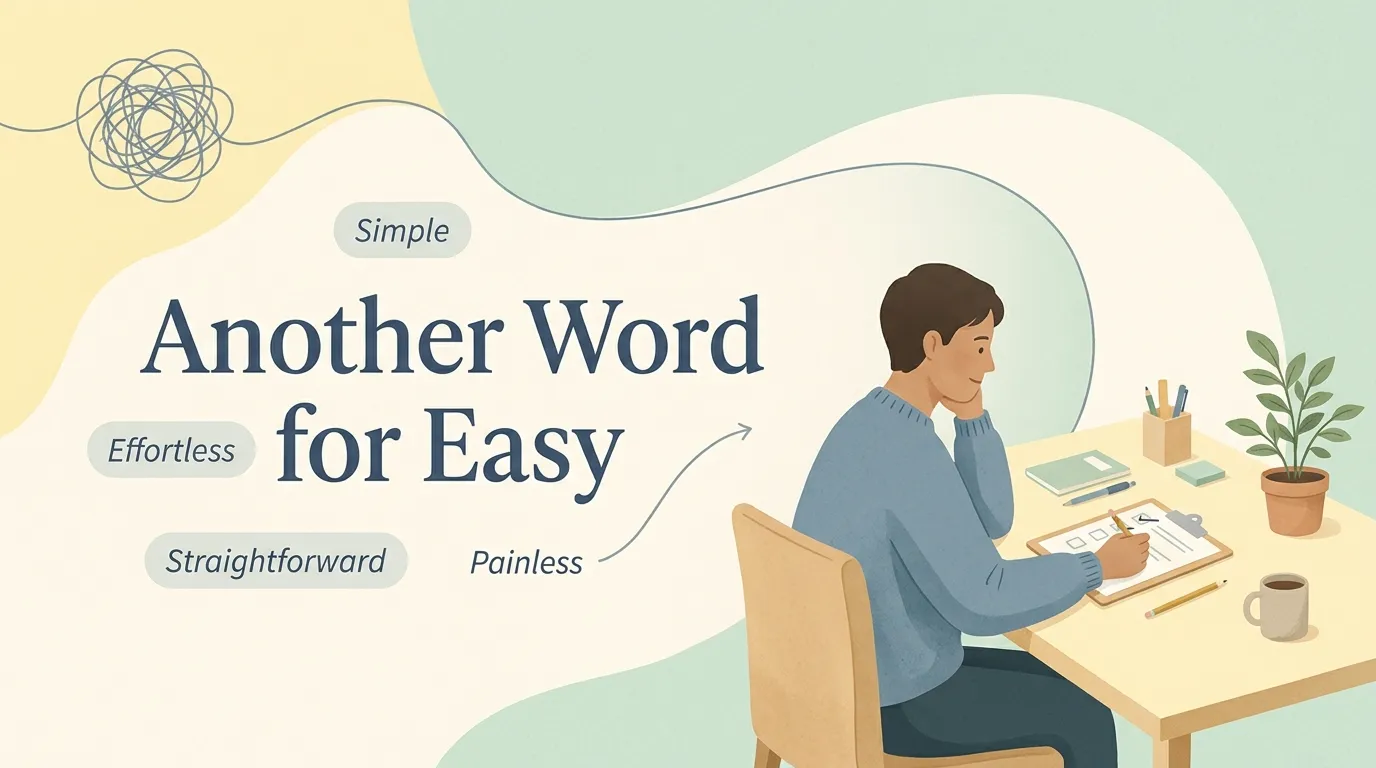
Another word for easy depends on the context. Common alternatives include simple, effortless, straightforward, uncomplicated, manageable, clear, basic, convenient, painless, and undemanding.
| Alternative | Best Used When |
| Simple | Something is easy to understand or do |
| Effortless | Something requires little effort |
| Straightforward | Something is clear and direct |
| Uncomplicated | Something has few difficulties |
| Manageable | Something feels possible to handle |
| Convenient | Something saves time or effort |
| Painless | Something causes little trouble |
| Basic | Something is simple or fundamental |
Easy is a common word we use every day. We say a task is easy when it does not require much effort, a lesson is easy when we understand it quickly, or a choice is easy when the answer feels clear. However, using the same word repeatedly can make writing sound dull. Learning another word for easy helps you express your thoughts more clearly and naturally.
For example, you might describe a simple question as straightforward, a relaxed activity as effortless, or a difficult-looking task as manageable. Each word adds a slightly different meaning.
Meaning of Easy

Definition
Easy is an adjective that describes something that requires little effort, skill, difficulty, or struggle. It can also describe a person who is relaxed, a situation that feels comfortable, or a task that is simple to complete.
Examples:
- This exercise is easy for beginners.
- She found an easy way to organize her notes.
- The teacher gave us an easy question.
Examples in Different Contexts
- Learning: The lesson was easy to understand.
- Work: We found an easy solution to the problem.
- Daily life: This app makes shopping easy.
- Personality: He is easy to talk to.
- Lifestyle: They prefer an easy and relaxed routine.
Connotative Meaning
The word easy usually has a positive or neutral meaning. It can suggest comfort, simplicity, convenience, or a lack of stress.
However, it may sometimes sound negative. Calling a task too easy can suggest that it is not challenging enough. Describing someone as easygoing is generally positive, while calling a person easy can have different meanings depending on the context.
Etymology of Easy

The English word easy entered the language through Old French, particularly forms related to aisie, meaning comfort or convenience. It developed from the Latin word adjacens, meaning lying near, through a historical linguistic pathway associated with comfort and convenience.
- Old English: The modern word easy was not a common native Old English form.
- Middle English: Forms such as esi and easie appeared through French influence.
- Modern English: Easy became a common adjective describing something requiring little effort or difficulty.
Today, the word is widely used in education, business, technology, and everyday conversation.
Pronunciation of Easy
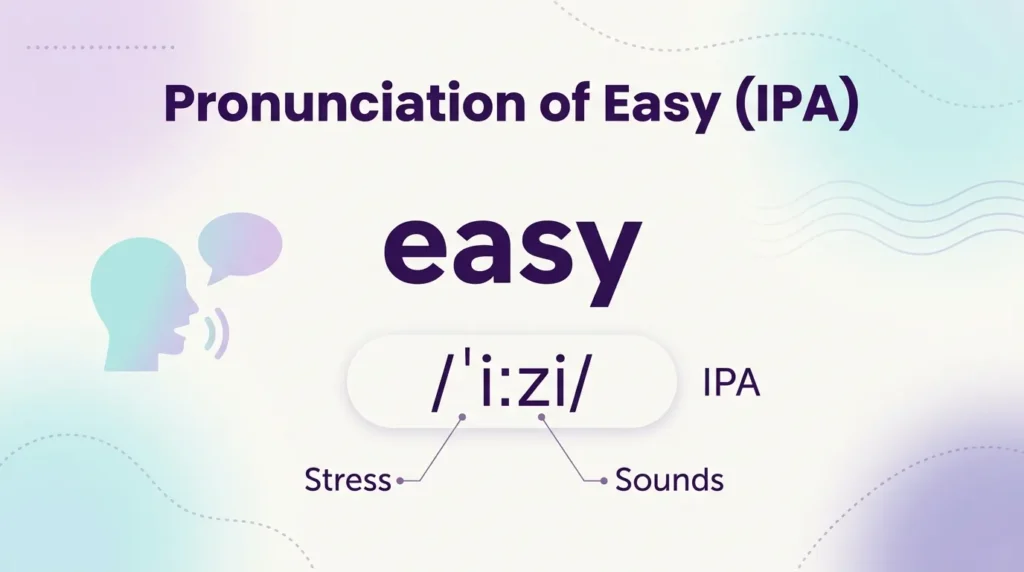
- IPA: /ˈiːzi/
- Syllables: 2
- Breakdown: ea-sy
- Stress: The first syllable receives the stress.
Example: The answer was easy to find.
Affixation Pattern of Easy
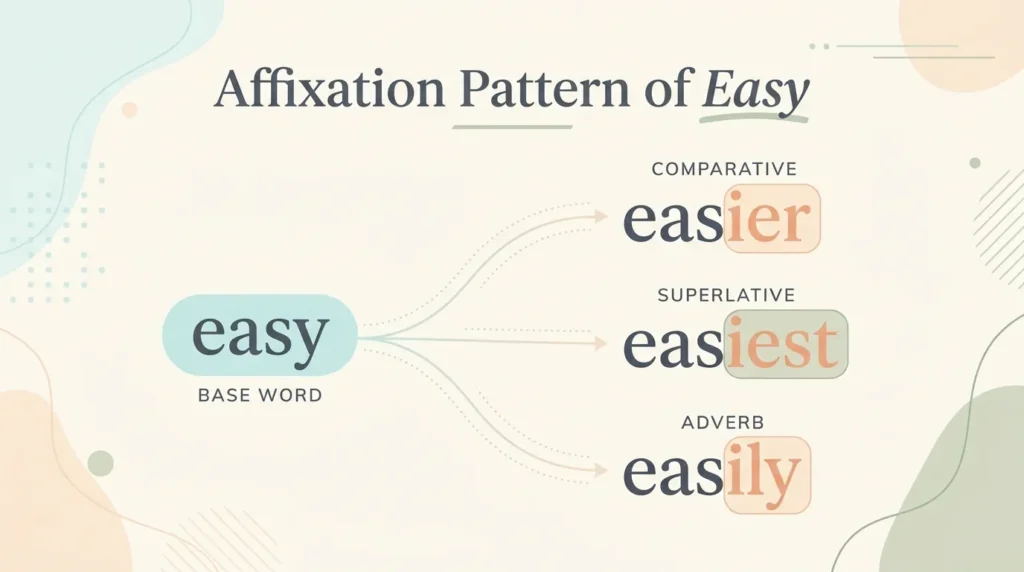
The root word is easy. It can form several related words by adding prefixes or suffixes.
| Word Form | Type | Meaning |
| Easy | Root adjective | Requiring little effort |
| Easily | Adverb with suffix -ly | Without difficulty |
| Easier | Comparative adjective with -er | Less difficult |
| Easiest | Superlative adjective with -est | Least difficult |
| Uneasy | Adjective with prefix un- | Worried or uncomfortable |
| Easiness | Noun with suffix -ness | The quality of being easy |
Examples:
- She easily solved the puzzle.
- This chapter is easier than the last one.
- That was the easiest question on the test.
- He felt uneasy before the interview.
24 Other Words for Easy With Meaning and Examples
Here are 24 useful alternatives to easy, grouped by meaning and everyday use.
1. Simple
Part of speech: Adjective
Meaning: Easy to understand, use, or complete.
Examples:
- The instructions are simple to follow.
- She prepared a simple meal for everyone.
2. Effortless
Part of speech: Adjective
Meaning: Requiring little or no visible effort.
Examples:
- He made the difficult move look effortless.
- Her presentation felt effortless and natural.
3. Straightforward
Part of speech: Adjective
Meaning: Clear and easy to understand or complete.
Examples:
- The application process is straightforward.
- We received straightforward answers to our questions.
4. Uncomplicated
Part of speech: Adjective
Meaning: Not involving many problems or difficult details.
Examples:
- The instructions were uncomplicated.
- They wanted an uncomplicated plan for the trip.
5. Manageable
Part of speech: Adjective
Meaning: Possible to deal with or complete successfully.
Examples:
- Breaking the project into steps made it manageable.
- Her daily schedule became more manageable.
6. Convenient
Part of speech: Adjective
Meaning: Suitable or useful because it saves time or effort.
Examples:
- Online payments offer a convenient way to shop.
- We chose a convenient time for the meeting.
7. Painless
Part of speech: Adjective
Meaning: Requiring little difficulty, discomfort, or trouble.
Examples:
- The software made the update process painless.
- The transition was relatively painless for the team.
8. Undemanding
Part of speech: Adjective
Meaning: Requiring little effort, attention, or skill.
Examples:
- He wanted an undemanding activity after school.
- The job was steady and undemanding.
9. Effort-free
Part of speech: Adjective
Meaning: Requiring no noticeable effort.
Examples:
- The automatic feature makes saving effort-free.
- They looked for an effort-free way to organize their files.
10. Basic
Part of speech: Adjective
Meaning: Simple and fundamental, without extra details.
Examples:
- The course covers basic grammar rules.
- You only need basic tools for this task.
11. Clear-cut
Part of speech: Adjective
Meaning: Easy to understand or decide because the facts are clear.
Examples:
- The evidence gave us a clear-cut answer.
- It was a clear-cut decision for the committee.
12. Accessible
Part of speech: Adjective
Meaning: Easy to reach, use, understand, or obtain.
Examples:
- The website makes information accessible to everyone.
- The teacher explained the topic in an accessible way.
13. User-friendly
Part of speech: Adjective
Meaning: Designed to be easy for people to use.
Examples:
- The new app has a user-friendly design.
- We need a user-friendly website for our customers.
14. Intuitive
Part of speech: Adjective
Meaning: Easy to understand or use without much instruction.
Examples:
- The controls are intuitive and simple.
- She found the editing tool intuitive.
15. Elementary
Part of speech: Adjective
Meaning: Basic or not difficult to understand.
Examples:
- The textbook begins with elementary concepts.
- The solution required only elementary mathematics.
16. Elementary-level
Part of speech: Adjective
Meaning: Intended for beginners or people learning the basics.
Examples:
- He enrolled in an elementary-level language course.
- The guide explains elementary-level computer skills.
17. Relaxed
Part of speech: Adjective
Meaning: Free from tension, pressure, or strict demands.
Examples:
- We had a relaxed discussion about the project.
- The relaxed schedule gave everyone more time.
18. Smooth
Part of speech: Adjective
Meaning: Happening without problems, interruptions, or delays.
Examples:
- The team made the launch smooth and organized.
- We enjoyed a smooth journey to the city.
19. Light
Part of speech: Adjective
Meaning: Not heavy, serious, or demanding in effort.
Examples:
- She completed some light work in the morning.
- We had a light discussion before the meeting.
20. Attainable
Part of speech: Adjective
Meaning: Possible to achieve with reasonable effort.
Examples:
- The team set attainable goals for the month.
- With practice, the target became attainable.
21. Feasible
Part of speech: Adjective
Meaning: Possible and practical to do.
Examples:
- The manager suggested a feasible solution.
- We need a feasible plan for the event.
22. Doable
Part of speech: Adjective
Meaning: Possible to complete or achieve.
Examples:
- The assignment looked long but was doable.
- A little planning made the task doable.
23. Child’s play
Part of speech: Idiom
Meaning: Something extremely easy to do.
Examples:
- For an experienced player, the first level was child’s play.
- The basic exercise was child’s play for the advanced students.
24. A breeze
Part of speech: Idiom
Meaning: Something that is very easy or enjoyable to complete.
Examples:
- The test was a breeze because she had studied well.
- Setting up the new device was a breeze.
Prototype Meaning
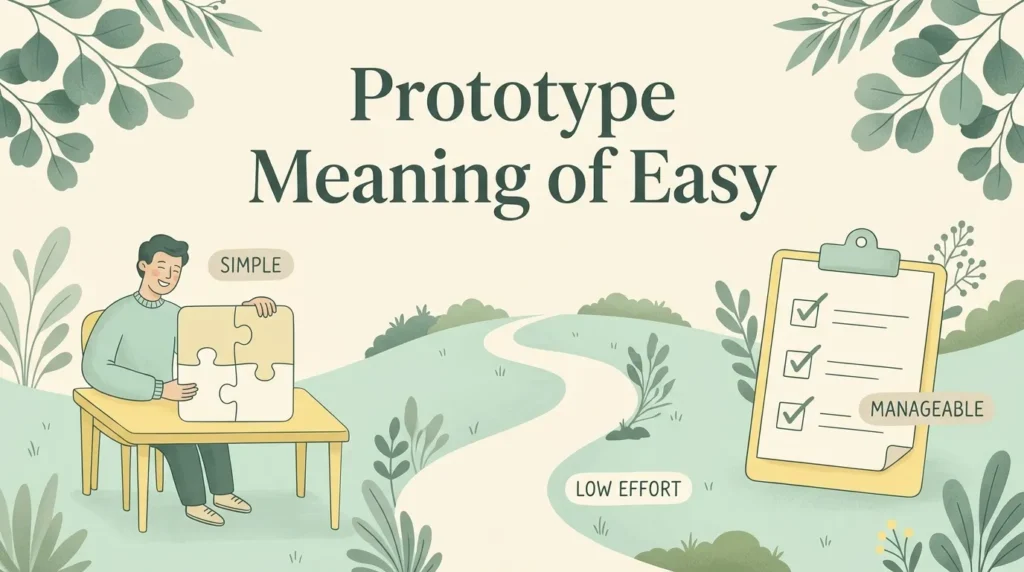
The prototype meaning of easy is something that requires little effort or difficulty. When people hear the word, they often imagine a task that can be completed quickly, a question with an obvious answer, or an activity that needs very little practice.
For example, a basic addition problem may be easy for someone who understands mathematics well. However, the same problem might feel difficult to a beginner. This shows that ease depends on a person’s knowledge, experience, and situation.
Prototype Categorization
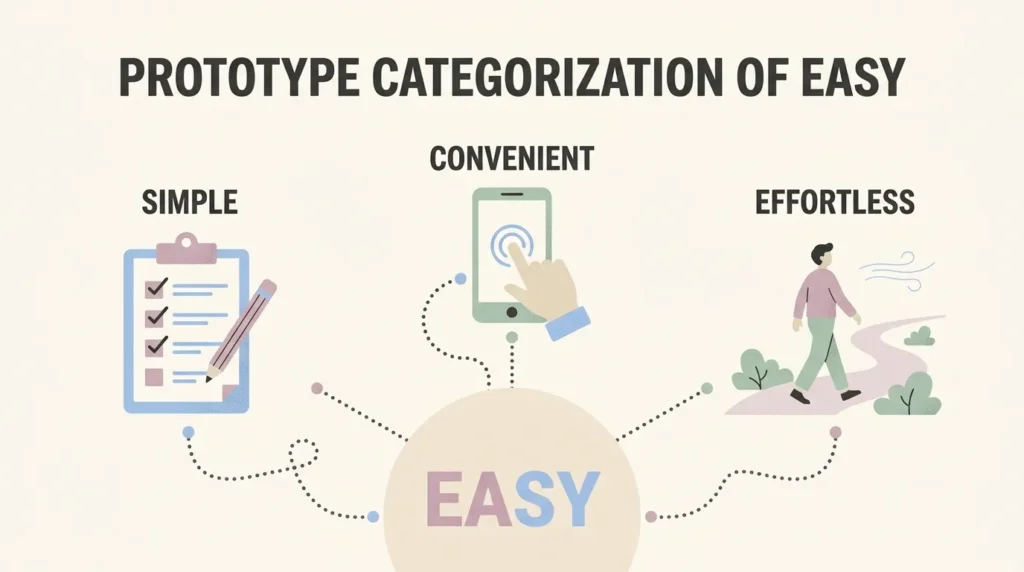
Different synonyms for easy fit different situations. Use these categories to choose a more precise word.
Simplicity and Understanding
- Simple: Easy to understand or do.
- Uncomplicated: Free from complex details.
- Basic: Focused on essential information.
- Elementary: Related to fundamental knowledge.
Low Effort and Difficulty
- Effortless: Requiring almost no effort.
- Undemanding: Requiring little energy or attention.
- Painless: Causing little trouble or discomfort.
- Light: Not very demanding.
Practicality and Achievability
- Manageable: Possible to handle.
- Doable: Possible to complete.
- Feasible: Practical and possible.
- Attainable: Possible to achieve.
Clarity and Usability
- Straightforward: Clear and direct.
- Clear-cut: Easy to decide or understand.
- Accessible: Easy to reach or understand.
- Intuitive: Easy to use without detailed instructions.
- User-friendly: Designed for ease of use.
Comfort and Convenience
- Convenient: Saves time or effort.
- Relaxed: Free from pressure.
- Smooth: Happening without problems.
- A breeze: Very easy to complete.
Another Word for Effective: 30 Powerful Alternatives
Antonyms of Easy
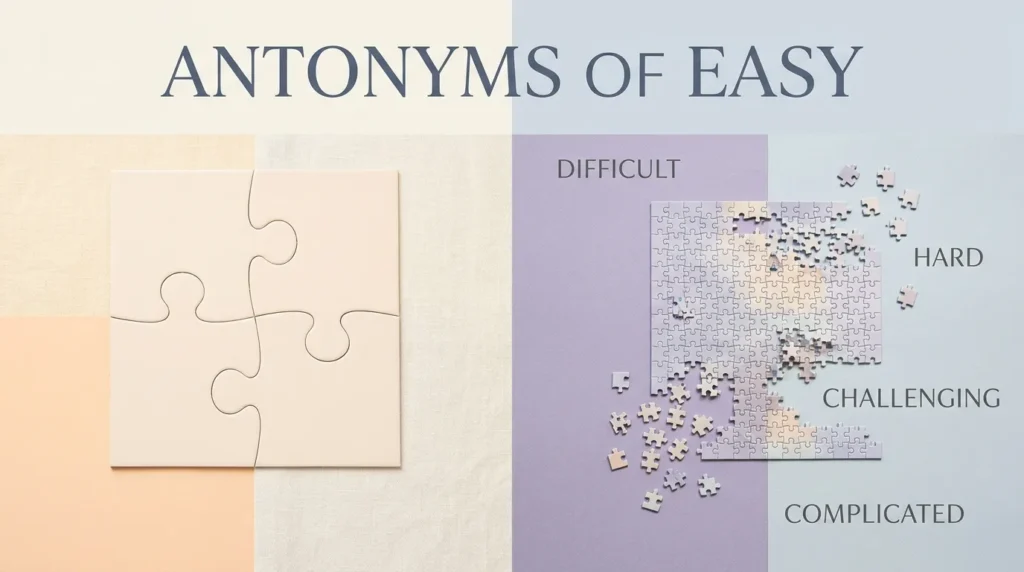
Antonyms are words with opposite meanings. The best opposite of easy depends on the context.
| Antonym | Part of Speech | Meaning |
| Difficult | Adjective | Not easy to do or understand |
| Hard | Adjective | Requiring much effort |
| Challenging | Adjective | Testing ability or skill |
| Complicated | Adjective | Involving many details or steps |
| Complex | Adjective | Made up of many connected parts |
| Demanding | Adjective | Requiring significant effort or attention |
| Arduous | Adjective | Requiring great effort over time |
| Troublesome | Adjective | Causing problems or inconvenience |
| Tough | Adjective | Difficult to manage or complete |
| Laborious | Adjective | Requiring a lot of work |
Examples:
- The easy question became a difficult one after the rules changed.
- The simple process turned into a complicated task.
- The manageable workload became demanding near the deadline.
Short Questions and Answers
1. What is the most common synonym for easy?
Simple is one of the most common synonyms. It works well when describing tasks, instructions, ideas, and everyday activities.
2. What is a formal word for easy?
Straightforward, feasible, and uncomplicated can work in formal writing. The best choice depends on whether you mean clear, practical, or not complex.
3. What is another word for very easy?
You can use effortless, child’s play, or a breeze. The idioms are more conversational, while effortless suits many formal and informal contexts.
4. What is another word for easy to understand?
Use clear, simple, straightforward, or accessible.
5. What is another word for easy to use?
Use user-friendly, intuitive, or convenient, depending on the sentence.
6. Is easy the same as simple?
Not always. Easy usually means requiring little effort or difficulty, while simple often means having few parts or details. A simple idea can still be difficult to carry out.
7. What is the opposite of easy?
Common antonyms include difficult, hard, challenging, and complicated.
Conclusion

Finding another word for easy can make your writing clearer, more engaging, and more precise. Words such as simple, straightforward, and uncomplicated work well when describing ideas or instructions. Alternatives like effortless, manageable, and doable are useful when talking about tasks and activities. Meanwhile, user-friendly and intuitive are especially helpful when describing websites, apps, and technology.
The key is to choose a synonym that matches your intended meaning and audience. A word that works in casual conversation may not be the best choice for an academic essay or professional email. By learning these alternatives and practicing them in sentences, you can expand your vocabulary and avoid repeating the same word. Start with a few familiar synonyms, then use more precise alternatives as your confidence grows.
Another Word for Difficult: 30 Useful Alternatives

I’m Mubashra Waleed, a content writer specializing in English vocabulary, synonyms, word meanings. I focus on creating clear, accurate, and engaging content that makes English language learning simple and useful for readers.