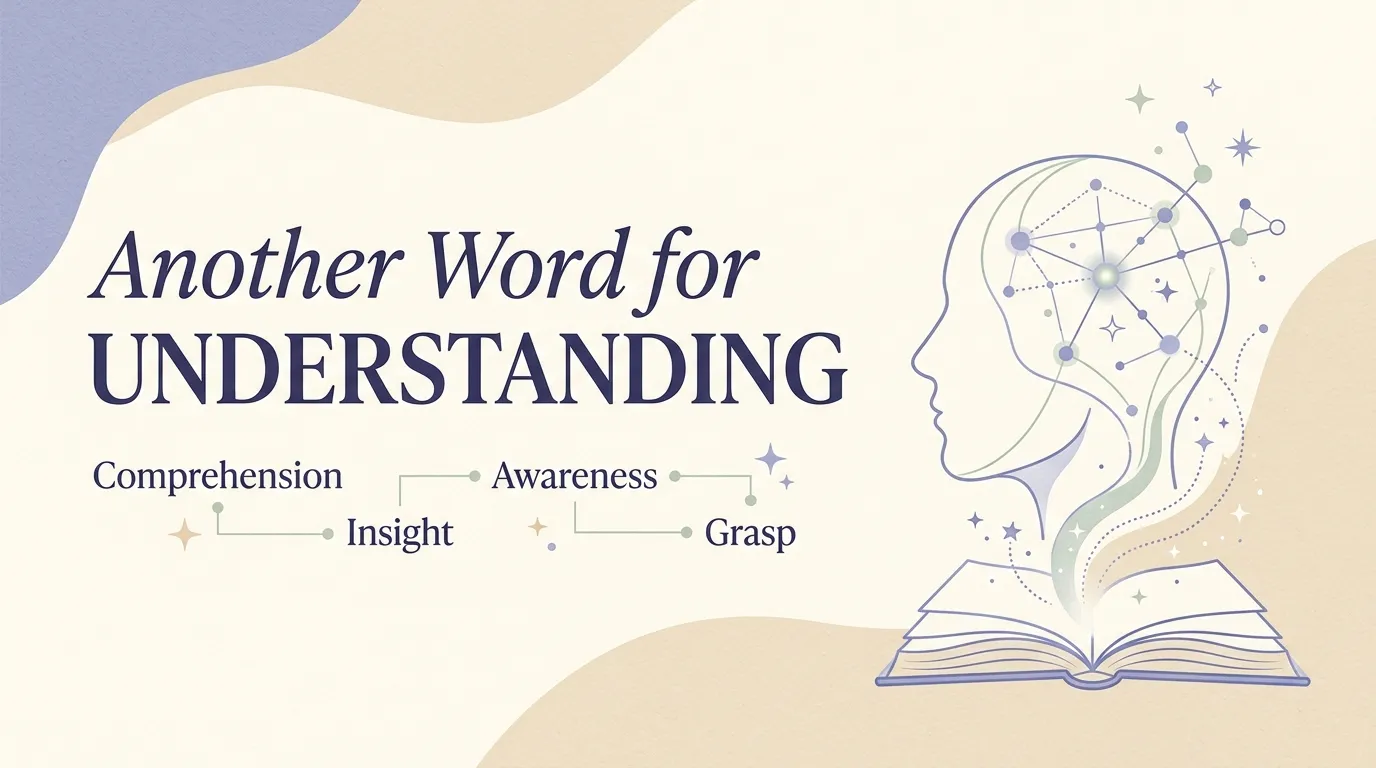
Another word for understanding depends on the context. Here are 10 useful alternatives:
- Comprehension: The ability to understand information.
- Knowledge: Facts or information you have learned.
- Insight: A deep and clear understanding of something.
- Awareness: Knowing that something exists or is happening.
- Grasp: A clear understanding of an idea.
- Perception: The way you understand or interpret something.
- Appreciation: Recognition of the value or meaning of something.
- Empathy: The ability to understand another person’s feelings.
- Interpretation: An explanation of the meaning of something.
- Realization: The moment you become aware of something important.
Understanding means knowing what something means or being able to see why it happens.
For example, a student may understand a lesson after reading it twice. A friend may show understanding by listening to your feelings without judging you. This word is common in education, relationships, business, and daily conversations. Yet, using it too often can make writing sound repetitive.
Meaning of Understanding
Definition
Understanding (noun or adjective):
As a noun, understanding means knowing the meaning of something, having knowledge of a subject, or recognizing another person’s feelings.
As an adjective, it describes someone who is kind, patient, and willing to consider another person’s needs.
Examples
- Her understanding of science improved after the lesson.
- Thank you for being so understanding during a difficult time.
- We reached an understanding about how to share the work.
Connotative Meaning
Connotation (the feeling or idea linked to a word beyond its basic meaning) depends on the context.
- Positive tone: Understanding can suggest wisdom, kindness, trust, or clear thinking.
- Negative tone: Limited understanding may suggest confusion or a lack of knowledge.
- Neutral tone: Understanding can simply mean knowing what a word, rule, or idea means.
Etymology
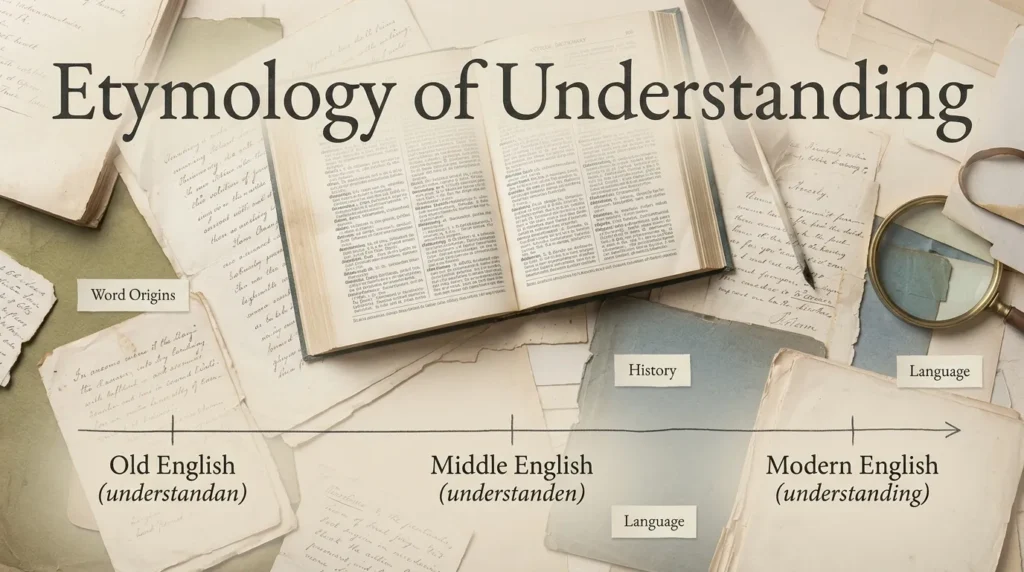
The word understanding comes from the verb understand, which developed from Old English understandan. Its exact early formation is debated, so it is best not to assume that it simply means standing beneath something.
- Old English (450 to 1100): Understandan meant to comprehend or grasp the meaning of something.
- Middle English (1100 to 1500): The word developed into forms close to modern understand and continued to mean comprehend or know.
- Modern English (1500 to present): Understanding became widely used for comprehension, shared agreement, and sensitivity to other people’s feelings.
Pronunciation (IPA)
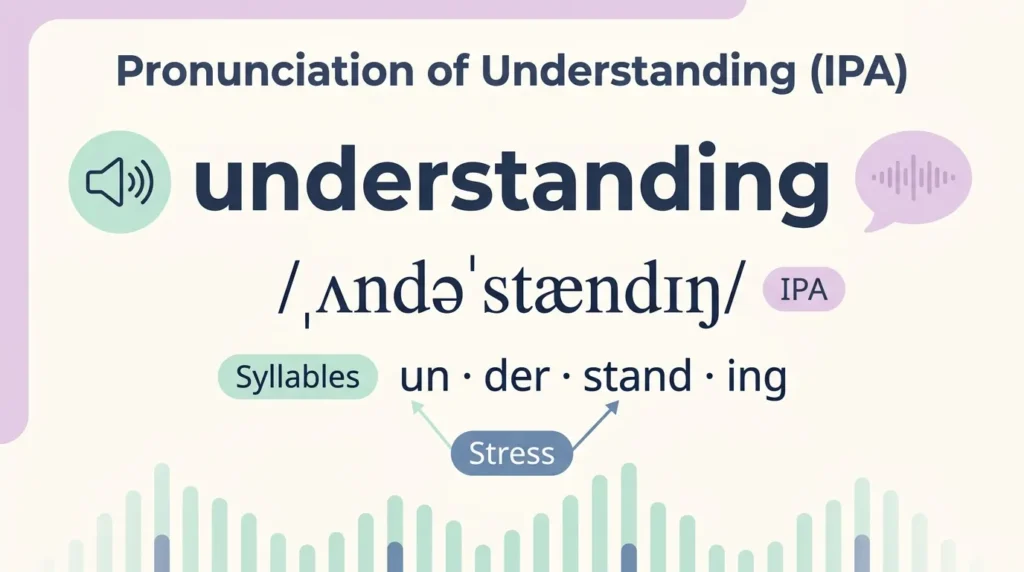
- IPA: /ˌʌndərˈstændɪŋ/
- Syllables: un-der-stand-ing
- Stress: The main stress falls on stand.
Affixation Pattern of Understanding
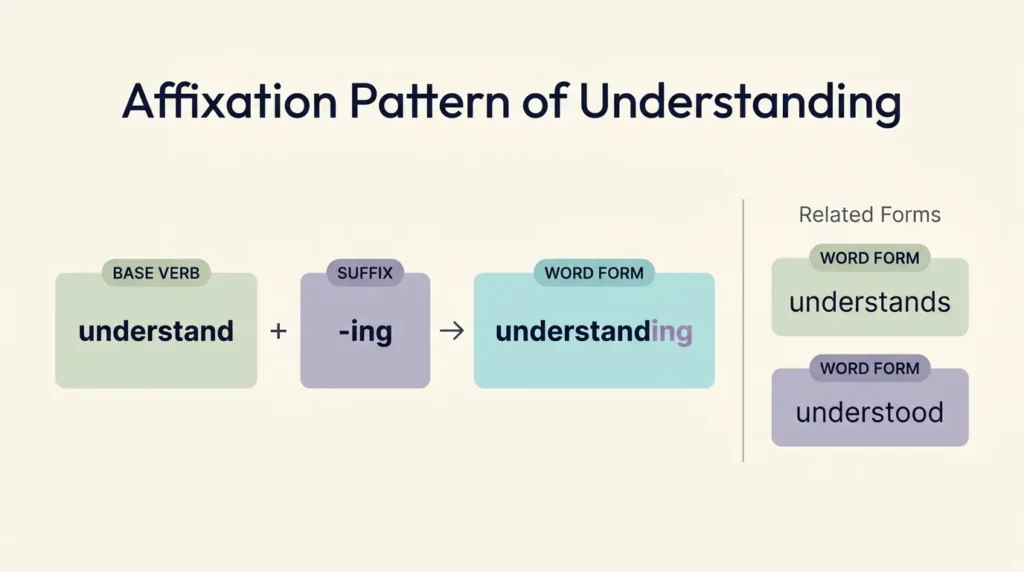
- Root: Stand, from the older verb understand.
- Prefix: Under- is part of the historical formation of understand. Its meaning in this word is not simply the modern sense of “below.”
- Suffix: -ing forms the noun understanding and can also appear in the verb’s participle form.
- Word formations:
- Understand (verb): To know the meaning of something.
- Understands (verb): Present-tense form used with he, she, or it.
- Understood (verb): Past tense and past participle of understand.
- Understanding (noun): Knowledge, comprehension, or agreement.
- Understanding (adjective): Patient and sympathetic.
- Understandable (adjective): Easy to understand or reasonable.
- Understandably (adverb): In a way that can be understood or reasonably expected.
- Misunderstand (verb): To understand something incorrectly.
- Misunderstanding (noun): A failure to understand something correctly.
- Misunderstood (adjective or verb): Not understood correctly.
23 Other Words for Understanding With Meaning and Examples
Not every synonym works in every sentence. Some alternatives refer to knowledge, while others describe empathy, awareness, or a shared agreement.
1. Comprehension (Noun)
Meaning: The ability to understand information, ideas, or language.
Examples:
- Her reading comprehension has improved.
- The teacher checked our comprehension of the story.
2. Knowledge (Noun)
Meaning: Information, facts, or skills gained through learning or experience.
Examples:
- He has strong knowledge of computer science.
- Reading can increase your knowledge of history.
3. Insight (Noun)
Meaning: A deep or clear understanding of a person, problem, or situation.
Examples:
- Her research gave us insight into the problem.
- The book offers insight into human behavior.
4. Awareness (Noun)
Meaning: Knowing that something exists, happens, or matters.
Examples:
- The campaign raised awareness of road safety.
- He showed awareness of the risks.
5. Grasp (Noun)
Meaning: A clear understanding of an idea or subject.
Examples:
- She has a good grasp of English grammar.
- I finally gained a grasp of the main concept.
6. Perception (Noun)
Meaning: The way someone notices, understands, or interprets something.
Examples:
- Our perception of the event was different.
- Her perception of the issue changed after the discussion.
7. Appreciation (Noun)
Meaning: Recognition of the value, meaning, or importance of something.
Examples:
- The course gave me a greater appreciation of art.
- His appreciation of music grew over time.
8. Empathy (Noun)
Meaning: The ability to recognize and understand another person’s feelings.
Examples:
- She showed empathy toward her upset friend.
- Empathy can help people build stronger relationships.
9. Interpretation (Noun)
Meaning: An explanation of the meaning of information, words, or events.
Examples:
- His interpretation of the poem was thoughtful.
- Different readers may have different interpretations of the story.
10. Realization (Noun)
Meaning: The moment when you become aware of or understand something.
Examples:
- She had a sudden realization about the mistake.
- His realization came after a long discussion.
11. Awareness of (Noun Phrase)
Meaning: Knowledge that a particular fact, issue, or situation exists.
Examples:
- The team developed an awareness of the risks.
- Public awareness of the issue has increased.
12. Familiarity (Noun)
Meaning: Knowledge of something gained through repeated contact or experience.
Examples:
- Her familiarity with the software saved time.
- I have some familiarity with the subject.
13. Discernment (Noun)
Meaning: The ability to judge or understand things clearly.
Examples:
- Good discernment helps leaders make wise choices.
- She showed discernment when reviewing the evidence.
14. Wisdom (Noun)
Meaning: The ability to use knowledge and experience to make sound decisions.
Examples:
- His wisdom helped the team solve the conflict.
- She shared words of wisdom with the students.
15. Intelligence (Noun)
Meaning: The ability to learn, reason, and solve problems.
Examples:
- Intelligence can help people solve complex tasks.
- The test measured several aspects of intelligence.
16. Perceptiveness (Noun)
Meaning: The ability to notice and understand details that others may miss.
Examples:
- Her perceptiveness helped her notice the problem early.
- The manager valued his perceptiveness during meetings.
17. Sympathy (Noun)
Meaning: Care or concern for someone who is facing pain or difficulty.
Examples:
- He expressed sympathy for the family.
- Her sympathy made the conversation easier.
18. Tolerance (Noun)
Meaning: Willingness to accept differences or views you may not share.
Examples:
- Tolerance helps people live together peacefully.
- The school promotes tolerance of different opinions.
19. Agreement (Noun)
Meaning: A shared view, decision, or arrangement between people.
Examples:
- We reached an agreement after the meeting.
- Their agreement helped the project move forward.
20. Rapport (Noun)
Meaning: A friendly connection in which people understand and trust each other.
Examples:
- The teacher built rapport with her students.
- Good rapport made the interview feel natural.
21. Common Ground (Noun Phrase)
Meaning: Shared beliefs, interests, or views between people.
Examples:
- They found common ground during the discussion.
- Music gave the two friends common ground.
22. Clarity (Noun)
Meaning: The quality of being clear and easy to understand.
Examples:
- The diagram brought clarity to the lesson.
- She explained the rules with great clarity.
23. Sympathy and Sensitivity: Consideration (Noun)
Meaning: Thoughtful attention to another person’s needs, feelings, or situation.
Examples:
- He showed consideration for his coworkers.
- Her consideration made everyone feel welcome.
Prototype Meaning

The most typical meaning of understanding is the ability to know what something means. People often picture a student who understands a lesson or a person who can explain a difficult idea clearly. The word can also describe emotional understanding, such as recognizing why a friend feels upset.
In some situations, it refers to a shared agreement between people. These meanings are connected, but they are not identical. Comprehension is often best for learning, insight for deep knowledge, empathy for feelings, and agreement for a shared decision.
Prototype Categorization
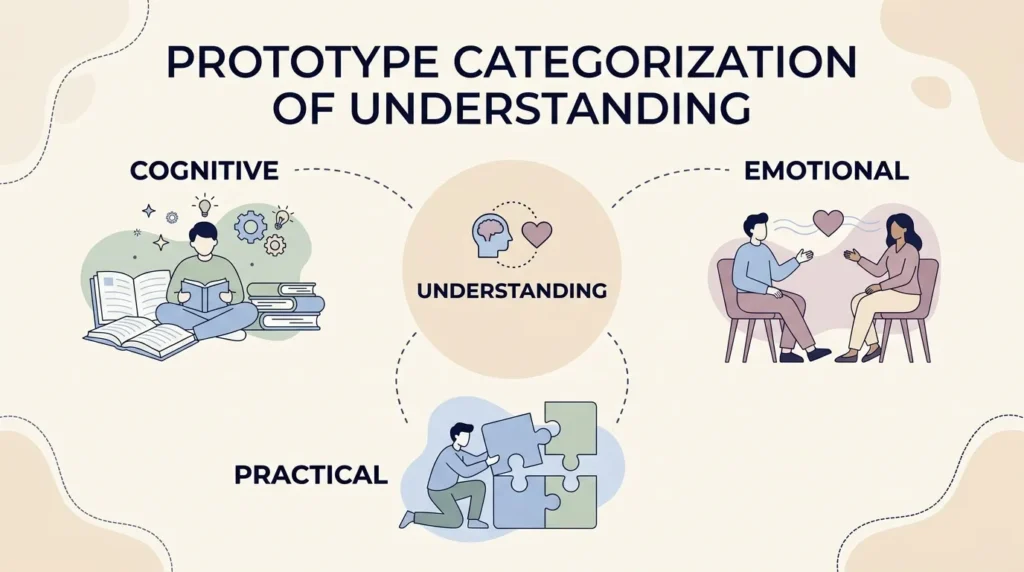
Grouping synonyms by meaning helps writers select a word that matches the message they want to convey.
- Learning and information: Comprehension, knowledge, grasp, familiarity. These words work well for school, study, and professional training.
- Deep thinking and judgment: Insight, discernment, wisdom, intelligence, perceptiveness. These describe the ability to think clearly or see beyond basic facts.
- Knowing and noticing: Awareness, awareness of, perception, realization, clarity. These fit situations where someone notices, recognizes, or explains something.
- Feelings and care: Empathy, sympathy, tolerance, consideration. These focus on recognizing feelings and treating people with care.
- Shared views and relationships: Agreement, rapport, common ground. These describe connection, trust, or a shared position.
- Meaning and interpretation: Interpretation, appreciation. These help explain how people understand a text, event, idea, or work of art.
Antonyms of Understanding
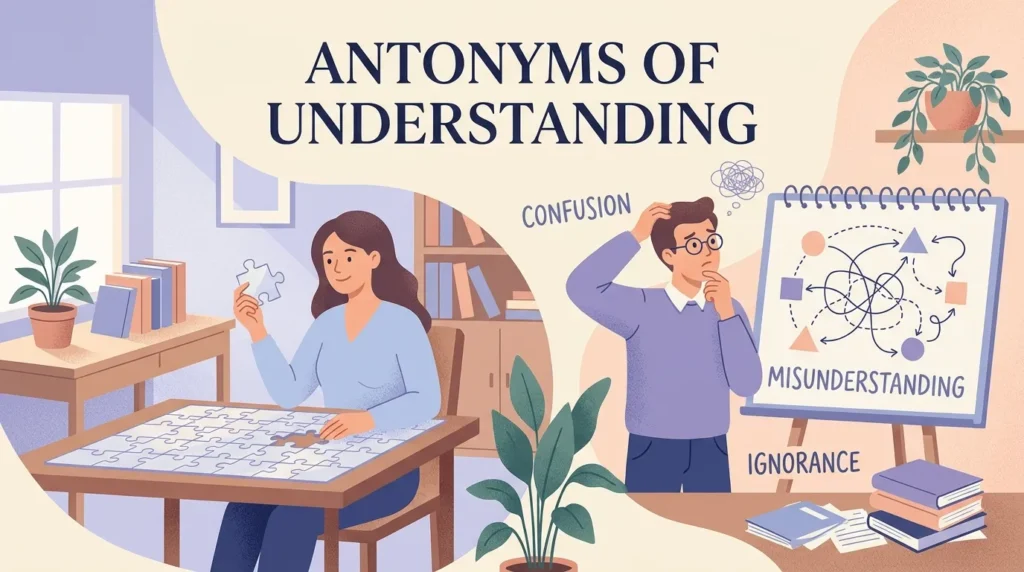
There is no single opposite of understanding in every context. These words describe different kinds of contrast.
1. Confusion (Noun)
Meaning: A state of being unsure or unable to understand something.
Example: The unclear instructions caused confusion.
2. Misunderstanding (Noun)
Meaning: An incorrect understanding of a message or situation.
Example: A misunderstanding caused a delay.
3. Ignorance (Noun)
Meaning: A lack of knowledge about a subject or fact.
Example: Education can reduce ignorance about health risks.
4. Incomprehension (Noun)
Meaning: A failure or inability to understand something.
Example: His expression showed incomprehension.
5. Intolerance (Noun)
Meaning: An unwillingness to accept differences or views that are not your own.
Example: Intolerance can make peaceful discussion difficult.
6. Disagreement (Noun)
Meaning: A difference of opinion between people.
Example: Their disagreement delayed the decision.
Short Questions and Answers
What does understanding mean?
Understanding means knowing the meaning of something, having knowledge of a subject, or recognizing another person’s feelings.
When should understanding be used?
Use understanding when discussing knowledge, comprehension, emotional awareness, or a shared agreement. The context tells readers which meaning you intend.
Is understanding positive or negative?
It is often positive because it suggests knowledge, clarity, or empathy. However, phrases such as “lack of understanding” can express a problem.
How is understanding different from similar words?
Comprehension focuses on grasping information. Insight suggests deeper knowledge. Empathy focuses on another person’s feelings, while agreement means people share a view or decision.
Conclusion

Learning another word for understanding can make your English clearer and more expressive. Words such as comprehension and grasp are useful for learning, while insight and discernment suggest deeper thinking. If you are discussing feelings, empathy may be the best choice. For shared views, words such as agreement and common ground can express your meaning more precisely.
The key is to choose a word that fits the sentence rather than replacing every use of understanding with the same alternative. Practice by reading examples, writing your own sentences, and noticing how these words appear in real conversations. Daily vocabulary practice can improve your writing, strengthen your speaking skills, and help you communicate with confidence.
Another Word for Knowledge: 30 Powerful Alternatives

I’m Mubashra Waleed, a content writer specializing in English vocabulary, synonyms, word meanings. I focus on creating clear, accurate, and engaging content that makes English language learning simple and useful for readers.